Introduction: A Dossier That Keeps Up with the Series
Hansa Mutual collects, in one place, everything that the fourteen volumes of The Transformed Architecture establish about one fictional organisation: a mutual insurance group headquartered in Hamburg, operating in seven countries, with about 9,500 employees. The organisation is invented. It first appears in AI Governance (Book 2) as one of two worked examples, and it then runs through every later volume up to AI Environment (Book 14), and through the companions Landscape and Tools. Each volume gave it new facts for its own subject: a system, a decision, a role, an incident, a figure. No single volume holds the whole picture, and a reader of one volume sees only that volume's slice. This chapter says what the dossier is and is not, what its sources are, how its six parts are arranged, and how it is kept in step with a series that is still growing.
Series state reflected by this release
Series state. This release of the dossier reflects Books 1 to 14 of The Transformed Architecture and the two companions Landscape and Tools, as published on 2026-11-16. It names the sibling dossier Nordvik Region (published at nordvik.geon.se), which gathers the second fictional organisation in the same way. It refers to no volume after Book 14. When a further volume appears, the dossier gains a chapter and the date and the series state on this page change (see the section on keeping the dossier current).
The statement is part of the content, not a formality. Hansa Mutual is described in the volumes at different times: the baseline of AI Governance is the autumn of 2026, and the later volumes carry the organisation forward through narrated years that run to the end of August 2033. All of those later years are fiction written in November 2026. The series state therefore tells the reader which volumes the facts were drawn from, and the extracts from which the chapters were written carry their own date of extraction in their headers.
What the dossier is
The dossier is a reference with a narrative. It is written for a reader who knows the series and wants to look something up (which identifier belongs to which decision, who owned a system, which volume first gave a role a name), and equally for a reader who has met Hansa Mutual in a single volume and wants the rest of the picture. Every chapter states what it covers and which volumes it draws on, gives the facts first, then what they mean, then what is unresolved.
The dossier is organised so that it can be used in two ways. Read in order, it moves from the organisation as a whole (Part I), through its AI estate (Part II) and through the series volume by volume (Part III), to the views that cut across the volumes (Part IV), a check of the fiction against real organisations of the same kind (Part V) and conclusions (Part VI). Read as a lookup, each chapter is a table-rich section that stands alone, and Appendix A lists every identifier with the volume and chapter that state it.
What the dossier is not
The dossier is not a case study of a real company, and it never describes one. Hansa Mutual's name, its people, its systems and its numbers are invented. Real legal instruments, supervisory authorities and standards are named in it only to show which obligations apply to an organisation of this kind, and statements about them are attributed to the instrument and article and framed as architectural and organisational implications, not as legal advice.
It is not a second source of facts. The dossier adds no fact about Hansa Mutual that a volume does not state. Where a chapter makes a judgement (for example that two volumes disagree, or that a figure has outlived its evidence), the judgement is labelled as the book's own and is kept for summaries and for Chapters 27 and 28.
It is not an extension of the series. The volumes stand on their own, each with its own numbering, bibliography, website and releases. The dossier is a companion without a number, complete in itself, which refers to Books 1 to 14 and to nothing later.
The series and where Hansa Mutual appears
The Transformed Architecture is a series of fourteen volumes by Gunnar Nordqvist, conceived and directed by him, with text written by AI agents under his briefs and reviewed and approved by him. The volumes build strictly in publication order: Book 1 refers to no other volume, Book 2 only to Book 1, and so on, so that there is no circular reasoning between them. The two companions Landscape and Tools and the two dossiers refer to the series but are not numbered books.
Hansa Mutual is not in Book 1. Architecture as Code has no example organisations, but it supplies the foundations (architecture, policy and evidence as code) on which the later volumes build (1, Nordqvist, 2025). From Book 2 onward the organisation appears in every volume. The table gives, for each volume, the period its narrated example covers and the part Hansa Mutual plays in it. The periods are those of the volumes' own example years; from 2027 onward they are illustrative fiction.
| Book | Title | Site | Period of the example | Role of Hansa Mutual in the volume |
|---|---|---|---|---|
| 2 | AI Governance | aig.geon.se | Baseline 2026, roadmap to 2028 | The builder in seven jurisdictions: provider and deployer, all six usage modes, two Mode 5 agents (2, Nordqvist, 2026) |
| 3 | AI Platform and Security | aips.geon.se | 2026, plan to 2028 | The full group platform, with containment layers and market overlays (3, Nordqvist, 2026) |
| 4 | AI Red Team | aired.geon.se | 2027 | The mature defender with a 24/7 SOC, red team and a SOC investigation agent (4, Nordqvist, 2026) |
| 5 | AI Threat | aithreat.geon.se | October 2026 to 2027 | The insurer whose board asks whether loss of control belongs in its ORSA (5, Nordqvist, 2026) |
| 6 | The Transformed Security Architect | tsa.geon.se | Autumn 2026 to 2027 | A team of six security architects whose forums cannot keep pace with agents (6, Nordqvist, 2026) |
| 7 | AI Boss | aiboss.geon.se | Autumn 2026 to 2027, plan to 2029 | An organisation whose agents already allocate work to people, under co-determination (7, Nordqvist, 2026) |
| 8 | AI Blue | aiblue.geon.se | 2027 | The large, building blue team: about 38 people and five SOC agents (8, Nordqvist, 2026) |
| 9 | AI Purple | aipurple.geon.se | January to April 2028 | The organisation that runs the purple loop continuously (9, Nordqvist, 2026) |
| 10 | AI Operations | aiops.geon.se | September 2028 to August 2029 | The organisation with a deployed Mode 5 operations agent and DORA as direct law (10, Nordqvist, 2026) |
| 11 | AI Leader | leader.geon.se | September 2029 to August 2030 | The privately owned, supervised case: executive board, supervisory board, two delegated routine classes (11, Nordqvist, 2026) |
| 12 | AI Developer | developer.geon.se | September 2030 to August 2031 | About 480 people in application development, a legacy estate and a delegation ceiling (12, Nordqvist, 2026) |
| 13 | Vibe to Dev | vibetodev.geon.se | September to December 2031 | A claims team leader who builds a tool and hands it over (13, Nordqvist, 2026) |
| 14 | AI Environment | environment.geon.se | September 2032 to August 2033 | The owner of its own capacity: it measures its Frankfurt data centre, counts AI inside Scope 2 and Scope 3 and reports under supervision (14, Nordqvist, 2026) |
| Companion | Landscape | landscape.geon.se | Model year 2027 | The "building" landscape, drawn as 17 AI uses (15, Nordqvist, 2026) |
| Companion | Tools | tools.geon.se | A toolbox year | The organisation's year of adopting tools, in a chapter on building a toolbox (16, Nordqvist, 2026) |
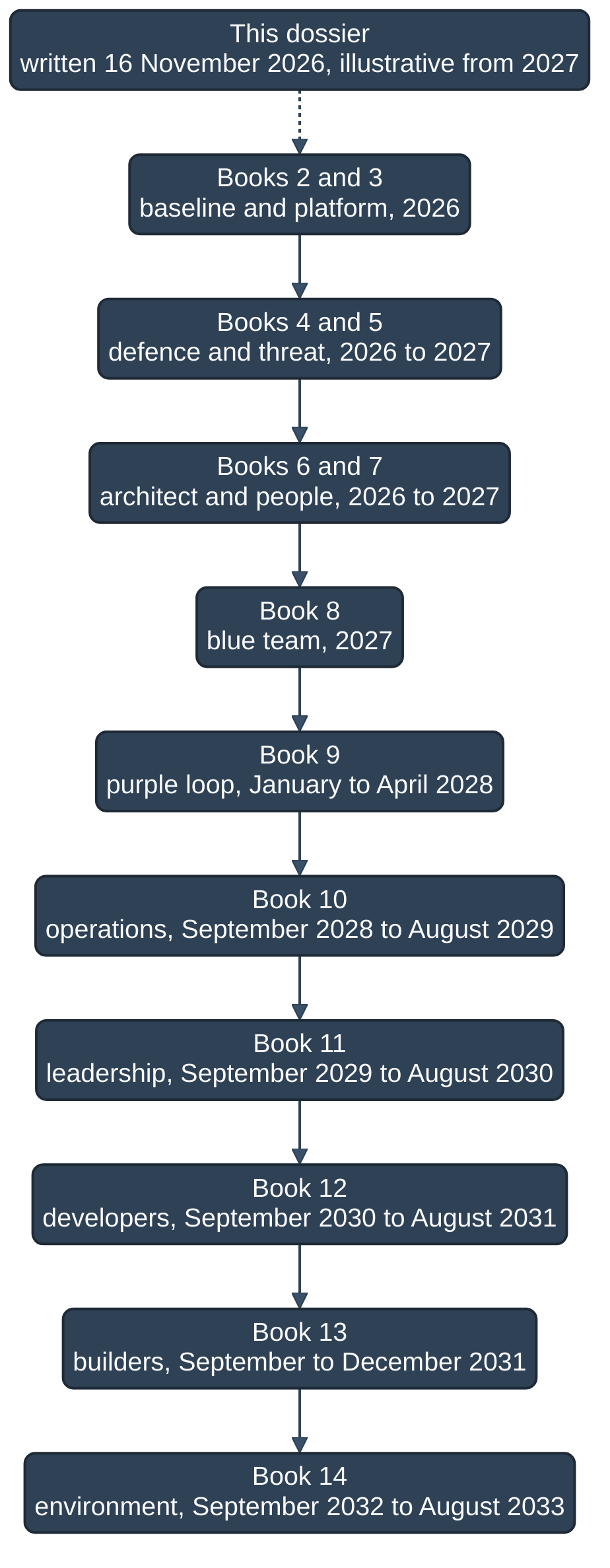
Figure 1.1: The periods of Hansa Mutual's example years across Books 2 to 14. The dossier is written on 16 November 2026, so everything from 2027 onward is illustrative fiction.
The shape of the table shows what the series does with the organisation. Each volume takes up a new question about AI in a large European organisation and tests it against the same two cases. The order matters for the dossier: Hansa Mutual grows by accretion, so a fact established in Book 2 is carried and sometimes revised by Book 13, and a role that is anonymous in Book 4 may have a name in Book 11. AI Environment (Book 14) is the first volume to name Hansa Mutual's head of group sustainability and its Frankfurt data-centre manager. Chapter 21 gives one chronology across all volumes and Chapter 24 the whole cast.
The source rule
The fourteen volumes are the only sources for facts about Hansa Mutual. Because the organisation is invented, no external source can establish a fact about it. The working notes of the dossier, one extract per volume and per companion in data/extracts/, were made from each volume's own profile of the example organisations and from the chapters that name Hansa Mutual. A ledger in data/ledger.jsonl records identifiers, events and figures in machine-readable form with the volume and chapter that state each, and a script checks that no ledger line cites an identifier that the chapter cited does not contain. Every statement about Hansa Mutual in a chapter therefore traces to a line of an extract and from there to a volume.
Four rules follow from this.
- Nothing is invented. If the extracts and the volumes do not say it, the chapter does not say it. A person, a figure, a date or an identifier that no volume gives is left out.
- Disagreement is recorded, not resolved. Where two volumes disagree (the extracts list many such places), the chapter states both values with their volumes and chapters, names the value the dossier uses as the working value, and marks the point Open thread. Chapter 27 collects every open thread. The dossier does not choose silently.
- Established or illustrative. A fact is established when a volume states it as part of the profile of the organisation, and illustrative when the volume labels it so. Most events from 2027 onward, and most figures in worked examples, are illustrative fiction. A chapter says which kind a table or a figure is, and gives the evidence age or clock that the volume itself gives it.
- A volume is a source for Hansa Mutual, never for the real world. A statement about a real instrument, authority or organisation is attributed to the instrument and article, or cited to an external source. External sources are used for one purpose only: Part V compares the fiction with real organisations of the same kind, from public sources, to judge whether the fiction is plausible. Real organisations are named there as comparators only and never as the model of an invented fact.
How to read the six parts
| Part | Chapters | What it holds |
|---|---|---|
| I The Organisation | 1 to 4 | This introduction; the organisation at a glance; its structure, people and roles; its legal setting and supervision |
| II The AI Estate | 5 to 7 | The systems and usage modes; suppliers, platforms and sovereignty; security, operations and resilience |
| III Through the Series | 8 to 20 | One chapter per volume (Books 2 to 14) and one for the two companions. A volume added after Chapter 19 gets a lettered chapter (19A for Book 14) so that no chapter number changes. This is the part that grows |
| IV Across the Series | 21 to 24 | A chronology; decisions and records; numbers and their evidence age; the cast |
| V Credibility | 25 to 27 | The real counterparts; how credible the fiction is; continuity and open threads |
| VI Conclusions | 28 | The book's own conclusions |
The back matter holds a glossary (Chapter 29), Appendix A, the ledger of identifiers generated from the ledger file (Chapter 30), Appendix B on the templates and tools of this repository, the references and a note on the author.
Chapters 8 to 19 and 19A follow one skeleton so that they can be compared: the volume in brief, the role of Hansa Mutual in it, what the volume establishes, decisions and records, events and figures, the usage modes or degrees of delegation, what the volume concludes for Hansa Mutual, and open threads. The chapters of Parts I, II and IV cut across the volumes and are organised by subject. Chapters 5 to 7 and the chapters of Part III carry a subsection on the usage modes or the degrees of delegation wherever the subject differs by mode, because the series' central distinction is between AI that supports a person's judgement and AI that acts with its own identity and permissions.
Conventions used in the dossier
Usage modes and degrees of delegation. The series' usage modes run from Mode 0 Ambient AI, Mode 1 Conversational assistants, Mode 2 Embedded workplace assistants and Mode 3 Agentic work tools, through Mode 4 Built AI applications, to Mode 5 Autonomous production agents (2, Nordqvist, 2026). The degrees of delegation run from Level 0 Advisory, Level 1 Assisted, Level 2 Supervised and Level 3 Bounded to Level 4 Autonomous. Both scales are used by their exact names, and the dossier never renames or renumbers them.
Identifiers. The volumes use families of identifiers, and the dossier writes them exactly as the originating volume does: AI Decision Records (AIDR-*), use cases (UC-*), exceptions (EXC-*), exit plans (EXIT-*), mandate manifests (MND-*), delegation profiles (DLG-*), role charters (ROLE-*), incident records (INC-*), post-incident reviews (PIR-*) and many more. Each volume reserves its own range of AIDR numbers, and the ranges are split between the two organisations where the volume says so: for Hansa Mutual the volumes record AIDR-0750 to AIDR-0799 (Book 8), AIDR-0850 to AIDR-0899 (Book 9), AIDR-0950 to AIDR-0999 (Book 10), AIDR-1050 to AIDR-1099 (Book 11), AIDR-1150 to AIDR-1199 (Book 12) and AIDR-1250 to AIDR-1299 (Book 13), while Book 7 reserves AIDR-0600 to AIDR-0699 and Hansa Mutual's records in it start at AIDR-0650. Chapter 22 describes the families and how they relate.
People. The dossier describes people by what the volumes establish. A role that a volume leaves unnamed stays unnamed. A person who is named in one volume and anonymous in another is recorded under the name, with the first volume that gives it. People are never described as lazy, stupid or replaceable, and AI systems are never described as wanting, understanding or deciding unless a decision was formally delegated to them, in which case the record says who delegated it.
Open threads. Wherever a volume disagrees with another on a fact about Hansa Mutual, the text carries the words Open thread and a pointer to Chapter 27. A frequent example is the number of Mode 5 agents the organisation runs: two in the profile of Book 2, three or four in Books 4 and 6, and six in the model of Landscape; AI Environment names a Mode 5 claims-triage agent and an IT-operations agent as footprint records. The dossier reports each count with its source rather than reducing them to one.
Keeping the dossier current
The dossier follows the series. The procedure in docs/UPDATING.md is the same for both dossiers and has seven steps when a new volume appears. First, an extract is written from the volume's profile and every chapter that names Hansa Mutual, with the eight sections that the other extracts have. Second, the ledger gains the identifiers, events and figures of the volume, and the check script fails if a ledger line cites an identifier that the chapter does not contain. Third, the volume's chapter is added to Part III and written to its brief. Fourth, Chapters 2 to 7 and 21 to 24 are revised where the profile, structure, legal setting, estate, suppliers or posture changed, and findings are added to Chapter 27. Fifth, the rules are updated: cites_up_to in the book configuration moves, the volume is added to the bibliography as the next numbered source, and Appendix A is regenerated. Sixth, if the volume gives Hansa Mutual a new scale, a new class of system, a new supervisor or a new incident, the comparison of Part V is re-run for that dimension. Seventh, the other sites that carry the book are updated.
When an earlier volume changes, the volume's profile is compared again, the ledger check is re-run, and the ledger lines and chapters it flags are corrected. A correction in a volume that the dossier had recorded as an inconsistency is moved from Chapter 27 to a note in the chapter concerned. Each release states, on this page, the series state it reflects.
The sibling dossier and the two companions
Hansa Mutual is one of two fictional organisations in the series. The other is Nordvik Region, a regional public authority with about 6,000 employees and about 450,000 residents, which works under one jurisdiction and public law, mostly deploys and procures its AI systems, and runs no Mode 5 agent (2, Nordqvist, 2026). The sibling dossier Nordvik Region (nordvik.geon.se) gathers its facts in the same way and is updated in the same set of changes as this one. The two dossiers are written to be read side by side: the series chose the organisations to differ, and Chapter 2 sets out how.
Landscape is the companion that draws the AI landscape of both organisations in a common notation, Contour, from landscape models. It gives Hansa Mutual a model of 17 AI uses for the year 2027 and is the book in which the organisation is the "building" landscape (15, Nordqvist, 2026). Tools is the companion that collects the artefacts, own tools, third-party tools and methods of Books 1 to 13 in one reference (it was written before Book 14), and it follows both organisations through a year of building a toolbox (16, Nordqvist, 2026). Chapter 20 treats what each adds to the picture of Hansa Mutual and where each restates or differs from the volumes. The dossier cites Landscape and Tools as companions, by the same rule as the volumes, and neither is a numbered book.
What the reader should take from this chapter
A reader of the dossier should hold five things. The organisation is fictional and its facts are drawn only from the volumes. The series state of this release is Books 1 to 14 and the two companions as of 2026-11-16. Facts from 2027 onward are illustrative, written in November 2026. Disagreements between volumes are recorded and marked Open thread, not resolved. And the dossier is kept current by a fixed procedure, so that its date and series state are always stated.
Summary
This chapter established the dossier's purpose, its source rule and its limits. Hansa Mutual is a fictional mutual insurance group in Hamburg that appears in Books 2 to 14 and in the companions Landscape and Tools, and not in Book 1, which supplies foundations only. The fourteen volumes are the only sources for facts about it, nothing is invented, and disagreements are recorded with both values. Facts are marked established or illustrative, and the narrated years from 2027 to 2033 are illustrative fiction written in November 2026. The release reflects the series as of 2026-11-16 and names the sibling dossier Nordvik Region at nordvik.geon.se. The dossier is organised in six parts, with one chapter per volume in Part III (Chapter 19A for Book 14), and a fixed update procedure keeps it in step with the series. The dossier's own conclusion from this chapter is a method rule: a reference on a fictional organisation is trustworthy only to the extent that every statement can be traced to a line in a volume, and the reader can check that trace.
Sources
- Nordqvist, G. Architecture as Code. (1, Nordqvist, 2025)
- Nordqvist, G. AI Governance: Governing Artificial Intelligence in European Enterprises and Public Authorities. (2, Nordqvist, 2026)
- Nordqvist, G. AI Platform and Security: Building and Securing AI Platforms in European Enterprises and Public Authorities. (3, Nordqvist, 2026)
- Nordqvist, G. AI Red Team: AI as an Active Part of Cyber Defence in European Enterprises and Public Authorities. (4, Nordqvist, 2026)
- Nordqvist, G. AI Threat: Are the Dystopias Coming True? Evidence, Risk and Response for European Enterprises and Public Authorities. (5, Nordqvist, 2026)
- Nordqvist, G. The Transformed Security Architect: Role, Craft and Career in the Age of AI in European Enterprises and Public Authorities. (6, Nordqvist, 2026)
- Nordqvist, G. AI Boss: When Artificial Intelligence Manages People in European Enterprises and Public Authorities. (7, Nordqvist, 2026)
- Nordqvist, G. AI Blue: How Artificial Intelligence Transforms the Blue Team in European Enterprises and Public Authorities. (8, Nordqvist, 2026)
- Nordqvist, G. AI Purple: How Red and Blue Learn Together When AI Joins the Loop in European Enterprises and Public Authorities. (9, Nordqvist, 2026)
- Nordqvist, G. AI Operations: How Artificial Intelligence Transforms IT Operations in European Enterprises and Public Authorities. (10, Nordqvist, 2026)
- Nordqvist, G. AI Leader: How Leadership Roles Change When AI Is Used Broadly in European Enterprises and Public Authorities. (11, Nordqvist, 2026)
- Nordqvist, G. AI Developer: How the Developer Role Changes When AI Is Used Broadly in European Enterprises and Public Authorities. (12, Nordqvist, 2026)
- Nordqvist, G. Vibe to Dev: From Vibe Coding to Professional Software, Step by Step, for Builders Who Are Not Developers, in European Enterprises and Public Authorities. (13, Nordqvist, 2026)
- Nordqvist, G. AI Environment: Designing AI for the Greatest Benefit and the Least Environmental Harm in European Enterprises and Public Authorities. (14, Nordqvist, 2026)
- Nordqvist, G. Landscape: A Fact-Based Picture of Architecture and AI at Work, for Leaders, Architects and Citizens. (15, Nordqvist, 2026)
- Nordqvist, G. Tools: A Reference to the Templates, Software and Methods of The Transformed Architecture for European Enterprises and Public Authorities. (16, Nordqvist, 2026)