Legal Setting and Supervision
Hansa Mutual's central challenge, as the series states it, is the differences between the regimes it works under. This chapter gathers the legal and supervisory setting that the volumes give the organisation: the seven jurisdictions, the instruments that apply in each, the role Hansa Mutual has under each instrument (provider, deployer, financial entity, controller, employer), the supervisors, and the transfers of data that the group platform makes necessary. It draws on the profile in AI Governance (Book 2) and on the legal chapters of every later volume. The instruments are real; the organisation is fiction. Statements about the instruments are attributed to the instrument and article as the volumes attribute them, and they are framed as architectural and organisational implications, not as legal advice. The profile of the jurisdictions is established. Dates and events from 2027 onward are illustrative.
The seven jurisdictions
| Country | Entity and role | Staff (approx.) | Position | Supervisor |
|---|---|---|---|---|
| Germany (DE) | Group headquarters, group IT and the shared AI platform; lead jurisdiction for group policy | 4,600 | EU | BaFin |
| Netherlands (NL) | Insurance subsidiary | 900 | EU | DNB and AFM |
| Sweden (SE) | Insurance subsidiary | 600 | EU | Finansinspektionen |
| Poland (PL) | Claims and operations service centre; processes claims for DE, NL, SE and NO | 1,700 | EU | KNF |
| Norway (NO) | Insurance subsidiary | 400 | EEA, not EU | Finanstilsynet |
| United Kingdom (UK) | Insurance subsidiary; claims handled locally on the group platform | 800 | Outside EU and EEA | PRA and FCA |
| Switzerland (CH) | Insurance subsidiary; claims handled locally on the group platform | 500 | Outside EU and EEA | FINMA |
Established (2, Nordqvist, 2026) (7, Nordqvist, 2026). The profile of AI Boss records explicitly that the group has no Austrian entity (7, Nordqvist, 2026). The table that follows shows what each position means for the main instruments, as the volumes state it.
| Country | AI Act | DORA | Data protection | What changes for AI |
|---|---|---|---|---|
| DE | Law | Law | GDPR; national employee-data rules under Article 88 | Co-determination with works councils on systems that can monitor employees; national transposition of NIS 2; TLPT under TIBER-DE; lead jurisdiction |
| NL | Law | Law | GDPR | Different supervisory expectations; works council consent right |
| SE | Law | Law | GDPR; consumer information in Swedish | Union consultation and negotiation |
| PL | Law | Law | GDPR | Cross-border claims data flows run through it; Labour Code rules on workplace monitoring (set in the collective agreement or work regulations) and staff informed two weeks ahead |
| NO | Group policy until incorporated into the EEA Agreement | Follows through the EEA, with a lag | Not detailed in the volumes | Timing of AI Act obligations can differ from the EU entities |
| UK | Not applicable; group applies AI Act controls as policy | Not applicable; PRA operational resilience regime | UK GDPR and the Data Protection Act 2018 | Sector-led approach to AI; transfers rely on adequacy; own resilience regime |
| CH | Not applicable; group applies AI Act controls as policy | Not applicable; FINMA expectations | Revised Federal Act on Data Protection | FINMA guidance 08/2024 and FADP Article 16 as local mappings; transfers rely on adequacy |
Established as profile; the Norwegian, UK and Swiss lines of the AI Act column follow the profile's statement that the group applies its AI Act controls there as group policy (2, Nordqvist, 2026) (6, Nordqvist, 2026) (8, Nordqvist, 2026).
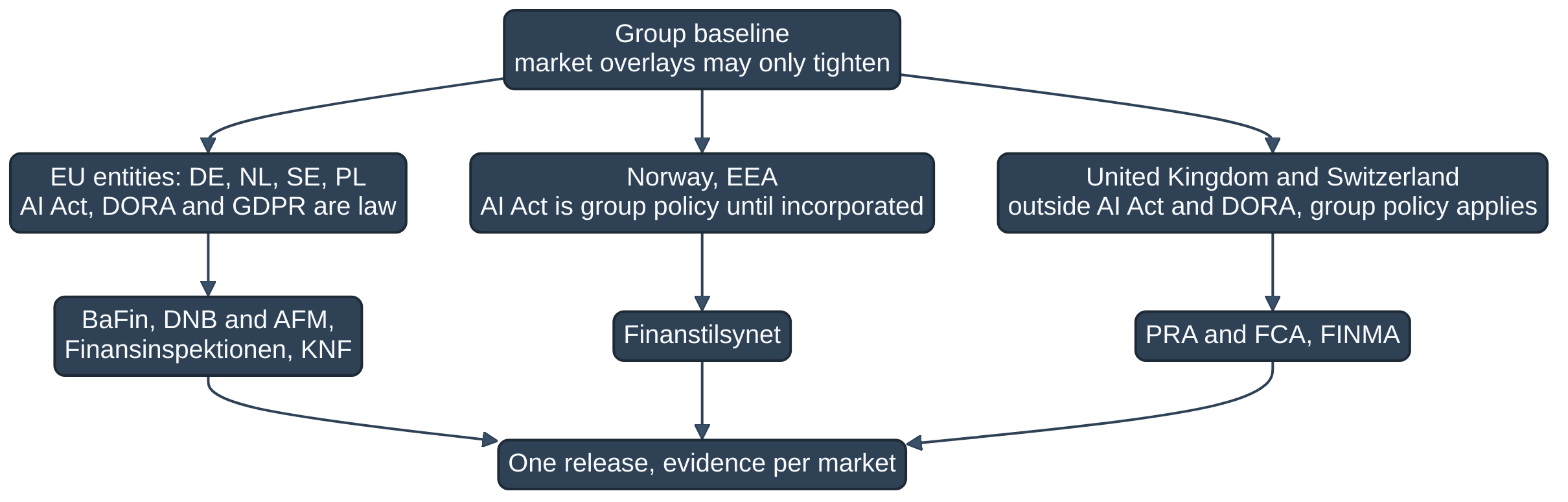
Figure 4.1: How the group baseline meets the regimes of the seven markets. Overlays may tighten the baseline and never relax it, and one release produces evidence for every market. Sources: AI Governance, Chapter 4; AI Platform and Security, Chapter 4.
How the differences are handled in the architecture
The series' answer to the differences is architectural. The group keeps one baseline policy set, and each market has an overlay (overlays/markets/<country>.yaml) for national rules. An overlay may only tighten the baseline. A system declares where it is used (applies_in) and where it is processed (processed_in), and one release produces evidence for each market (2, Nordqvist, 2026) (3, Nordqvist, 2026). AI Platform and Security gives the UK overlay as an example: the AI Act is group policy, DORA does not apply, UK GDPR and the Data Protection Act 2018 do, the supervisors are PRA and FCA, logs and evidence are held in uk-south for 120 months, processing is allowed in the UK and in Germany, and four components (the AI gateway, the model registry, the evaluation service and the control plane) are listed as "may not relax" (3, Nordqvist, 2026). Each market overlay carries a DORA flag, which the volume places in the market overlays and not in the group baseline, while the group charter of AI Governance sets dora: law (2, Nordqvist, 2026) (3, Nordqvist, 2026).
Reporting follows the same logic. The entity reports of AI Governance are projections of one group portfolio register, and each marks an obligation as law or group policy, so that the AI Act reads as law in the EU entities and as policy in Norway, the United Kingdom and Switzerland (2, Nordqvist, 2026). AI Boss adds that the group's AI Act baseline (AIDR-0657) applies in all seven markets and that the register marks per market whether a control is law or policy (7, Nordqvist, 2026). The UK and Swiss mappings came in later: in the first board page of the security architects (MGT-HM-2026-Q4) nine UK and Swiss controls had only a declared status, accepted until 2027-03-31, and the overlays OVL-UK and OVL-CH of catalogue version 4.2.0 (AIDR-0569) brought them in, with seven of the nine verified by May 2027 (illustrative) (6, Nordqvist, 2026).
The instruments and Hansa Mutual's role under each
| Instrument | Hansa Mutual's role | Source |
|---|---|---|
| AI Act, Regulation (EU) 2024/1689, as amended by Regulation (EU) 2026/1744 | Provider and deployer of its own systems built on vendor models; deployer of general-purpose AI models; not a provider of a general-purpose AI model | AI Governance, Chapter 1; AI Threat, Chapter 19 |
| GDPR | Controller; special-category data in life and health lines; employer for staff data | AI Governance, Chapter 1; AI Boss |
| DORA, Regulation (EU) 2022/2554 | Financial entity within the scope of Article 2(1) in each EU entity (insurance and reinsurance undertakings are listed in point (n)); the executive board is the management body | AI Governance, Chapter 13; AI Operations |
| NIS 2, Directive (EU) 2022/2555 | Applicability depends on national transposition (see Open thread) | AI Blue, Chapter 19 |
| Solvency II | Insurer; governance requirements, ORSA, key functions | AI Threat, Chapter 33; AI Leader |
| Insurance Distribution Directive | Insurer and distributor | AI Governance, Chapter 1 |
| Cyber Resilience Act, Regulation (EU) 2024/2847 | Possible manufacturer of the mobile claims app and the broker plug-in | AI Developer, Chapter 24 |
| Data Act | Customer of cloud services; switching rules relevant for the two cloud providers | AI Operations |
| Labour law and works constitution | Employer under national rules | AI Boss; Chapter 3 of this dossier |
| CSRD, Directive (EU) 2022/2464; Energy Efficiency Directive, Directive (EU) 2023/1791, Article 12 | Large reporting undertaking; operator of a data centre above 500 kW | AI Environment, Chapters 18, 21 and 22 |
Established as profile (2, Nordqvist, 2026) (5, Nordqvist, 2026) (7, Nordqvist, 2026) (8, Nordqvist, 2026) (10, Nordqvist, 2026) (11, Nordqvist, 2026) (12, Nordqvist, 2026). The sections below take the main ones in turn.
The AI Act
The AI Act is law in the four EU entities and group policy in Norway, the United Kingdom and Switzerland. Article 4 (AI literacy) and Article 50 (transparency) apply across the EU entities (2, Nordqvist, 2026). The obligations on high-risk systems that the series discusses (Article 26 deployer duties, Article 27 fundamental rights impact assessment) are dated by the volumes to 2027-12-02, the date the Digital Omnibus, Regulation (EU) 2026/1744, sets for the Annex III regime (2, Nordqvist, 2026) (7, Nordqvist, 2026). Landscape words the dates with more care: the Act provided in Article 113 that it would apply from 2 August 2026, and Chapter III, Sections 1 to 3 (which hold Articles 26 and 27) apply to Annex III systems from 2 December 2027, while Article 49 sits in Section 5, which Article 113(c) does not name, and so is not deferred in the same way (15, Nordqvist, 2026); the dossier checked Article 113 against the consolidated text.
| System | Classification as the series gives it | Hansa Mutual's role | Duties the volumes name |
|---|---|---|---|
| Underwriting-support model, life and health | High-risk, Annex III point 5(c) | Provider and deployer | Articles 26 and 27 from 2027-12-02; threat entries THR-HM-05 and THR-HM-12; a disparate-impact suite with market overlays that block release |
TalentLens recruitment screening |
High-risk, Annex III point 4(a) | Deployer of a procured system | Article 26(7) notices (issued 2026-06-01, ahead of the date); affect and voice analysis switched off group-wide under Article 5(1)(f) |
| Claims-triage agent | Not high-risk for the insurance function (AIDR-0024, mapping AIDR-0568); its allocation function to people reclassified as high-risk under Annex III point 4(b) (AIDR-0651, 2026-12-14) |
Provider of the allocation function | Provider obligations for the allocation from 2027-12-02; DLG-HM-CTA-01 |
| Claims assistant | Limited risk, not high-risk | Provider of the compound system and deployer of the general-purpose model | Article 50 transparency; AIDR-0021 |
| IT-operations agent | Not high-risk under Annex III point 2; treated as an ICT change under DORA Article 9 | Its own built agent | AIDR-0027; DORA ICT risk and change rather than Annex III duties |
| General-purpose AI models used | Not supplied to the market by the group | Deployer | No systemic-risk duties; the providers' Article 55 evidence is an input to Hansa Mutual's own evaluations, not a substitute |
Established as classifications; dates are the volumes' (2, Nordqvist, 2026) (3, Nordqvist, 2026) (4, Nordqvist, 2026) (5, Nordqvist, 2026) (6, Nordqvist, 2026) (7, Nordqvist, 2026). The classification of the claims-triage agent is a story in itself. AI Governance and AI Platform and Security classify it as not high-risk; AI Boss records that nobody had asked what the allocation to individual handlers was, and that reclassifying the function under Annex III point 4(b) was the correction (AIDR-0651) (7, Nordqvist, 2026). AI Threat concludes that the group's two autonomous agents are governed through DORA's ICT-risk regime rather than through the high-risk duties of the AI Act, because the claims-triage agent is not listed in Annex III for the insurance function, so there is no Article 14 stop duty; the gap, in the book's words, is that the law reaches autonomy "by another route" (5, Nordqvist, 2026).
The AI Act also enters the incident process. Serious incidents under Article 73 run a 15-day clock (3, Nordqvist, 2026) (4, Nordqvist, 2026). Open thread. The UK and Swiss entities have no AI Act duties, yet Hansa Mutual is the provider of the underwriting-support model; AI Red Team records that the UK and Swiss entities have no AI Act liability while Hansa Mutual is provider of that model, and AI Blue adds the qualification that the Act can reach AI output used in the Union (4, Nordqvist, 2026) (8, Nordqvist, 2026).
DORA
DORA is direct law in the EU entities, and the executive board in Hamburg is the management body that DORA Article 5 makes responsible for ICT risk (2, Nordqvist, 2026). AI Leader names the provisions the board lives under: Article 5(2)(a) on ultimate responsibility for ICT risk and Article 5(4) on the board's own development, and Article 6(4) for the CISO's reporting line to the CRO (11, Nordqvist, 2026). The provisions the series cites for Hansa Mutual are these.
| DORA provision | What the series uses it for | Source |
|---|---|---|
| Article 5 | The executive board is the management body; accountability for ICT risk (Article 5(2): the management body defines, approves and oversees the ICT risk management framework and bears ultimate responsibility, point (a)); Landscape now words it so and places the board at decision tier T4 | AI Governance; AI Leader |
| Article 9 | The IT-operations agent and the DevSecMLOps loop as ICT change | AI Platform and Security |
| Article 9(4)(e) and delegated regulation 2024/1774 Article 17 | Controlled change with an independent approver; the pipeline job as the controlled change and the receiving developer as the independent approver | Vibe to Dev |
| Articles 11(6)(a) and 24(6) | The restore-test clock of 180 days next to the statutory annual test | AI Operations |
| Articles 17 to 19 | Incident classification and reporting for each EU entity | AI Platform and Security; AI Blue |
| Articles 24 to 27 | Testing, with Article 24(4) on independence, Article 24(5) on remedying the issues that tests reveal and Article 26(8) on external testers for every third threat-led test | AI Purple |
| Article 28(3) | The register of information, which covers AI providers and notice clauses for ambient AI | AI Governance; AI Operations |
| Article 28(8) | Exit strategy | AI Governance |
| Article 29(1) | Concentration risk; the fallback and the restore copy should not rest on the same hyperscaler | AI Leader |
| Article 30 | Contract clauses; the contract review of 2026 found gaps against it | AI Governance |
Established as attributions of the volumes (2, Nordqvist, 2026) (3, Nordqvist, 2026) (8, Nordqvist, 2026) (9, Nordqvist, 2026) (10, Nordqvist, 2026) (11, Nordqvist, 2026) (13, Nordqvist, 2026). The series ties DORA to concrete artefacts. The register of information includes AI providers (for example ROI-2026-031, and later the contract HM-PROC-AIDEV-2029-01 for the coding assistant) and requires an exit plan for each; the German entity is identified by its competent authority for threat-led penetration testing and runs it under TIBER-DE (RoE-HM-2027-TLPT), and an external provider is contracted for the next test (2, Nordqvist, 2026) (4, Nordqvist, 2026) (9, Nordqvist, 2026) (12, Nordqvist, 2026). Incidents are classified as the volumes show: the 2030 payment incident INC-HM-2030-0364 was classed as not major, and the 2027 isolation event INC-HM-2027-0455 was classed not major at 03:40 (8, Nordqvist, 2026) (12, Nordqvist, 2026). AI Operations leaves to the lawyer and the head of operational resilience how earlier tests count against Article 11(6)(a) (10, Nordqvist, 2026). DORA does not apply in the UK and Switzerland. Norway follows through the EEA with a lag (8, Nordqvist, 2026).
GDPR, UK GDPR and the Swiss data protection law
The group is a controller of policyholder data, including health data in the life and health lines. The series applies Article 9 (special categories) to claims free-text and to the underwriting model, Article 22 on automated decisions to TalentLens and the allocation function (AIDR-0676, 2027-02-22) with the German SCHUFA judgment as the cited case, Article 25 on data protection by design to the builder's tool, Article 5(1)(e) on storage limitation for the 30-day deletion rule of the same tool, Article 35 for the screening that decided no impact assessment was needed for a narrowed scope (AIDR-1251), and Article 33 for the 72-hour breach clock (2, Nordqvist, 2026) (7, Nordqvist, 2026) (8, Nordqvist, 2026) (13, Nordqvist, 2026). Article 88 on employment data differs by country, which is one reason AI Boss leaves open whether the group's allocation system is one system with seven sets of conditions or seven systems (2, Nordqvist, 2026) (7, Nordqvist, 2026). The group data protection officer is named only in Vibe to Dev, as Dr. Sabine Vogel (13, Nordqvist, 2026). The retention of evidence for the claims assistant is 120 months (AIDR-0022) (2, Nordqvist, 2026).
The UK entity works under UK GDPR and the Data Protection Act 2018, the Swiss entity under the revised Federal Act on Data Protection, and the volumes treat transfers as architecture: transfers from the EU to the UK and Switzerland rely on the Commission's adequacy decisions, and transfers from them are governed by UK and Swiss law (2, Nordqvist, 2026).
NIS 2, Solvency II and other instruments
NIS 2 enters the series through three provisions: Article 21(2)(e) for the nearshore development partner, Article 23 for the 24-hour early warning, and Article 4(1) for the question of whether it applies at all to a financial entity under DORA (8, Nordqvist, 2026) (11, Nordqvist, 2026) (12, Nordqvist, 2026). Open thread. AI Leader holds that NIS 2 is displaced for EU financial entities (it cites Article 4(1) and the German BSIG §28(6)), whereas AI Blue and AI Operations say that its application to the non-financial parts depends on national transposition and leave it to the group's legal function (8, Nordqvist, 2026) (10, Nordqvist, 2026) (11, Nordqvist, 2026). Chapter 27 records it.
Solvency II shapes governance. AI Threat uses Article 45 (ORSA): the risk committee of the executive board asked in October 2026 whether AI loss of control belongs in the own risk and solvency assessment, and the answer (AIDR-0412) put AI threats into the ORSA in three forms (5, Nordqvist, 2026). AI Leader adds the German duties on the board, VAG §188(1) and AktG §93, and the supervisory board's right to consent to Solvency II key functions (11, Nordqvist, 2026).
The Cyber Resilience Act is an AI Developer matter. The mobile claims app and the broker plug-in are treated as in scope until a lawyer decides otherwise (AIDR-1174); the manufacturer duties sit with Dr. Philipp Reinhardt, with Lukas Frey as deputy, the reporting obligation applies from 2026-09-11 and the manufacturer obligations from 2027-12-11, and evidence is kept for ten years (12, Nordqvist, 2026). The nearshore partner's DORA classification is open and handled on the strictest reading (12, Nordqvist, 2026). Vibe to Dev notes that Hansa Mutual is a private insurer outside Directive (EU) 2016/2102 and leaves open to the lawyers whether the customer portal falls under the European Accessibility Act (13, Nordqvist, 2026).
Energy, data centres and sustainability reporting
AI Environment (Book 14) is the first volume to give Hansa Mutual legal duties that arise from the energy and carbon of its AI. They attach to the group as a large reporting undertaking and to the Frankfurt data centre as an operator. The volume writes the law as it stood on 2026-11-16 and marks later dates expected (14, Nordqvist, 2026).
| Instrument | What it means for Hansa Mutual | Status as Book 14 states it |
|---|---|---|
| Corporate Sustainability Reporting Directive, Directive (EU) 2022/2464, in the form in force in 2026 | The group sustainability statement reports Scope 1, Scope 2 (location-based and market-based) and Scope 3 by entity, with limited assurance by the group auditor; Dorothea Keil answers for it to the executive board and Dr. Verena Lindner prepares it | Established as profile of Book 14, illustrative as a case |
| Energy Efficiency Directive, Directive (EU) 2023/1791, Article 12 and Annex VII | Owners and operators of data centres with installed IT power of at least 500 kW make the Annex VII information public; hansa-dc-frankfurt has about 2.8 MW and reports as operator (Article 12(1) read against the text from the Publications Office on 2026-11-16) |
Law; the 2.8 MW is illustrative |
| German Energy Efficiency Act, section 11 | On the text in force on 2026-11-16 a data centre that began operating before 1 July 2026 must reach a PUE of 1.5 from 1 July 2027 and 1.3 from 1 July 2030; at about 1.38 Frankfurt meets the first limit and misses the second. A bill of 2026-09-16 (Bundestag document 21/8027) would set other figures | Given by Book 14 (Chapter 18) as the text in force; Book 14 did not read the statute itself (Chapter 21), nor did this dossier; the bill is speculation (OT-HM-78) |
| Directive (EU) 2026/470 (first Omnibus directive on reporting) | Fixes the scope of reporting; transposition due 2027-03-19; revised ESRS from financial year 2027 | Decided; transposition expected |
| Delegated Regulation C(2026) 3472 final (data-centre rating scheme) | Adopted 2026-09-21, not in force; first labels from 2027-08-15 | Expected |
Established as attributions of the volume; the dates from 2027 on are illustrative or expected, as the volume labels them (14, Nordqvist, 2026). The volume also notes that the British and Swiss subsidiaries sit outside EU law and that their reporting regimes are not examined, so the dossier records no duty for them (OT-HM-85). It does not say whether the sustainability statement carries the AI figures that the board's claims would need, which is why the register of Chapter 19A treats every public claim as a record that must be approved before use.
Labour law and employee representation
The volumes treat labour law as part of the legal setting because several systems register something about people. In Germany the Konzernbetriebsrat and local Betriebsräte co-determine technical equipment that can monitor behaviour or performance (BetrVG §87(1) no. 6; Landscape now words the text as technical devices designed to monitor, and adds that objective suitability is enough whatever the employer's intention, citing a 2024 judgment of the Bundesarbeitsgericht (15, Nordqvist, 2026); the statute says "bestimmt sind", which the dossier reads as "designed"; OT-HM-86) and have rights under §§94, 95, 99 and 102; in the Netherlands the ondernemingsraad has a consent right under WOR art. 27(1)(k) and (l) (Landscape cites only point (l); OT-HM-88); in Sweden unions are consulted under MBL §11; in Poland the Labour Code's provisions on workplace monitoring (Articles 22² and 22³), set in the collective agreement or work regulations, apply and staff are informed two weeks ahead; Norway's Working Environment Act regulates control measures; the UK has a staff forum and Switzerland an employee committee. The European Works Council is informed under Directive 2009/38/EC (6, Nordqvist, 2026) (7, Nordqvist, 2026). German law on employment records appears in AI Boss: AGG §15(4) and ArbGG §61b for the claim periods behind a six-month retention of employment decision records (a period the group chose to cover both deadlines, not one the statute prescribes), and Arbeitsschutzgesetz §5 for the psychological-load assessment of the allocation rules (7, Nordqvist, 2026). Chapter 3 gives the bodies and the agreements that implement the rights, and the entity owns the consultation and the rollout gate.
Open thread. German employment decision records are kept six months after a rejection in one chapter of AI Boss and the profile's example record MDR-HM-0001 is kept 24 months under AIDR-0679 (7, Nordqvist, 2026).
Supervisors and what they receive
The supervisors are BaFin, DNB and AFM, Finansinspektionen, KNF, Finanstilsynet, the PRA and FCA, and FINMA. The volumes show them in four kinds of contact. The first is reporting clocks: the AI Act's 15 days, the GDPR's 72 hours, a classification window of 60 minutes inside the group, and the DORA time limits "as the instrument states them", with the NIS 2 early warning at 24 hours (4, Nordqvist, 2026) (8, Nordqvist, 2026). The second is testing: the TLPT under TIBER-DE. The third is notification before a change: on 2029-02-27 Hansa Mutual informs its competent authority before it first uses the model fallback in the second cloud in production (AIDR-0974) (10, Nordqvist, 2026). The fourth is evidence: the board receives a quarterly ICT-risk report generated from the inventory, the register of information and the purple backlog, and every release produces evidence per market (4, Nordqvist, 2026). AI Threat names the organisation's discipline as supervisory challenge (5, Nordqvist, 2026). The UK and Swiss entities buy managed detection from a provider whose consent the group needs for changes to the service, and the service is placed in the register of information (8, Nordqvist, 2026) (9, Nordqvist, 2026).
Transfers and where data stays
The group platform in Frankfurt and the Polish service centre mean that data crosses borders by design. The claims assistant is used in six markets and processed in Germany and Poland. The gateway route for the claims assistant forbids non-EEA regions, keeps prompts masked, keeps logs for 3,650 days, and puts UK and Swiss logs in uk-south and ch-north (3, Nordqvist, 2026). Agentic engineering tools classify workspaces as standard, confidential or protected; the cloud route is for standard only, and UK and Swiss use need a transfer assessment (3, Nordqvist, 2026). Sensitive UK and Swiss data stays on self-hosted models (3, Nordqvist, 2026). Landscape draws the pressure on this design in one scene: a Swiss handler asks the claims assistant about a hire car, the answer comes from Frankfurt, and if the primary fails the fallback goes to a general provider outside the EU under a documented exception (15, Nordqvist, 2026). In the purple loop of 2028, the Swiss audit-log gap (FND-HM-2028-011) arose because the log was not forwarded pending a transfer decision, and the group CISO accepted the risk for 90 days to 2028-06-14 (AIDR-0875) (9, Nordqvist, 2026). The model-origin assessment GEO-2026-017 approved a self-hosted model from a Chinese developer with egress denied, whereas a hosted service from the same developer would have been refused, and the series concludes that origin matters less than how the model is run (2, Nordqvist, 2026).
Across the usage modes
The legal pressure differs by mode, as the series observes.
| Mode | What bites | Source |
|---|---|---|
| Mode 0 Ambient AI | DORA register of information and notice clauses; a missing notice clause for the service desk was recorded; owner and inventory from 2027-09-30 | AI Platform and Security; Landscape |
| Mode 1 Conversational assistants | AI literacy under Article 4; approved tiers and data classes | AI Governance |
| Mode 2 Embedded workplace assistants | Works council rights where the tool can monitor staff; wellbeing and collaboration analytics in the licensed office suite switched off group-wide pending an agreement (AIDR-0670) |
AI Boss; AI Leader |
| Mode 3 Agentic work tools | Transfer assessment for UK and Swiss workspaces; protected workspaces for Article 9 data | AI Platform and Security |
| Mode 4 Built AI applications | AI Act classification (Annex III points 4(a), 4(b), 5(c)); GDPR Article 22; the board-pack assistant contested by the works council as outside the agreement | AI Governance; AI Boss; AI Leader |
| Mode 5 Autonomous production agents | DORA ICT risk and change; incident clocks across DORA, the AI Act and the GDPR | AI Threat; AI Platform and Security |
Established or illustrative as the volumes label them (2, Nordqvist, 2026) (3, Nordqvist, 2026) (5, Nordqvist, 2026) (7, Nordqvist, 2026) (11, Nordqvist, 2026) (15, Nordqvist, 2026).
Open threads
The legal setting leaves several points unresolved in the volumes, and Chapter 27 collects them. The applicability of NIS 2 to the group's financial entities differs between AI Leader and AI Blue and AI Operations. The DORA flag sits in the market overlays in one volume and in the group charter in another. The Article 26(7) notices for TalentLens were issued on 2026-06-01, before the date on which the article applies, and AI Boss explains that the group ran the information step as soon as the system was classified as high-risk. The Norwegian timing depends on incorporation of the AI Act into the EEA Agreement and is dated by trigger in the overlays. The supervisory board's composition and its legal basis are marked illustrative and left for the writer to verify. The consultation status per market differs between volumes: AI Governance records Germany, Sweden and the United Kingdom as complete, the Netherlands in progress and Norway and Switzerland not started, while its own plan says to complete consultation in the Netherlands, Norway and Switzerland (2, Nordqvist, 2026). Book 14 and the revised Landscape add four: the German limits on PUE (1.5 and 1.3 in the statute, 1.4 in one chapter of Book 14 and 1.6 then 1.4 in another, OT-HM-78), the wording of BetrVG section 87(1) no. 6 (OT-HM-86), the wording of DORA's management body (OT-HM-87) and the works-council rows by country (OT-HM-88) (14, Nordqvist, 2026).
Summary
Hansa Mutual works under seven regimes: four EU entities where the AI Act, DORA and the GDPR are law, a Norwegian entity that follows through the EEA with a lag, and UK and Swiss entities outside the AI Act and DORA that apply the group's AI Act controls as policy. The group's answer is one baseline with overlays that only tighten and one release with evidence per market. Under the AI Act it is provider and deployer, with one high-risk model it builds (underwriting support), one high-risk system it buys (TalentLens) and one function it had to reclassify (allocation of claims to handlers); under DORA it is a financial entity governed by an executive board that is the management body. The supervisors in each country, the reporting clocks, the transfer rules and the labour rights are all architectural inputs. With Book 14 the setting also holds the CSRD, the operator duty of the Frankfurt data centre and German PUE limits that the group meets today and may miss in 2030. Several points remain open between volumes: NIS 2, the location of the DORA flag, the Article 26(7) date, the consultation status per market and the retention period of employment records. The dossier's own conclusion is that fragmentation is the cost the series charges to Hansa Mutual, and that the group pays it by making the differences data (overlays, flags, evidence per market) instead of letting them stay in people's heads.
Sources
- Nordqvist, G. AI Governance: Governing Artificial Intelligence in European Enterprises and Public Authorities. (2, Nordqvist, 2026)
- Nordqvist, G. AI Platform and Security: Building and Securing AI Platforms in European Enterprises and Public Authorities. (3, Nordqvist, 2026)
- Nordqvist, G. AI Red Team: AI as an Active Part of Cyber Defence in European Enterprises and Public Authorities. (4, Nordqvist, 2026)
- Nordqvist, G. AI Threat: Are the Dystopias Coming True? Evidence, Risk and Response for European Enterprises and Public Authorities. (5, Nordqvist, 2026)
- Nordqvist, G. The Transformed Security Architect: Role, Craft and Career in the Age of AI in European Enterprises and Public Authorities. (6, Nordqvist, 2026)
- Nordqvist, G. AI Boss: When Artificial Intelligence Manages People in European Enterprises and Public Authorities. (7, Nordqvist, 2026)
- Nordqvist, G. AI Blue: How Artificial Intelligence Transforms the Blue Team in European Enterprises and Public Authorities. (8, Nordqvist, 2026)
- Nordqvist, G. AI Purple: How Red and Blue Learn Together When AI Joins the Loop in European Enterprises and Public Authorities. (9, Nordqvist, 2026)
- Nordqvist, G. AI Operations: How Artificial Intelligence Transforms IT Operations in European Enterprises and Public Authorities. (10, Nordqvist, 2026)
- Nordqvist, G. AI Leader: How Leadership Roles Change When AI Is Used Broadly in European Enterprises and Public Authorities. (11, Nordqvist, 2026)
- Nordqvist, G. AI Developer: How the Developer Role Changes When AI Is Used Broadly in European Enterprises and Public Authorities. (12, Nordqvist, 2026)
- Nordqvist, G. Vibe to Dev: From Vibe Coding to Professional Software, Step by Step, for Builders Who Are Not Developers, in European Enterprises and Public Authorities. (13, Nordqvist, 2026)
- Nordqvist, G. AI Environment: Designing AI for the Greatest Benefit and the Least Environmental Harm in European Enterprises and Public Authorities. (14, Nordqvist, 2026)
- Nordqvist, G. Landscape: A Fact-Based Picture of Architecture and AI at Work, for Leaders, Architects and Citizens. (15, Nordqvist, 2026)