Conclusions: What the Series Shows Through Hansa Mutual
This chapter states the dossier's own conclusions. It adds no fact about Hansa Mutual and cites no new source: every statement rests on a finding of the chapters before it, and the volumes are named only where a figure needs its origin. The chapter answers five questions. What does the series show when it is read through one organisation? What does Hansa Mutual teach that its sibling, Nordvik Region, does not? What does the credibility check of Chapters 25 and 26 say about the fiction? What has to be fixed in the fiction before it can serve as a reference? And how will the dossier follow the series as it grows? As throughout the book, the profile to 16 November 2026 is established and everything dated after that day is illustrative fiction written in that month (2, Nordqvist, 2026).
What the series shows through Hansa Mutual
Read one volume at a time, Hansa Mutual is a worked example for that volume's subject. Read in order, it is a single organisation that is given a platform, then agents, then a security organisation, then a posture towards threats, then a decision structure, then a management problem, then a defence, a loop, an operations discipline, a leadership, a development function, a builder and an owner of capacity that must count what its AI consumes. Seven conclusions follow from the whole.
The series is consistent about who decides. The four decision tiers, the asymmetric stop right (a named holder may stop without prior approval) and the classes of decision that are never delegated are stable from The Transformed Security Architect to Vibe to Dev. Chapter 3 found that structure at Hansa Mutual reads best as a set of decision rights with numbers and names attached, and Chapter 22 found the same in the chain of records: a question, an answer, a mandate, a profile, a drill, a finding. A reader who wants to know why a level is where it is can follow that chain without leaving the file (6, Nordqvist, 2026).
Autonomy is granted by evidence and lapses with it. The estate of 17 units across all six usage modes, six of them at Mode 5, holds the ceiling at Level 3 for reversible actions and keeps everything about people at Level 1 or below (Chapter 5). No volume lets a level stand without a clock. The one Level 3 class of AI Developer lapsed to Level 2 for a week because its rehearsal was not repeated; the Level 3 for restart in AI Operations holds on condition of an observer; the loop runner of AI Purple reaches Level 3 only for benign scenarios within scope, tied to two operators who can do the work unaided. The dossier's conclusion is that the series' real unit of trust is the pair of a level and a date (9, Nordqvist, 2026) (10, Nordqvist, 2026) (12, Nordqvist, 2026).
The stop path is slower than its target the first time it is tried. The first stop drill of the IT-operations agent took 17 minutes against a budget of five; in AI Blue an independent stop path ended an agent's credentials in 57 seconds against a target of 120, after a human had approved a second isolation in 38 seconds because the screen lacked asset tags. The same pattern appears in The Transformed Security Architect, in AI Operations (a restart verified through the endpoint the restart resets, caught after 61 seconds by a probe the agent did not control) and in both companions. Chapter 24 found the stop right held by roles that are not the system's owner and never by a forum (6, Nordqvist, 2026) (8, Nordqvist, 2026) (10, Nordqvist, 2026).
The instrument figure and the sample disagree, and the sample is usually lower. Chapter 23 found one pairing after another: an adoption claim read as 74 per cent by a dashboard and 38 per cent by a sample (AI Leader); 90 per cent on known scenarios and 71 per cent on held-out shapes (AI Purple); a median board wait of 17 calendar days replaced by 9 minutes at the gate and four working days at the design authority, with review capacity among six people as the binding constraint (The Transformed Security Architect); an assistant's 18 tests that an independent oracle written by a handler with years of glass claims outperformed (Vibe to Dev). The series teaches by showing that the flattering figure and the honest one come from different instruments, and by naming which a claim may rest on (11, Nordqvist, 2026) (9, Nordqvist, 2026) (13, Nordqvist, 2026).
Most of what matters is a time, not a count. Drill durations, evidence ages, expiry dates and review clocks carry the safety claims. Chapter 21 found that many of the most consequential dates are expiries (an exception that ends, a rehearsal that lapses, an adoption claim that expires) and that these are the series' real clock. A reader who quotes a figure from the dossier should quote its status and its age with it.
People remain accountable, and are the most strained part. The cast is small for 9,500 employees and loads the same few roles: a conductor, an oracle owner, a coordinator, a night operator (Chapter 24). AI Boss shows an advisory score that became decisive, a disparate impact of 0.69 to 0.71 and rejections in 38 seconds, and answers not with a ban but with a decision rights file whose list of consequence decisions that throughput may feed is empty, with change classes negotiated with the Konzernbetriebsrat. The binding constraint in that volume is co-determination across seven markets (7, Nordqvist, 2026).
A claim needs a boundary, and a figure without one is not a number. AI Environment is the volume in which Hansa Mutual owns its capacity, and it applies the evidence rule to energy and carbon. The claims-triage agent costs 2.3 Wh a claim counted bottom-up and about 21 Wh counted top-down, a gap of about 13 times at one boundary that the book treats as a finding and never merges; the draft sentence "100 per cent renewable and carbon neutral" was arithmetically defensible and misleading; the board's sentence that AI work "became more efficient" was held until a claim record existed, and the narrow claim that replaced it withdrew itself when its evidence expired. The first stop drill of the triage agent took 11 minutes against a target of 5 because the burst route used a key held at the provider, the same slow first drill as in the earlier volumes. The group grows only on evidence: it consolidated its GPU pool from twelve servers to nine before buying any, refused to double the engineers' tool licences without a measure, and cut the Cloud A burst to a monthly cap in billed accelerator hours. What the dossier concludes is that Book 14 adds no new kind of fact about the organisation, but a new kind of age: the figure that was true at one boundary and one date, and is quoted at another (14, Nordqvist, 2026).
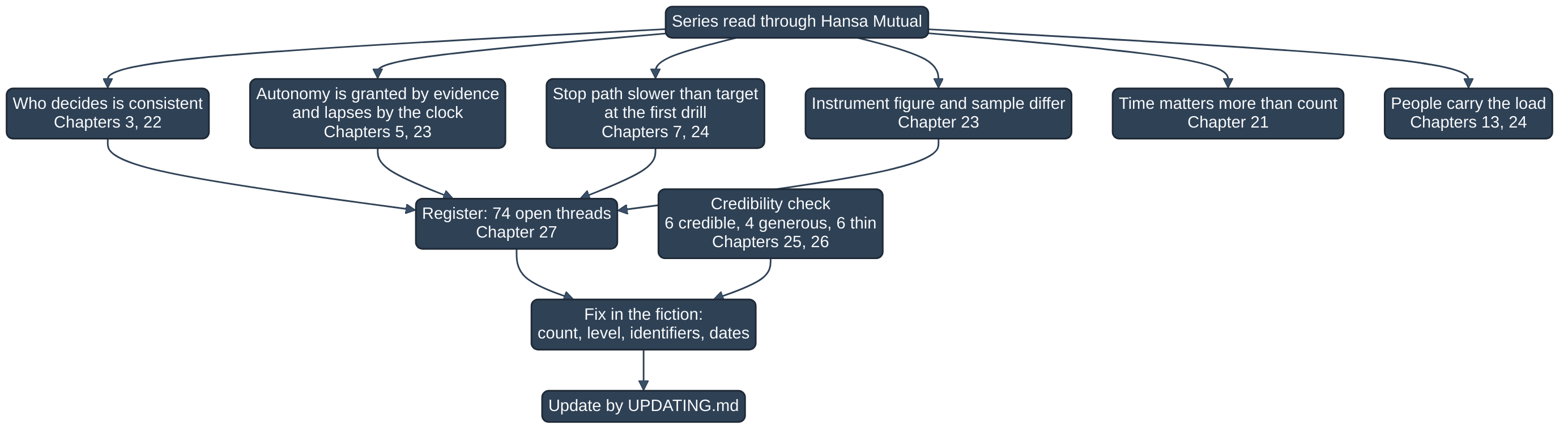
Figure 28.1: Six of the seven conclusions about the series, the chapters that carry them and the fixes that follow; the seventh, on boundaries and the age of a figure, comes from Book 14.
Across the degrees of delegation
The six conclusions can be read once more by degree of delegation. The table gathers where the dossier finds each degree used and what limits it.
| Degree | Where Hansa Mutual uses it | What limits it | Chapter |
|---|---|---|---|
| Level 0 Advisory | Sales score; most development work classes; strategic and risk decisions of the executive board | Rule: nothing about a named person's pay, discipline or employment above Level 1 | 5, 13, 17 |
| Level 1 Assisted | Screening with TalentLens; restore-overwrite; most of the management of people |
Human decision in every case; works council annexes | 5, 13, 16 |
| Level 2 Supervised | HM-SEC-001 at the start; development classes below the one Level 3 class |
Named reviewer; capacity of six architects | 7, 12 |
| Level 3 Bounded | Two reversible security actions; three reversible operations classes under condition; one dependency-update class; the loop runner for benign scenarios | Identity, manifest, policy point outside the model, stop path outside the agent, dated rehearsal | 7, 15, 16, 18 |
| Level 4 Autonomous | Not used for an irreversible action or for a decision about a person | Rejected by schema in AI Blue; Chapter 27 records that AI Boss is inconsistent on whether any system reached it in practice | 14, 27 |
Illustrative after 2026, except the rules, which are established as design rules of the volumes (7, Nordqvist, 2026) (8, Nordqvist, 2026).
What Hansa Mutual teaches that Nordvik Region does not
The series chose its two organisations to differ in the ways that matter for governing AI (Chapter 2). Nordvik Region is a regional public authority with about 6,000 employees in one jurisdiction under public law; Hansa Mutual is a mutual insurance group with about 9,500 employees in seven. The contrast is summed up in Landscape: Nordvik Region's question is usually "may we", Hansa Mutual's "in which of seven ways must we" (15, Nordqvist, 2026). The dossier draws five lessons from Hansa Mutual that the sibling dossier cannot draw from its own organisation.
| Lesson | Why Hansa Mutual shows it | The sibling's position (profile only) |
|---|---|---|
| Containment is a design task | Hansa uses every mode and must contain Modes 3 and 5: layered containment, manifests, policy points and stop paths outside agents | Avoids Modes 3 and 5 for now |
| The platform is the lever | Hansa mostly builds and is provider as well as deployer; limits are enforced where the shared platform runs | Leverage is the contract; mostly deploys and procures |
| Fragmentation is a cost to be paid in data | Seven regimes handled by one baseline with overlays that only tighten, flags per market and one release with evidence per market | A single legal regime |
| Autonomy has to be priced in evidence | Six Mode 5 units force the question of how to keep a level honest: dated drills, observers, independent oracles | Few autonomous units to test |
| Co-determination shapes the pace | Representation through the Konzernbetriebsrat and parallel arrangements in six markets set the rate at which a class can be introduced | Not compared in the profile table |
Established as profile contrasts (2, Nordqvist, 2026); the lessons are the dossier's own reading.
The converse also holds. Hansa Mutual does not show what a small platform team and a long procurement cycle do to a public authority, nor what lock-in costs when a contract is the only lever; those lessons are Nordvik Region's to teach. The two dossiers are written to be read together, and an observation that holds for both is a finding about the series, while one that holds for only one is a finding about the organisation.
What the credibility check says
Chapters 25 and 26 asked whether a fictional mutual group of 9,500 people in seven countries is plausible against what five real comparators and four data points publish. The verdicts across sixteen dimensions are six credible, four generous and six thin.
The credible dimensions are scale, form, product mix, the supervisory map, the DORA setting and ordinary generative AI use. Nothing found contradicts the series there. The generous dimensions are the number of markets, the maturity of group AI governance and the two Mode 5 agents that the check examined; the dossier reads them as design cases, as the series presents them. The thin dimensions are premium volume, employee representation, costs, daily claims volume, the platform-engineering team and the Polish claims centre, where the figures are internally consistent and externally unanchored.
Three conclusions follow, and they are the book's own. First, the series is most believable where public evidence is richest and least testable where it is not; the plausibility of Hansa Mutual is good in the first case and unproven in the second. Second, the generous verdicts concern integration, not impossibility: real insurers do some of what Hansa does, but not all of it in one group, and the series says so by calling the organisation the builder in seven jurisdictions. Third, the check does not turn a fictional fact into a real one. A real insurer that does what the series assigns to Hansa Mutual is a coincidence of design and not a source, and the reverse is equally true.
What has to be fixed in the fiction
Chapter 27 records 89 open threads in five kinds. The dossier does not make the corrections; it recommends them. The conclusions of the register are summarised here as the list of work for the author, in the order the dossier recommends.
- Settle the Mode 5 count and the level of
HM-SEC-001(OT-HM-01 and OT-HM-02). These two decide how far the series says the group trusts its agents. The recommended step is to define "Mode 5 agent" once, publish the count with its definition, and give the security agent one dated sequence of levels. - Settle the incident identifiers of 2027 (OT-HM-33). Three formats, two events in the same minute and a fourth identifier that changed after editorial review affect the reading of three volumes.
- Align levels, ceilings and limits (OT-HM-07 to OT-HM-11 and OT-HM-15 to OT-HM-19). Most are one table or one sentence that needs the same value in two volumes, such as the token life of 5 and 15 minutes or the holders of the stop record.
- Resolve the identifier collisions (OT-HM-34 to OT-HM-40), above all
RST-HM-2031-0001, which names a rehearsal in one volume and a restore test in another, andHM-SEC-006, which names two systems. - Re-date the clashes (OT-HM-41 to OT-HM-52), which are mostly one date against its identifier.
- Close the outcomes (OT-HM-53 to OT-HM-66 and OT-HM-85). These can be written as facts in the next volume, and the dossier recommends that each volume begin with the results of the previous volume's open tests.
-
Adopt the plausibility adjustments of Chapter 26: state the choices that real references make visible (legal form, field distribution, branches against subsidiaries), anchor or declare absent the premium figure, mark the generous dimensions as design cases, label the thin numbers as model values, disambiguate the 14 seats, add trajectories, report incidents in the supervisor's unit and return to employee representation and the Polish centre with sources.
-
Settle the readings of Book 14 and of the revised Landscape (OT-HM-75 to OT-HM-89): the boundary of each figure of September 2032, the owner of
FPR-HM-0002, the German limits on PUE, the wording of BetrVG section 87(1) no. 6 and of DORA's management body, and the works-council rows by country.
Two principles apply to all eight. A correction in an earlier volume is made in the same set of changes as the volume that exposed it, so that the series order is kept and no earlier volume refers to a later one. And a value that cannot be settled by the author's own record, such as the applicability of NIS 2 to the non-financial parts, goes to counsel and is stated once (11, Nordqvist, 2026).
How the dossier is updated
The dossier follows the series by the procedure of docs/UPDATING.md, which is the same for the sibling and run in the same set of changes. When a new volume appears (a Book 15 or later), seven steps are taken in order:
| Step | Action |
|---|---|
| 1 Extract | Read the volume's profile and every chapter that names Hansa Mutual; write data/extracts/NN_<slug>.md with the eight sections of the others |
| 2 Ledger | Append identifiers, events and figures to data/ledger.jsonl; run scripts/check_ledger.py |
| 3 Chapter | Add the volume's chapter to Part III through scripts/toc_definition.py and write it to the brief |
| 4 Cross-cutting | Revise Chapters 2 to 7 and 21 to 24; add findings to Chapter 27 |
| 5 Rules | Move cites_up_to in book.yaml, add the bibliography entry, regenerate Appendix A, run bookengine test -q and audit_references |
| 6 Credibility | Re-run the comparison of Part V for any new dimension |
| 7 Companions | Update the other sites that carry the book |
When an earlier volume changes, the dossier diffs its profile, reruns the ledger check and corrects the chapters flagged. A correction in a volume that the dossier had recorded as an open thread moves from Chapter 27 to a note in the chapter concerned, so that the register shrinks as the series is repaired. Each release states the series state it reflects on the title page of Chapter 1; this release reflects Books 1 to 13 and the two companions as of 2026-11-16.
The register has a use beyond bookkeeping. A volume that is about to be written can read Chapter 27 first, and the author can decide, before the volume is drafted, which value of a contested fact the new text will take. The cheapest correction in a series built in publication order is the one made before the later volume exists.
Summary
Read through Hansa Mutual, the series shows an organisation that decides consistently and counts inconsistently. It keeps authority in roles with records, grants autonomy by evidence and takes it back by the clock, finds its stop path slower than its target at the first drill, and learns that the figure from the instrument and the figure from the sample are different numbers, and with Book 14 that a figure is only as good as its boundary and its date. It teaches what Nordvik Region cannot: containment of Modes 3 and 5, the platform as lever, fragmentation paid in data, autonomy priced in evidence and co-determination as a pace. The credibility check finds the fiction credible in six dimensions, generous in four and thin in six, and the generous ones are design cases. Eighty-nine threads in Chapter 27 are the work still to do, and the first three (the Mode 5 count, the level of HM-SEC-001 and the incident identifiers of 2027) matter most. The dossier is kept current by the seven steps of UPDATING.md, and each release says which series state it reflects.
Sources
- Nordqvist, G. AI Governance: Governing Artificial Intelligence in European Enterprises and Public Authorities. (2, Nordqvist, 2026)
- Nordqvist, G. The Transformed Security Architect: Role, Craft and Career in the Age of AI in European Enterprises and Public Authorities. (6, Nordqvist, 2026)
- Nordqvist, G. AI Boss: When Artificial Intelligence Manages People in European Enterprises and Public Authorities. (7, Nordqvist, 2026)
- Nordqvist, G. AI Blue: How Artificial Intelligence Transforms the Blue Team in European Enterprises and Public Authorities. (8, Nordqvist, 2026)
- Nordqvist, G. AI Purple: How Red and Blue Learn Together When AI Joins the Loop in European Enterprises and Public Authorities. (9, Nordqvist, 2026)
- Nordqvist, G. AI Operations: How Artificial Intelligence Transforms IT Operations in European Enterprises and Public Authorities. (10, Nordqvist, 2026)
- Nordqvist, G. AI Leader: How Leadership Roles Change When AI Is Used Broadly in European Enterprises and Public Authorities. (11, Nordqvist, 2026)
- Nordqvist, G. AI Developer: How the Developer Role Changes When AI Is Used Broadly in European Enterprises and Public Authorities. (12, Nordqvist, 2026)
- Nordqvist, G. Vibe to Dev: From Vibe Coding to Professional Software, Step by Step, for Builders Who Are Not Developers, in European Enterprises and Public Authorities. (13, Nordqvist, 2026)
- Nordqvist, G. AI Environment: Designing AI for the Greatest Benefit and the Least Environmental Harm in European Enterprises and Public Authorities. (14, Nordqvist, 2026)
- Nordqvist, G. Landscape: A Fact-Based Picture of Architecture and AI at Work, for Leaders, Architects and Citizens. (15, Nordqvist, 2026)