Book 11, AI Leader: Answering for Decisions
This chapter gathers what AI Leader (Book 11) establishes about Hansa Mutual: the governance structure and the six layers of management, the leaders who are named, the board-pack assistant and the other AI that leaders already use, the decision rights that were written for people and say nothing of AI, the delegation profile of the executive board, the adoption claim that a dashboard and a sample read differently, and the exercises and tests by which the volume judges the group's answerability. It draws on AI Leader, Chapters 1 to 33, and on the leadership profile that the volume adds to the example-organisation file (11, Nordqvist, 2026). The group's structure and roles are placed in Chapter 3 and its legal setting in Chapter 4 of this dossier; this chapter adds what the leadership volume contributes.
The facts are of two kinds. The leadership profile (structure, named roles, spans, existing AI use) is established. The volume's year, September 2029 to August 2030, written in November 2026, is illustrative fiction, including its dates, its figures and its drill results. The volume marks several outcomes "in this illustration", and the chapter repeats that marking. The volume also flags that the legal basis for a supervisory board with ten of twenty seats held by employee representatives is for the writer to verify (11, Nordqvist, 2026).
The volume in brief
AI Leader asks what happens to leadership (in the board, the executive team, the middle layer, the first line and the public authority) when AI is used broadly across the organisation and not in one system or function. Its thesis has five parts. Leadership is transformed, not abolished: from information intermediary to sense-maker, designer of decision rights and accountable answerer. Delegation of leadership decisions is graded and has a ceiling, and Level 4 is never used for a decision about a named person's employment, pay, discipline or access to work, for a decision that law assigns to the management body or a named office, for a decision that sets an AI system's own mandate, budget, oversight or stop path, or for an irreversible decision beyond the system's mandate. The span grows and the middle layer is redesigned and not deleted. AI may inform, draft, prepare and, within a mandate, execute, but may not answer: the answerability principle asks of a named leader three tests, Name, Explain and Reach. Adoption, productivity and leadership capability are claims that need evidence, and evidence expires. The work divides into five leadership functions: L1 Orient, L2 Decide, L3 Organise, L4 Enable and L5 Answer (11, Nordqvist, 2026).
The role of Hansa Mutual in the volume
Hansa Mutual is the volume's private, supervised case: a mutual with an executive board in Hamburg as the management body under DORA Article 5, a supervisory board of 20, a 120-page authority-matrix spreadsheet that does not mention AI, and two Mode 5 agents (claims triage and IT operations). The volume uses it to show what the leadership roles become when AI is used widely in a group under several legal regimes, and above all how a target of 70 % weekly use of embedded assistants can be met by a dashboard that counts log-ins (74 %) while a sample shows 38 % (11, Nordqvist, 2026).
The starting point is AIDR-1050 (2029-09-17). The chief executive, Friedrich Albrecht, asks the chief HR officer Marlene Voss, the chief risk officer Dr. Annette Krämer and the group CIO for a leadership profile, with the audit and risk committee and the Konzernbetriebsrat invited to review it; the first report is due 2030-04-30. The volume's conclusion for the group is to close what has expired before anything new is opened, and its strongest instrument is the drill, with the warning that a drill that is not repeated drifts (11, Nordqvist, 2026).
What the volume establishes
Governance and layers
The supervisory board has 20 members, ten elected by the members' representative assembly and ten employee representatives, chaired by Dr. Margarethe Linde. Its audit and risk committee is chaired by Dr. Katrin Wendt, and there is a personnel committee. The executive board has seven members.
| Member | Role |
|---|---|
| Friedrich Albrecht | chief executive since 2025, formerly CFO of a competitor |
| Dorothea Keil | chief financial officer |
| Dr. Annette Krämer | chief risk officer since 2022; chair of the group AI governance board |
| Katrin Ohlsen | chief claims officer |
| (unnamed) | chief underwriting and actuarial officer |
| Marlene Voss | chief HR officer and labour director since 2023 |
| Rainer Lehmann | chief information and operations officer, the group CIO |
The group CISO reports to the CRO, the head of the group AI platform, Anja Weiß, to the group CIO, and the general counsel, Ulf Zimmermann, to the chief executive. There is no chief AI officer: the executive board decided against one in March 2029 (AIDR-1051, dated 2029-03-14 and filed retrospectively in October 2029). The duties went to the group AI governance board and the head of the group AI platform, and the decision is to be reviewed in March 2031 against two tests (an unanswered decision outlasting its response time, and a business head declining ownership) (11, Nordqvist, 2026).
There are six layers: the chief executive; the executive board; about 28 function and country heads; about 160 department heads; about 520 team leaders; and employees. About 715 of 9,500 hold a management post, one in 13. The spans are the chief executive 7, board members 5 to 8, department heads 5 to 7 team leaders, claims team leaders 15 to 25 (Jana Petersen about 20), contact centre 20 to 30, IT 6 to 10 and underwriting 8 to 12 (11, Nordqvist, 2026).
The people
| Person | What the volume gives |
|---|---|
| Friedrich Albrecht | set the 70 % target; answerable for the dashboard; crisis leader in the exercises; ROLE-HM-CEO-01 (draft version 0.3, 2029-12-05) makes him the named answerer for adoption claims; quarterly unassisted explanation with Linde |
| Dr. Annette Krämer | independent evidence owner; deputy crisis leader; owns HZN-HM-2030-01 and the review of AIDR-1050; reports the catch rate to the audit and risk committee |
| Marlene Voss | liaison to the Konzernbetriebsrat; sponsor of leadership development; owner of the restatement of "Lean Claims" in the plan |
| Rainer Lehmann | owner of DLG-HM-EXE-01; second deputy crisis leader; prepares deputies |
| Dorothea Keil | her dissent stands named in LDR-HM-2029-0005; owns the budget envelope (DEC-HM-002) |
| Katrin Ohlsen | decided LDR-HM-2029-0005; owns ACC-HM-2029-01 |
| Jana Petersen | claims team leader in Hamburg, about 20 handlers and, from January 2027, the agents of HM-AB-PILOT-01 (two agents); ROLE-HM-TL-01; CMP-HM-TL-014; TRN-HM-2029-CL-HAM-01 |
| Katrin Wolter | deputy team leader in Hamburg, exercised 2029-10-16 |
| Thomas Brandt | chair of the Konzernbetriebsrat; observed the second crisis exercise |
| Dr. Hannes Ostermann | leads the group actuarial department (46 actuaries) |
Three people are named Katrin (Ohlsen, Wendt, Wolter). The board secretary, the data protection officer and group controlling are not named (11, Nordqvist, 2026).
AI that leaders already use
The board-pack assistant is a Mode 4 application on the group AI platform, limited risk (AIDR-1052, MND-HM-LDR-01), at Level 1 Assisted. It summarises the papers of the executive and supervisory board committees and drafts minutes, linking to source passages. Its dissent field was empty by design when the source showed no dissent; the later requirement is that it is never merely empty but carries either the dissent or the secretary's dated statement that none is recorded. Other leader use is embedded work assistants (Mode 2), approved tiers (Mode 1) and ambient AI (Mode 0). The claims-triage agent (Mode 5) allocates cases to handlers at Level 3 Bounded, and the agent-boss pilot HM-AB-PILOT-01 lets two team leaders direct small sets of Mode 5 agents. The IT-operations agent (AIDR-0027) also appears. Reused records include AIDR-0021, AIDR-0034 and -0063, AIDR-0633 (time saved goes to staff, 2027-08-25), AIDR-0671 (CHN-HM-CLM-01), AIDR-0683 (ROLE-HM-MGR-01, 2027-06-28), AIDR-0685 (DLG-HM-CTA-01 version 1.2.0), MND-HM-CLM-01, DLG-HM-AB-01, KBV-IT-2024, CNT-HM-0001, EXIT-004 and the screening tool TalentLens (11, Nordqvist, 2026).
Decision rights and delegation today
Decision rights are the executive board's rules of procedure (portfolios), the supervisory board's list of transactions requiring consent (strategy, large investments, key functions under Solvency II) and the 120-page authority matrix with approval limits by level and country. DORA Article 5 makes the executive board responsible for ICT risk. None of these mention AI. The current delegation by decision class is strategic Level 0, resource Level 0 (models, not generative AI), structural Level 0, people Level 1 for screening (TalentLens) and not delegated for pay and discipline, risk Level 0, external Level 1 and crisis Level 0 (11, Nordqvist, 2026).
The register DRR-HM-001 lists ten decisions, of which five carry an identifier in the extract: DEC-HM-001 approving an AI system for consequential use (10 working days); -002 the AI budget envelope (chief financial officer); -003 accepting residual risk above tolerance (CRO, 5 working days); -004 stopping an AI system or revoking an agent identity (holder set CISO, system owner and agent operator, immediate, no prior approval); -005 changing a system's own mandate, oversight or stop path (CRO, 10 working days; Level 4 never). The asymmetry is deliberate: the right to stop needs no approval (11, Nordqvist, 2026).
Representation and law
The Konzernbetriebsrat, local works councils, the European works council, the Dutch ondernemingsraad, Swedish unions and Norwegian and Polish arrangements are all in play. KBV-IT-2024 covers the claims-triage figures and TalentLens; the Konzernbetriebsrat contested that the board-pack assistant lies outside the agreement. The volume frames its legal points through DORA Article 5 (5(2)(a) ultimate responsibility for ICT risk; 5(4) the board's own development), VAG section 188(1), AktG section 93, BetrVG section 87(1) no. 6, NIS 2 Article 4(1) and BSIG section 28(6) (NIS 2 displaced for EU financial entities), Annex III point 5(c) for underwriting support with Articles 26 and 27 from 2027-12-02, and Annex III point 4(b) for the allocation of work to handlers. The UK and Switzerland lie outside the AI Act and DORA and are not mapped (11, Nordqvist, 2026).
Decisions and records
| Record | Date | Content |
|---|---|---|
| AIDR-1050 | 2029-09-17 | the request for a leadership profile |
| AIDR-1051 | 2029-03-14, filed October 2029 | against a chief AI officer |
| AIDR-1052 | not dated | approval of the board-pack assistant (MND-HM-LDR-01) |
| AIDR-1053 | proposed 2029-10-08, resolved 2029-10-09, version 1.0 adopted 2029-10-15 | DLG-HM-EXE-01 |
| AIDR-1059, -1066 | SPN-HM-2029-01 (to be written, not reproduced), SPN-HM-2030-01 (the record that exists) |
|
| AIDR-1060, -1062 | adopted 2029-11-05 for the first | ACC-HM-2029-01, ACC-HM-2030-01 |
| AIDR-1061 | 2029-10-22 | leadership competence records for development only |
| AIDR-1063 | approved 2029-11-12; noted by the audit and risk committee 2029-11-26 | BRD-HM-001, the board briefing specification |
| AIDR-1067 | in force 2029-10-08 | ROLE-HM-TL-01, replacing ROLE-HM-MGR-01 |
| AIDR-1069 | 2029-11-26; in force 2030-01-15 | ROLE-HM-UW-01 safeguard clause |
| AIDR-1070 | 2029-10-08 | adoption target reworded to feature events; no new percentage |
| AIDR-1071 | 2029-11-20 | wellbeing analytics switched off |
| AIDR-1073 | 2030-02-12 | crisis exercise specification and LDR-HM-2030-0023 |
| AIDR-1074, -1075 | 2029-12-03, 2029-11-12 | DRR-HM-001-LEG, DLG-HM-VAL-01 |
| AIDR-1077, -1078 | 2029-12-10, 2030-02-12 | competence records and the Konzernbetriebsrat, KBV-LDR-2030-01 |
| AIDR-1088 | 2030-03-12 | LDR-HM-2030-0030 |
| AIDR-1096, -1097, -1099 | CMP-HM-2029-21; the twelve-month plan of 2030-09-09 (illustrative); HZN-HM-2030-01 (June 2030) |
Other artefacts: ADP-HM-2029-01 (adoption, an investment ledger with an empty return ledger) and ADP-HM-2029-02 (value hypotheses and resampling), LDR-HM-2029-0005, LDR-HM-2029-0412, LDR-HM-2030-0026, LDR-HM-2030-0032 (plan), LDR-HM-2030-0040 (Chapter 33), ROLE-HM-CISO-01 (reports to the CRO, DORA Article 6(4)), ROLE-HM-SA-AI and TRN-HM-2029-CL-HAM-01 (11, Nordqvist, 2026).
Events and figures
Before the volume's year
The profile records three pieces of history. The first is "Lean Claims" in 2028, a consultant benchmark of claims spans after which two team-leader layers were merged in the Polish service centre and the Netherlands (40 posts); the escalation backlog grew and 22 posts were reinstated within a year, but the savings figure was never recalculated. The second is the pay-conversation score of 2027 (CNT-HM-0001): a sales manager used a sales performance score as the main argument in a pay conversation, the contestation succeeded, and use was limited by an amendment to KBV-IT-2024. The third is the green adoption dashboard of 2029. Petersen's pilot HM-AB-PILOT-01 started in January 2027, and the decision against a chief AI officer fell on 2029-03-14 (11, Nordqvist, 2026).
The adoption claim
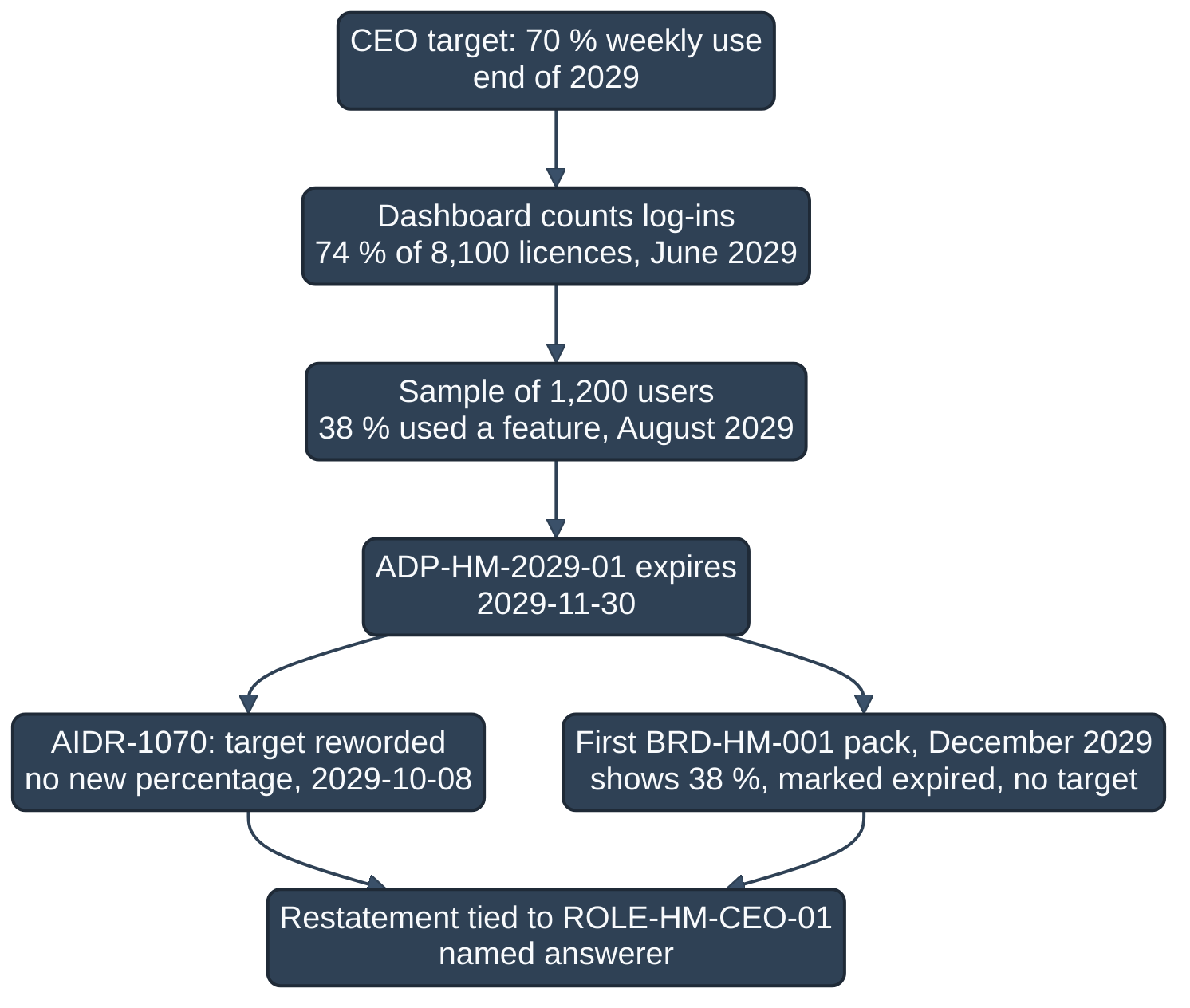
Figure 17.1: How the adoption claim of ADP-HM-2029-01 was tested and restated. Dates and figures are illustrative.
The chief executive's target was 70 % weekly use of embedded assistants at the end of 2029. The group holds 8,100 licences. In June 2029 the dashboard showed 74 % "weekly active", counting log-ins. In August 2029 a sample of 1,200 of the 8,100 users showed 38 % using any feature in a week. ADP-HM-2029-01 expired on 2029-11-30. AIDR-1070 reworded the target on 2029-10-08 to feature events and set no new percentage until value had been measured. The first pack under BRD-HM-001 in December 2029 carried an adoption paragraph that showed 38 %, marked it expired and gave no target. The volume notes that the figure was presented as expired and not recalculated. Of nine claims standing at year end across both organisations, six were expired or open (11, Nordqvist, 2026).
The year in dates (illustrative)
- 2029-09-26: the board secretary compared 30 summaries; 28 were faithful and two dropped a reservation. The claim expires 2030-03-26 with no retest recorded.
- October 2029: a seeded-error exercise on 60 summaries seeded 12 errors and caught 7, a catch rate of 58 %; no ceiling rises, every figure is checked mechanically before release, and the exercise is repeated next quarter. 2029-10-16: Wolter exercised.
- 2029-10-23: first test of
ACC-HM-2029-01: 17 of 20 letters traceable within four hours; three intake classifications ran against a superseded document version; Explain partial; stop drill six minutes against a target of ten; evidence valid to 2030-01-21, on which date it expired with no rerun recorded. - 2029-11-12: pre-mortem;
BRD-HM-001andDRR-HM-001approved. 2029-11-19:LDR-HM-2029-0005reinstates eight of the remaining 18 Dutch team-leader posts, with a tripwire on 2030-04-30 and a review on 2030-05-31. - 2030-02-12:
KBV-LDR-2030-01signed after the Konzernbetriebsrat contested; the board chose negotiation over a settlement decision; the European works council was informed of six other countries. First board exercise the same day. - 2030-03-12:
LDR-HM-2030-0030: Name approved, Explain conditional, Reach partial, deadline 31 May for the group CIO; "AI theatre" put on watch. - 2030-03-26: the summaries evidence and the
DLG-HM-EXE-01evidence expire. 2030-04-15: the delegation review falls due. 2030-04-30: first report on AIDR-1050; the tripwire inLDR-HM-2029-0005is triggered in the illustration (backlog not below the level on 31 October). - Last week of May 2030: a pause exercise found two failings: a deputy had changed role, and the CRO's office did not know where the switch was. June:
HZN-HM-2030-01. 2030-08-12: second board exercise with the chief executive absent for the first 25 minutes, Krämer as crisis leader, observed by Brandt; the conclusion expires 2031-02-12. August: the chief executive's unassisted explanation of the adoption target. - Planned: 2030-09-09 plan; 2030-09-11 resampling; 2030-10-31 board-pack retest; 2030-11-30 rerun of
ACC-HM-2029-01; 2031-01-31KBV-LDR-2030-01checked against six other arrangements; 2031-02-12 third exercise; 2031-03-31 Dutch posts review; 2031-04-30 pause of the roll-out if verified use is under 25 % at expiry; 2031-06-30 horizon register; 2031-08-31 year read-out (11, Nordqvist, 2026).
The volume gives no result for the reruns, the retest, the resampling or the seeded-error exercise of the next quarter; they are plan items.
The crisis exercises
| Measure | February 2030 | August 2030 | Direction |
|---|---|---|---|
| Crisis leader confirmed | 9 min | 12 min | worse |
| Stop decision for the triage agent | 14 min | 19 min | worse |
| First holding statement (target 60) | 71 min | 64 min | better |
| Log entries without a reason | 5 of 22 | 3 of 26 | better |
In February, with assistants on, drafts for three markets in three languages took 12 minutes, and two statements without an entry in the fact register were held back. Two measures improved and two worsened (11, Nordqvist, 2026).
Other figures
Petersen's Monday review had an acceptance of 97 % over six weeks, with a median of 38 seconds between opening and approval against a review allowance of four minutes. For underwriting, one read in twenty (0.05) is blind, the actuarial department has 46 actuaries and 12 trainees a year, and the EXIT-004 second source scored 0.89 against 0.94. The delegation profile controls are an authority matrix check, a 10 % weekly sample and 10 seeded errors a quarter, with a stop if any approval falls outside policy or the catch rate drops below 90 %, and evidence at most 90 days old. The plan's stop rule is verified use under 25 % (11, Nordqvist, 2026).
Across the degrees of delegation
DLG-HM-EXE-01 version 1.0 (owner Lehmann, reviewer Krämer) puts strategic, resource, structural, risk and crisis decisions at Level 0 and external at Level 1, with two exceptions at Level 3 Bounded: travel (reversible, R1) up to EUR 2,500 a trip, and board scheduling (R2). Everything else is Level 0 or 1 and people decisions are not delegated. The board-pack assistant stays at Level 1 with provenance, age, dissent, independent sources and a stop path outside it. The Konzernbetriebsrat agreement follows the mandate, not the release. Excluded are speaker-time statistics and ranking of named staff, consent is needed for a higher level, new input or a personal report, and the owner, the reviewer or Brandt can stop the assistant through the platform office (11, Nordqvist, 2026).
| Use | Mode | Level | Note |
|---|---|---|---|
| Embedded assistants | 2 | not set by class | adoption claim at issue |
| Board-pack assistant | 4 | Level 1 Assisted | limited risk; MND-HM-LDR-01 |
| Claims-triage agent | 5 | Level 3 Bounded | allocates cases to handlers |
| Agent-boss pilot | 5 (agents directed) | per DLG-HM-AB-01 |
two team leaders, two agents |
| Executive travel and board scheduling | not stated | Level 3 Bounded | only these two classes |
| People decisions, pay, discipline | not delegated | Level 4 never |
What the volume concludes for Hansa Mutual
The decisions the volume records are to keep the decision against a chief AI officer and test it; to adopt no new adoption percentage until value has been measured; to hold that the drill is the strongest instrument and must be repeated; and to treat the cut layer of Lean Claims as the structural risk, recalculating the saving first (SPN-HM-2030-01). On people, wellbeing analytics stay switched off until a works agreement covers them, because of the Article 5(1)(f) question, and a team pulse in claims runs with Petersen's team under the same limits. For underwriters and actuaries a safeguard clause excludes any use target for named people, one read in twenty is blind, trainee intake continues, and first-year reserving is derived unassisted first. In the volume's Chapter 15 the stop right is set as an asymmetry (holder set, no prior approval). Its Chapter 26 holds that the fallback and the claims core restore copy must not rest on the same hyperscaler (DORA Article 29(1)), that EXIT-004 should be rerun, that a quality gap of 0.05 is accepted for the fallback, and that the board reads the exit result in the source and not in the summary (11, Nordqvist, 2026).
The lessons of the volume's Chapter 31 are that the first honest figure was lower than the first dashboard, that claims expire, that failures are silent, and that disagreement became text. The conclusion for Hansa is that no new level is opened without a verified claim and fresh evidence. The horizon register frames the future in the series' three labels: falling entry-level hiring is observable in United States data, fewer layers is expected, and an agent-led unit is speculation that needs twelve months of data (11, Nordqvist, 2026).
Open threads
These are collected in Chapter 27.
- Ceilings.
DLG-HM-EXE-01sets strategic, resource, structural, risk and crisis at Level 0 and external at Level 1, whereas the register table in the volume's Chapter 15 gives strategic Level 1, resource Level 1, structural Level 0 and risk Level 0 (highest levels per class), and its Chapter 8 describes "two routine classes" at Level 3. The same facts appear at different levels in different tables. - Screening. The profile gives people Level 1 for screening (existing); the volume's Chapter 4 says the screening support "sits outside" the executive board's profile.
TalentLenshas no chapter of its own. - Dates.
BRD-HM-001was approved 2029-11-12 and noted 2029-11-26. AIDR-1051 is dated March 2029 and filed after AIDR-1050. AIDR-1053 is dated 2029-10-15 in the volume's Chapter 8, while the profile refers to a proposal on 2029-10-08 and a resolution on 2029-10-09.SPN-HM-2029-01"will be written" but is not reproduced. - Statutory points. DORA and NIS 2: here NIS 2 is displaced for EU financial entities, whereas AI Operations says application depends on national transposition. The supervisory board's composition is flagged for verification.
- Unrecorded results. The rerun of
ACC-HM-2029-01, the summaries retest, the resampling and the next seeded-error exercise have no recorded results;ADP-HM-2029-01expired on 2029-11-30 but was shown in December as expired and not recalculated. - Names. Katrin Wendt is the audit and risk committee chair; the profile calls her "the only Hansa audit and risk committee chair". The coverage of the German agreement
KBV-LDR-2030-01over six other arrangements, including the UK and Switzerland, is an open check (Zimmermann, 2031-01-31).
Summary
Our conclusions are three. First, the leadership volume shows Hansa Mutual as a group whose decision rights are older than its AI: the 120-page matrix, the board rules and the consent list do not mention it, and the volume's work is to add a register, a delegation profile and named answerers, not to add authority. Second, its most useful single episode is the adoption claim, because the same number is read as 74 % by the dashboard and 38 % by a sample, and what the group did was restate it with an age and no target; the claim and its restatement concern the function L5 Answer. Third, the evidence ages in the volume are short (90 days for a delegation profile, weeks for a summary check), and several results lapse in the record without a rerun, which the volume itself reads as the drift of a drill that is not repeated. The year is illustrative; the structure and roles are established.
Sources
- Nordqvist, G. AI Leader: How Leadership Roles Change When AI Is Used Broadly in European Enterprises and Public Authorities. (11, Nordqvist, 2026)