Book 14, AI Environment: The Footprint
This chapter gathers what AI Environment (Book 14) establishes about Hansa Mutual: the environmental register and the Count rule, the seven footprint records, the benefit records, the budgets and their stop drills, the Frankfurt data centre, the hosting comparison, the hardware decision, the board's held sentence and the year from September 2032 to August 2033. It draws on AI Environment, Chapters 1 to 29, on its Chapters 27 and 28, which tell and conclude the year at the two organisations, and on the environmental profile it adds to the example-organisation file (14, Nordqvist, 2026). Chapter 16 of this dossier covers the operations picture from which the stop paths come, Chapter 18 the development organisation whose engineering tools Book 14 meters, and Chapter 19 the builder lane.
The status of the facts is this. The older profile of the group (Hamburg, about 9,500 employees, seven countries) is established. The environmental profile, every figure, name of a record, identifier and date in Book 14 is illustrative fiction: the volume says so at each number, covers September 2032 to August 2033 and was written in November 2026. It reads law as it stood on 16 November 2026, and every statement about the future carries one of the three labels of AI Governance, Chapter 22 (observable, expected, speculation) (14, Nordqvist, 2026) (2, Nordqvist, 2026).
The volume in brief
AI Environment asks what a large European enterprise or public authority should do, use by use, so that the benefit of AI is as large as possible and the environmental harm as small as possible, and what evidence it needs before it says it has succeeded. Its method has three tests, Count, Compare and Cap, called the net-benefit principle: count what a use costs the environment at a stated boundary, compare what it gives with what the alternative would give, and cap what it may spend, with a stop path outside the system it stops. The five environmental functions are E1 Measure, E2 Justify, E3 Design, E4 Operate and E5 Account; they are not the operations functions O1 to O5, the leadership functions L1 to L5 or the developer functions D1 to D5 of the earlier volumes. An optimisation hierarchy orders the levers (the model, the serving, training or retrieval, the agent budget, the hardware, the place and time), and evidence expires: a footprint record lasts 90 days, a benefit record 180, a stop drill 90, a supplier disclosure 12 months and a claim at most the reporting year (Chapter 24). Level 4 is never used for publishing an environmental claim, for an agent that provisions its own compute above budget, for an action that closes a meter, a budget or a stop path, or for a decision about a named person's access to work (14, Nordqvist, 2026).
The role of Hansa Mutual in the volume
Hansa Mutual is the organisation that owns its capacity, meters it and reports under supervision. Its counterpart Nordvik Region buys most of what it runs. The group mixes its own Frankfurt capacity (hansa-dc-frankfurt), burst capacity in two clouds and hosted model providers, and its levers are metering, routing models by task, agent budgets and clause families. The volume's main question for the group is how to count AI inside Scope 2 and Scope 3 and make the board's statements defensible (14, Nordqvist, 2026).
The volume uses the group for eight things: a Mode 5 agent that makes nine model calls per claim, whose footprint differs about 13 times depending on the direction of counting (FPR-HM-0002); a cascade of a small and a large model and the serving levers for the claims assistant; the board's sentence that AI work "became more efficient", which is held until a claim record exists (CLM-HM-0001); a stop drill that fails because a key sits with the provider; the consolidation of the GPU pool without a purchase; a hosting comparison between Frankfurt, Cloud A and a regional provider; the clause family HM-PROC-ENV; and a board that learns to say no (14, Nordqvist, 2026).
What the volume establishes
Profile additions
The profile carries forward the group's established facts and adds the environmental ones below.
| Item | Value | Status |
|---|---|---|
| AI inference and platform spend | about EUR 17 million in the 12 months to August 2032 (EUR 9 million in the 2028 profile); the IT operations agent's cap of EUR 6,000 a month stands | illustrative |
| Frankfurt installed IT power | about 2.8 MW, above the 500 kW threshold of Annex VII, so the group reports as an operator under Article 12 of the Energy Efficiency Directive | illustrative (new) |
| Electricity | bought with guarantees of origin on an annual basis, so the market-based and location-based figures differ; location-based factor 350 g CO2e/kWh | illustrative |
At the baseline the group measured tokens, cost and showback per use case and entity, with the routing and carbon policy RP-HM-CLAIMS-2026-02 feeding a monthly report per entity. It lacked the following: AI separable in Scope 2 and 3, a reading of Cloud A burst, supplier figures on one boundary, water by use, energy per completed agent task, benefit records, environmental budgets, a rebound measure and a record behind the board's sentence (14, Nordqvist, 2026).
The people
Dr. Annette Krämer (chief risk officer) chairs the group AI governance board and approves every claim. Dorothea Keil (CFO) answers to the board for the sustainability statement and is claimant for CLM-HM-0001. Rainer Lehmann (group CIO) answers for IT's footprint and sets EBG-HM-0002 and EBG-HM-0005. Anja Weiß (head of the group AI platform) is register keeper (ROLE-HM-ENV-02, deputy Jan Berger), owns RP-HM-CLAIMS-2026-02, EBG-HM-0001, EBG-HM-0003, EBG-HM-0004, EBG-HM-0006, HWL-HM-0001 and PLC-HM-0001, and holds the stop with the platform on-call. Tobias Richter (Group SRE) owns the IT operations agent (FPR-HM-0005) and the fixed profile SP-SAFE; Ulf Zimmermann (general counsel) reviews public statements; Katrin Ohlsen (chief claims officer) owns the claims uses; Dr. Philipp Reinhardt owns the engineering tools (FPR-HM-0006); Thomas Brandt chairs the group works council. New in this volume are Dr. Verena Lindner (head of group sustainability and CSRD reporting; owns the method for counting AI inside Scope 2 and 3, delegated in AIDR-1350, and signs claim records), Jan Berger (FinOps lead; compiled HCS-HM-2032-11), Katja Neumann (head of the Frankfurt data centre; owns metering, made the independent check of CLM-HM-0001 on 2032-11-03 and can close racks through the facility's power control) and Stefan Wiedemann (head of group procurement; HM-PROC-ENV). Three heads of claims operations and underwriting are unnamed (14, Nordqvist, 2026).
The uses
The volume registers seven footprint rows for the group. The first six are uses; the seventh is a model.
| Record | Use | Mode | Volume | Note |
|---|---|---|---|---|
FPR-HM-0001 |
claims assistant (SVC-HM-007), retrieval over policy wording, limited risk |
4 | about 1.1 million questions a month, about 2,900 active handlers | Frankfurt self-hosted, burst in Cloud A; business owner Ohlsen |
FPR-HM-0002 |
claims-triage agent (SVC-HM-002) |
5 | about 140,000 claims a month, about nine calls per claim | acts through the Polish service centre |
FPR-HM-0003 |
claims correspondence assistant | 4 | about 210,000 letters a month | classification-routed hybrid, hosted models for non-sensitive and self-hosted for sensitive; exit plan EXIT-004 for the classifier |
FPR-HM-0004 |
underwriting-support model (SVC-HM-008), life and health, high-risk |
4 | about 11,000 case assessments a month | rack-level energy only, no footprint record; owner the head of underwriting (unnamed) |
FPR-HM-0005 |
IT operations agent (HM-OPS-001) |
5 | about 2,400 runs a month | cost cap EUR 6,000 a month only, no footprint record; owner Richter |
FPR-HM-0006 |
agentic work tools for engineering | 3 | about 700 licensed engineers, about 38,000 sessions a month | sensitive code on self-hosted models in Frankfurt, other routes to a hosted provider; owner Reinhardt; licence doubling declined (AIDR-1375) |
FPR-HM-0007 |
model footprint of claims-route-classifier v2032.2, about one billion parameters |
sensitivity classifier used by FPR-HM-0003 |
The volume's artefact families are FPR-*, BEN-*, EBG-*, CLM-*, PLC-*, SDR-*, HWL-*, HCS-*, MCR-*, WCH-*, LGL-*, MND-* and DLG-*, with the clause family HM-PROC-ENV-01 to -10 and the register file register/environment-hm.yaml (14, Nordqvist, 2026).
Decisions and records
The volume's AIDR range is AIDR-1300 to AIDR-1399, Nordvik Region 1300 to 1349 and Hansa Mutual 1350 to 1399. A decision in volume chapter n is numbered 1350 plus n, and a second decision in the same chapter from 1376 upwards; the first number of each range is the adoption of the register. AIDR-0021, 0024, 0027, 0034, 0063, 0953 and 1250 are reused from earlier volumes (14, Nordqvist, 2026).
| AIDR | Date | Decision | Volume chapter |
|---|---|---|---|
| AIDR-1350 | 2032-09-27 | adopt the register and the Count rule; AI inside Scope 2 and 3 delegated to Dr. Lindner | 4 |
| AIDR-1359 | 2032-11-15 | redesign the triage agent: rules for structured claims, the agent for free text; 90-day retest | 9 |
| AIDR-1361 | 2032-10-25 | board stance (calm reading); the efficiency statement held until CLM-HM-0001 exists; watch list WCH-HM-0001 |
11 |
| AIDR-1362 | 2032-10-28 | claims assistant cascade (MCR-HM-0001, EBG-HM-0002) |
12 |
| AIDR-1366 | 2032-11-22 | consolidate the Frankfurt GPU pool to nine servers; benchmark before any order (HWL-HM-0001) |
16 |
| AIDR-1369 | 2032-11-15 | Frankfurt as baseline; Cloud A burst only under EBG-HM-0006; 90-day pilot with the regional provider |
19 |
| AIDR-1372 | 2032-12-13 | claim CLM-HM-0001 revision 2 approved (test-pool energy) |
22 |
| AIDR-1376 | 2032-12-13 | scale-up gate on the claims assistant approved inside the volume trigger; BEN-HM-0001 due 2033-03-31 |
24 |
| AIDR-1375 | 2033-02-15 | decline the doubling of the agentic work tool licences; hold at 700 | 25 |
| AIDR-1377 | 2033-05-10 | revision 2 not renewed; a renewed claim needs a production-boundary reading; the sentence on all AI work stays held | 27 |
| AIDR-1379 | 2032-12-14 | metered fortnight on the Frankfurt rack to reconcile FPR-HM-0002 before any statement; EBG-HM-0001 unchanged; owner Dr. Lindner |
29 |
The records of the volume carry the facts below. All are illustrative (14, Nordqvist, 2026).
| Record | Content |
|---|---|
FPR-HM-0001 |
two labelled values that are never added: evaluation set at node boundary, measured 2032-10-18, 0.996 Wh per question, 1,096 kWh a month; sentinel pool at rack IT boundary, measured 2032-10-28, 3.91 Wh before and 2.42 Wh after the levers, about 4,303 and 2,664 kWh a month |
FPR-HM-0002 |
bottom-up and top-down at different boundaries (see Events and figures); the two are carried with their direction and never merged |
FPR-HM-0007 |
11 runs; 240 accelerator-hours in the final run (1,420 in all); 0.62 kWh per accelerator-hour; PUE 1.38; 880 kWh IT and 1,215 kWh facility; 425 kg location-based (final run 72 kg), 85 kg market-based (20 per cent unmatched), 12.5 kg embodied; 0.087 g per use over 24 months (5,040,000 uses); as of 2032-09-30, review 2033-01-04; method Dr. Lindner, metering Neumann |
BEN-HM-0002 |
benefit record of the triage agent; eight weeks to 2032-10-31, 6,000 claims; correct routing 93.5 per cent for the agent against 91.8 per cent for the rules; structured claims (62 per cent) 97.2 against 97.0; free text (38 per cent) 87.4 against 83.3; a re-routed claim loses a median of 1.3 working days; about 2,380 extra correct routes a month; 48 g per extra correct route (22 to 99; about 600 g counted top-down); expires 2033-05-14; Compare fails for the use as built |
EBG-HM-0001 |
triage agent: per run 18 model calls, 25 tool calls, 120 s, 7.0 Wh; per day 13 kWh; per month 390 kWh at facility (about 137 kg at 350 g/kWh); volume report over 168,000 claims (1.2 times September); Cloud A burst at most 10 per cent of calls (0.22 Wh per call, low confidence); paired outcome mean at most 3.0 Wh per claim, handler share at most 0.08 (provisional); drills 2032-11-15 fail, 2032-11-29 pass, valid to 2033-02-27 |
CLM-HM-0001 |
revision 1: the board sentence "AI work at the group became more efficient in the year to August 2032", held (AIDR-1361); revision 2, dated 2032-12-06 and approved 2032-12-13 (AIDR-1372): claims assistant, test pool, rack IT energy per question, 3.9 to 2.4 Wh (minus 38 per cent), valid to 2033-01-26, withdrawn automatically on that date (withdraw_if) |
MCR-HM-0001 |
model choice for the cascade (RP-HM-CLAIMS-2026-02 revision 3, effective 2032-11-02): an 8-billion and a 70-billion class model, both self-hosted; measured 2032-10-18, valid to 2033-01-16; 0.996 Wh per question at 22 per cent escalation; cascade quality 96.8 per cent (95.9 to 97.7) against a requirement of 96.0; small alone 88.4, large alone 97.2; 1,500 questions from four claims specialists; break-even escalation 0.67; never_answer_alone: appeal or complaint, legal dispute |
MND-HM-ENV-0001 |
mandate of the triage agent, AIDR-1365, 2032-11-08, operating mandate AIDR-0034; active after the drill of 2032-11-29; delegation profile DLG-HM-ENV-0001; stop paths are the gateway identity service (revoke the credential, close the burst route) and the claims core routing flag; holders Weiß, the SRE on call and the claims duty manager; target 5 minutes |
Events and figures
The year in dates
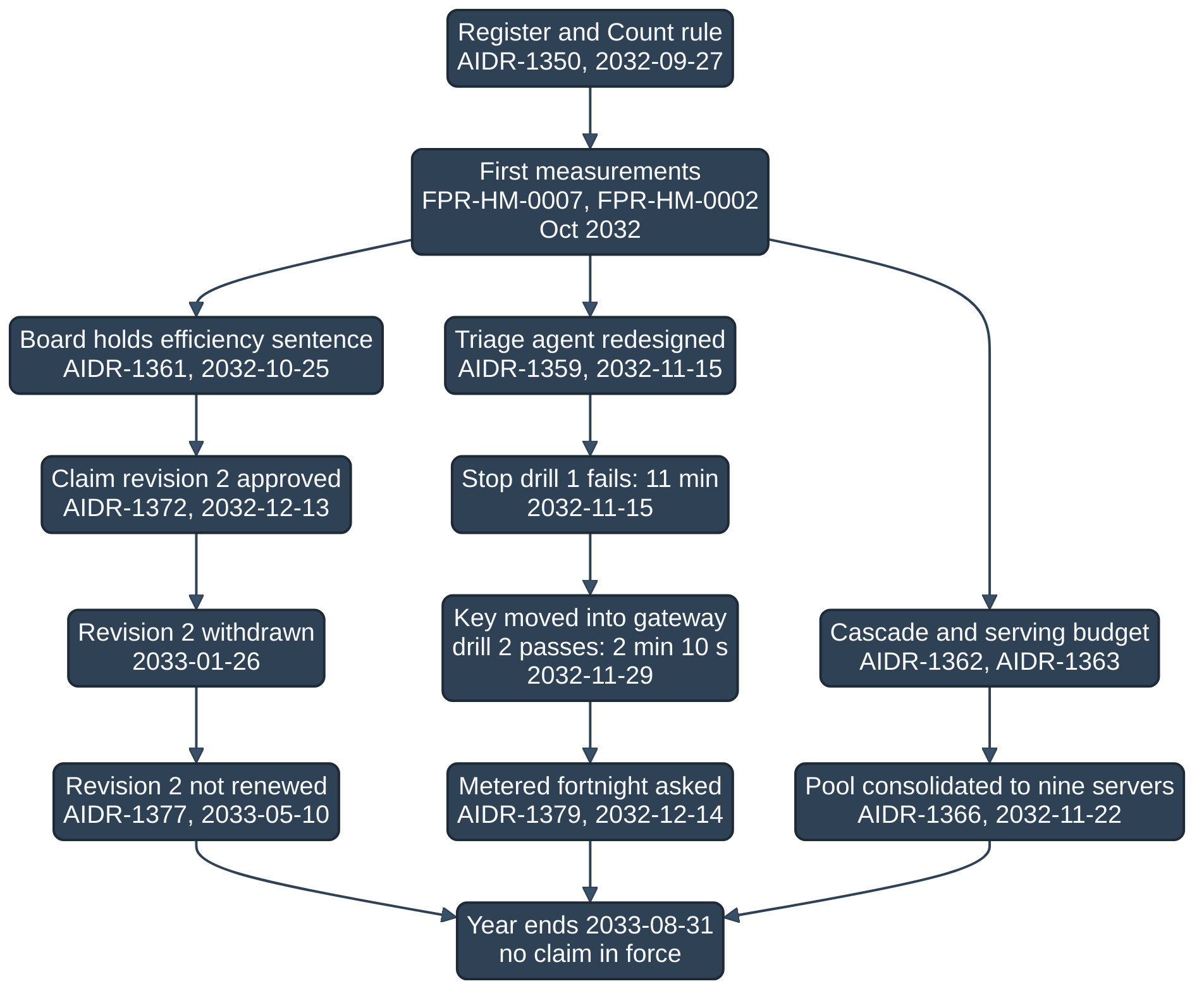
Figure 19A.1: The group's year from the adoption of the register to the end of August 2033. Dates and outcomes are illustrative.
| When | Event |
|---|---|
| 2032-09-27 | AIDR-1350: register and Count rule adopted; the baseline month is September 2032 |
| 2032-10-25 | AIDR-1361: the board holds the efficiency sentence and adopts WCH-HM-0001 |
| 2032-11-15 | AIDR-1359 redesigns the triage agent; AIDR-1369 sets the hosting stance; the first stop drill fails at 11 minutes against a target of 5 |
| 2032-11-22 | AIDR-1364 (stay at retrieval) and AIDR-1366 (consolidate to nine servers) |
| 2032-11-29 and 2032-11-30 | the second drill passes at 2 minutes 10 seconds; AIDR-1371 adopts the regulatory register |
| 2033-01-26 | CLM-HM-0001 revision 2 expires and is withdrawn automatically (Level 3, a person informed) |
| 2033-02-15 | AIDR-1375 declines the doubling of the engineering tool licences; 700 held |
| 2033-03-30 | BEN-HM-0001 delivered a day early, graded as measured, from a comparison of handlers with and without the assistant on a sample of handled claims; the rebound check of the triage agent finds about 140,000 claims and the design holds |
| 2033-05-10 | AIDR-1377: revision 2 not renewed; the second-quarter evidence-age review of the group (the Region held its own on 3 May) changed the benefit rule and the claim rule |
| 2033-05-14 | BEN-HM-0002 expires; the one allowed exception extends it to 2033-06-13 while a new paired sample runs |
| 2033-08-31 | the year ends: no claim in force; the group statement carries AI in Scope 2 and 3 on what support exists, both electricity bases side by side and no efficiency claim |
Figures
| Figure | Value | Note |
|---|---|---|
| Platform racks, September 2032 | 62 MWh IT, 85.6 MWh facility, 30.0 t CO2e location-based; market-based about 0 t if guarantees cover all | about 3.4 million requests across all uses, about 25 Wh and 8.8 g per request at facility boundary including idle capacity |
| Triage agent, bottom-up | 2.3 Wh (1.1 to 4.8), 0.81 g (0.38 to 1.68) per claim; about 325 kWh and 114 kg a month | active accelerator-seconds, facility boundary, measured 2032-10-06 |
| Triage agent, top-down | 6 per cent of 49,800 kWh including idle = 2,988 kWh IT = 21 Wh per claim; 4,123 kWh facility, 1,443 kg, 10.3 g per claim | the gap is about 13 times at one boundary; the likely cause, idle capacity, is not measured; Cloud A burst unmeasured |
HWL-HM-0001 weighed four options for the 12 servers: keep (826 MWh and 289 t a year), consolidate to nine (710 MWh, 249 t; about 116 MWh and 41 t saved with no purchase), replace with four new (365 MWh, 128 t, new embodied 13.7 t, resting on an assumed 2.5-fold gain) and a stepwise mix (489 MWh, 171 t). AIDR-1366 chose consolidation and a benchmark before any order. The hosting sheet HCS-HM-2032-11 (32 accelerators, index Frankfurt = 100) gave Cloud A burst 65, a regional Nordic provider 15, and showed that utilisation of 0.30 raises Cloud A to 95 while 0.80 lowers Frankfurt to 84; the index is illustrative (14, Nordqvist, 2026).
Evidence ages are 90 days for a footprint, 180 for a benefit record, 90 for a drill, 12 months for a supplier and the reporting year at most for a claim; one extension of at most 30 days is allowed (14, Nordqvist, 2026). Between September 2032 and August 2033 the group's counts of its six uses moved from 0 to 3 footprint records inside their age, 0 to 2 benefit records, 0 to 3 drilled stops and 0 to 2 complete rows, with no public claim in force at either end.
Across the usage modes and degrees of delegation
The table sets the modes of the group's uses against the delegation in DLG-HM-ENV-0001 and the volume's ceiling for an agent that can spend resources.
| Element | Mode | Level | Note |
|---|---|---|---|
| Triage agent and IT operations agent | 5 | Level 3 Bounded to measure and recommend, schedule and start a run on a registered trigger inside its limits | the stop at the budget is a gateway control, not a delegated action |
| Provision or scale up compute | 5 | Level 2 Supervised | above the budget Level 1 Assisted |
| Change its own limits, meters, credential or stop path | 5 | Level 0 Advisory | a person only |
| Publish an environmental claim | any | Level 1 Assisted (a draft) | Level 4 never; a named person answers (Dr. Lindner signs, the board approves) |
For the triage agent the profile gives these DLG-HM-ENV-0001 values: start a run on a registered event 3, retry inside the limit 3, spawn a sub-agent 0, schedule 0, provision compute 0, change its own limits, meters or stop 0 and publish a claim 0 (14, Nordqvist, 2026).
What the volume concludes for Hansa Mutual
The volume's Chapter 28 draws its conclusions for the group at the register snapshot of 2032-12-13, and Chapter 29 closes with AIDR-1379. The conclusions are to keep the cascade, the triage redesign and Frankfurt as the base; to measure the burst; to close the benefit records; to write footprint records for the underwriting support and the IT operations agent, because a cost cap is not an energy budget and an agent with write access needs a budget and a drill before a footprint; to finish the facility budget with a drill of SP-SAFE; and to add a memo line on AI to the group statement with both electricity bases, owned by Dr. Lindner. It asks the group to stop the board sentence, the growth of the engineering tools, orders placed before a benchmark and the reading of a supplier's tool as the group's own method. It asks Cloud A for both electricity bases, PUE and WUE and region and hour; the regional provider for measured values before the pilot ends; and the hosted model providers for energy per request with method, or a rung 4 estimate, and notice of a model change (14, Nordqvist, 2026).
The lessons are that an expired narrow claim is no licence to resume the broad one, that "100 per cent renewable and carbon neutral" was arithmetically defensible but misleading, that energy is a safer unit than carbon, and that a clause is not a disclosure (14, Nordqvist, 2026).
Open threads
These are collected in Chapter 27.
- Metering base in September 2032. Chapters 2, 11 and 22 of the volume use platform racks of 62 MWh (85.6 MWh facility, 30.0 t), while Chapters 8 and 18 and
FPR-HM-0002use GPU racks of 49,800 kWh; the difference is not explained, and the 3.4 million requests across all uses are not matched by the volumes in the table, which sum to about 1.5 million. - German PUE limits. Chapter 18 of the volume gives the text in force as 1.5 from 2027 and 1.3 from 2030, and the proposal as 1.4; Chapter 21 gives the proposal as 1.6 and then 1.4, with a margin of 0.02 against the other.
- Stop times and routes. The mandate records a passing drill at 2.2 minutes, the text 2 minutes 10 seconds; the stop of
EBG-HM-0002sits in the claims application, that ofEBG-HM-0001in the gateway and the claims core flag. - The claim record. Revision 2 is dated 2032-12-06 and approved 2032-12-13; Table 27.2 of the volume says "revision 3 needs a production reading", but no revision 3 exists.
- The size of the triage gap. About 13 times in grams at one boundary (Chapter 29), about nine times in Wh at two boundaries (Chapter 20); the cause, probably idle capacity, is not measured.
- The owner of
FPR-HM-0002. Ohlsen in Table 24.6 of the volume, Weiß in the register of Appendix A; the profile names Ohlsen business owner, Weiß producer and Dr. Lindner responsible. - Facts the volume leaves open. Cloud A burst is not measured; water by use in Frankfurt; the district-heating study; the AIDR-1379 reading, which waited for tagged rack meters and had not reported when the year ended; the production-boundary reading for
FPR-HM-0001; Cloud B's basin lookup, so a move there stays blocked; a benefit record for the engineering tools; the UK and Swiss regimes; and the Taxonomy indicators for insurers.
Summary
Our conclusions are three. First, AI Environment gives Hansa Mutual its most completely metered picture: seven footprint records at stated boundaries, two of them for one agent that disagree by about 13 times, a model-scope record that can be counted in full, and a board that learned to hold a sentence until a record exists. Second, the volume's central lesson for the group is about evidence rather than efficiency: a stop counts only from a passed drill, a claim only inside its age and at its boundary, and the one claim approved withdrew itself on the day its evidence expired, so the group ended the year with no claim in force and a register that makes the next one possible. Third, the weak points are those the volume itself names: the unmeasured Cloud A burst, the idle capacity behind the triage gap, the engineering tools without a benefit record, and the dates and boundaries on which the volume's own chapters differ, which Chapter 27 records (14, Nordqvist, 2026).
Sources
- Nordqvist, G. AI Environment: Designing AI for the Greatest Benefit and the Least Environmental Harm in European Enterprises and Public Authorities. (14, Nordqvist, 2026)
- Nordqvist, G. AI Governance: Governing Artificial Intelligence in European Enterprises and Public Authorities. (2, Nordqvist, 2026)