Structure, People and Roles
This chapter gathers how Hansa Mutual is organised and who holds which role, as the series establishes it: the governance bodies, the units, the decision tiers and decision rights, the employee representation, who owns which system, and the named people. The structure is not given whole in any one volume. AI Governance (Book 2) gives the governance bodies and the hub-and-spoke model, and each later volume adds the roles that its own subject needs: security architects in Book 6, managers and the Konzernbetriebsrat in Book 7, the SOC and its leads in Book 8, the purple coordinator in Book 9, incident commanders in Book 10, the executive board by name in Book 11, developers in Book 12 and a builder in Book 13. The chapter says in which book each role first appears. Chapter 24 lists the full cast; this chapter explains the structure that the cast stands in. The structure of the profile is established. Named people, role charters and dates from 2027 onward are illustrative.
The group and its units
Hansa Mutual is a group of national entities with a head office in Hamburg. Germany holds the headquarters, group IT and the shared AI platform; the Netherlands, Sweden, Norway, the United Kingdom and Switzerland have insurance subsidiaries; Poland has a claims and operations service centre (2, Nordqvist, 2026). The model is hub and spoke: platform and enabling teams sit in group IT in Hamburg, use cases are owned in the subsidiaries, each entity has a market liaison to the group platform (compliance liaisons for DE, NL, SE, NO, UK and CH), and the entity owns the consultation of employee representatives, with a rollout gate per entity (2, Nordqvist, 2026).
| Unit | Size | Head or lead | First appears |
|---|---|---|---|
| Group IT | About 1,300 | Group CIO (Rainer Lehmann) | Book 10 (role), Book 11 (name) |
| Group Infrastructure and Cloud | About 420, including the Frankfurt data centre, cloud platform engineering and network, and the FinOps lead (Jan Berger, Book 14) | Not named | Book 10 |
Frankfurt data centre (hansa-dc-frankfurt) |
Not given | Katja Neumann, manager; owns metering and the annual report to the operator duty | Book 14 |
| Group sustainability and CSRD reporting | Not given | Dr. Verena Lindner, reporting to the chief financial officer | Book 14 |
| Group procurement | Not given | Stefan Wiedemann, head of group procurement; holds the clause family HM-PROC-ENV |
Book 14 |
| Group Site Reliability and Incident Management | About 95, Hamburg and the Polish service centre | Tobias Richter | Book 10 |
| Group AI platform team | Not given | Head of the group AI platform (Anja Weiß) | Book 2 (role), Book 10 (name) |
| Group Service Desk | About 140, Hamburg and Poland | Polish head Katarzyna Zielińska | Book 10 |
| Product lines' application operations | About 310 | Not named | Book 10 |
| Group Application Development | About 480 (Hamburg about 260, Poland about 120, Frankfurt about 60, market liaisons about 40) | Dr. Philipp Reinhardt | Book 12 |
| Hansa Forge (internal developer platform) | 24 | Lukas Frey | Book 12 |
| Group SOC | About 38 (22 analysts, 6 senior analysts or investigation leads, a duty manager per shift, a SOC lead) | SOC lead; head of the group SOC | Book 4, Book 8 |
| Red team, threat-intelligence cell, detection engineering | 5, 3 and 4 | Mareike Hartmann (red team), Lena Vogel (detection engineering) | Book 4 (teams), Book 8 and Book 9 (names) |
| Security architecture | 6, in Hamburg, with one post at the Polish service centre | Head of security architecture | Book 6 |
| Group actuarial department | 46 actuaries | Dr. Hannes Ostermann | Book 11 |
| Claims operations | About 3,600 in claims, about 1,400 of them at the Polish service centre | Head of claims operations (group head of claims operations) | Book 2, Book 7 |
Established as profile unless the volume labels it illustrative (2, Nordqvist, 2026) (6, Nordqvist, 2026) (8, Nordqvist, 2026) (10, Nordqvist, 2026) (11, Nordqvist, 2026) (12, Nordqvist, 2026). The staff by function and by country are in Chapter 2. A group CISO sits in Hamburg and reports to the chief risk officer, with a dashed line to the group AI governance board; the UK and Swiss entities have local security officers who report to the group CISO (4, Nordqvist, 2026). Head of operational resilience is a second-line post under the chief risk officer, owns the DORA register and the testing programme, and is independent of operations (10, Nordqvist, 2026). The security architecture team reports to the group CISO and through that line to the chief risk officer, with a dashed line to group enterprise architecture (6, Nordqvist, 2026).
Open thread. The headcounts of AI Operations (Group IT about 1,300, whose listed parts add up to about 965 before the AI platform team) and AI Developer (Group Application Development about 480, reporting to the same CIO) do not reconcile in the volumes. Chapter 27 records the question of whether the 480 are counted inside the 1,300.
Governance bodies
Hansa Mutual is a mutual with a two-tier board. AI Governance gives the AI governance board and the executive board; AI Leader gives the supervisory board and its committees, and names the members of the executive board.
| Body | Composition | Role | First appears |
|---|---|---|---|
| Supervisory board | 20 members: ten chosen by the members' representative assembly, ten employee representatives (illustrative; the volume says the writer verifies the legal basis); chair Dr. Margarethe Linde | Consents to strategy, large investments and Solvency II key functions | Book 11 |
| Audit and risk committee | Chair Dr. Katrin Wendt, the only audit and risk committee chair | Notes the board-pack specification BRD-HM-001 on 2029-11-26; receives the catch rate from the chief risk officer |
Book 11 |
| Personnel committee | Not detailed | A committee of the supervisory board | Book 11 |
| Executive board | Seven: chief executive Friedrich Albrecht (since 2025), CFO Dorothea Keil, CRO Dr. Annette Krämer, chief claims officer Katrin Ohlsen, chief underwriting and actuarial officer (not named), chief HR officer and labour director Marlene Voss, chief information and operations officer and group CIO Rainer Lehmann | The management body for DORA purposes; approves risk appetite; decides at tier 4 | Book 2 (body), Book 11 (members) |
| Risk committee of the executive board | Not detailed | Asked in October 2026 whether AI loss of control belongs in the ORSA; asked in 2028 whether the operations agent's autonomy could grow | Book 5, Book 10 |
| Group AI governance board | Chair: chief risk officer. Voting: COO, CFO, head of claims, head of underwriting, head of AI platform, chief architect. Advisory: DPO, CISO, head of internal audit, head of model risk | Tier 3; sets ceilings; grants every autonomy level above Level 2; its chair must consent | Book 2 |
| Entity boards (NL, SE, NO, UK, CH) | Each subsidiary's board | Keep their own legal duties and are informed of decisions affecting the entity | Book 2 |
| Architecture review board and design authority | The board meets every other week; the design authority is a tier 2 forum inside it, chaired by the chief architect and quorate only with a security architect | Decides on pull requests within five working days | Book 6 |
| Konzernbetriebsrat | Group works council; chair Thomas Brandt since 2022 | Co-determination on systems that can monitor employees | Book 7 |
Established as profile; the supervisory board's composition and all events from 2027 on are illustrative (2, Nordqvist, 2026) (5, Nordqvist, 2026) (6, Nordqvist, 2026) (7, Nordqvist, 2026) (10, Nordqvist, 2026) (11, Nordqvist, 2026).
Open thread. The voting members of the AI governance board in AI Governance include a COO, while the executive board of AI Leader lists no separate COO and gives the group CIO the title chief information and operations officer. The volumes do not say whether the seats are the same. The profile of AI Leader also records that the executive board decided in March 2029 against a chief AI officer (AIDR-1051, filed retrospectively in October 2029) and gave the duties to the AI governance board and the head of the group AI platform, with a review in March 2031 (11, Nordqvist, 2026).
Added by Book 14. The group AI governance board also approves every environmental budget above 2,500 kWh a month, every Mode 5 budget, every facility budget and every environmental claim before it is published; the group CIO decides below the 2,500 kWh line (AIDR-1374, 2032-12-07, illustrative) (14, Nordqvist, 2026).
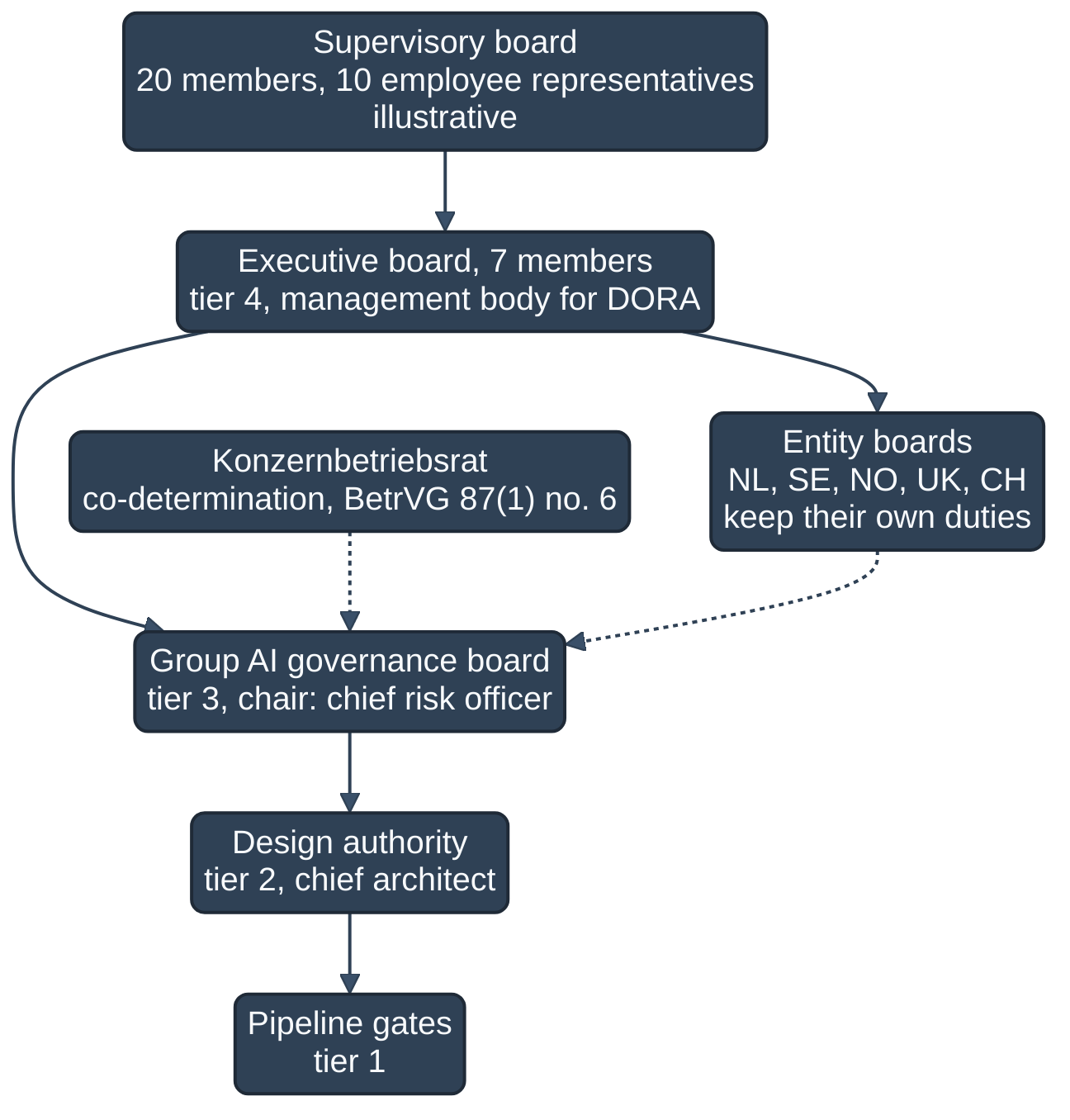
Figure 3.1: The governance chain of Hansa Mutual and the decision tiers that Book 6 numbers one to four. The Konzernbetriebsrat and the entity boards are consulted or informed, not in the chain of approval. Sources: AI Governance, Chapter 13; The Transformed Security Architect, Chapter 4; AI Leader, Chapter 13.
Decision tiers and decision rights
Four tiers carry the decisions about security architecture and agents, and the same numbering recurs in the model of Landscape. Tier 1 is the pipeline gate; tier 2 is the design authority; tier 3 is the group AI governance board; tier 4 is the executive board. The charter files of the security architects record that agents never approve, that routine decisions are delegated to gates, and that four classes are never delegated: lock-in, data residency, operational dependency and agent conflict (6, Nordqvist, 2026). The head of security architecture holds the role ROLE-HM-SA-HEAD, and the AI domain security architect ROLE-HM-SA-AI decides the containment profile for a Mode 5 agent within five days and has a veto over a Mode 5 go-live without a tested stop path and over an agent's autonomy level, which only the group AI governance board can override (6, Nordqvist, 2026).
AI Leader adds a decision rights register, DRR-HM-001, that lists ten decisions. Five of them are described:
| Decision | Holder | Time |
|---|---|---|
DEC-HM-001 Approve an AI system for a consequential use (claims, underwriting, people) |
Business executive of the function the system serves | 10 working days |
DEC-HM-002 Set the AI budget envelope |
CFO | Not stated |
DEC-HM-003 Accept residual risk above tolerance |
CRO | 5 working days |
DEC-HM-004 Stop an AI system or revoke an agent identity |
Holder set: CISO, system owner, agent operator | Immediate, no prior approval |
DEC-HM-005 Change a system's own mandate, oversight or stop path |
CRO | 10 working days; Level 4 never |
Illustrative (11, Nordqvist, 2026). The register makes stop rights an asymmetry: anyone in the holder set can stop, but raising autonomy needs several keys. The same asymmetry is in the earlier volumes. In AI Red Team the group AI governance board sets the ceilings within which the group CISO may raise the SOC agent's level, in AI Blue the board grants every level above Level 2, and in AI Purple it grants any higher level against a stop rule written as a number (4, Nordqvist, 2026) (8, Nordqvist, 2026) (9, Nordqvist, 2026).
Landscape gives each AI use a seat with a tier and a holder, and shows how seats move. In its modelled year 2027 the IT-operations agent's seat rises from tier 2 (head of the group AI platform) to tier 4 (executive board) on 2027-03-31; the claims-triage agent's allocation function rises from tier 2 (head of claims) to tier 3, held by the chief HR officer together with the chief risk officer, on 2027-04-30; and ambient AI, which had no seat, receives one at tier 2 with the head of the group AI platform as holder on 2027-09-30 (15, Nordqvist, 2026). All three moves are illustrative.
Across the degrees of delegation
Decision rights differ by the degree of delegation of the thing that is decided. The table gives the highest degree the volumes record for each class of system, with the body that grants it.
| System class | Highest degree recorded | Granted by | Source |
|---|---|---|---|
| Claims assistant, correspondence assistant, underwriting-support model | Level 1 Assisted | Head of claims or head of underwriting (tier 2) | Landscape |
SOC investigation agent HM-SEC-001 |
Level 3 Bounded for two or three reversible actions; Level 2 Supervised by default | Group AI governance board | AI Red Team, AI Blue |
| IT-operations agent | Level 3 Bounded for restart, certificate renewal and horizontal scaling; Level 2 for configuration change and rollback | Group AI platform and the executive board (tier 4 seat in 2027) | AI Operations, Landscape |
| Claims-triage agent | Level 3 Bounded for routing and allocation, settle a claim at Level 0 |
Head of claims; after 2027-04-30 the CHRO and the CRO together | Landscape, AI Boss |
Executive delegation profile (DLG-HM-EXE-01) |
Level 3 Bounded for two routine classes: trips under EUR 2,500 per trip and board scheduling | Group CIO (DLG-HM-EXE-01), reviewed by the CRO |
AI Leader |
| Coding agents | One Level 3 Bounded class: patch-level dependency updates outside security-critical paths | Group CIO (DLG-HM-DEV-01), reviewed by the CRO |
AI Developer |
Established or illustrative as the volumes label them (4, Nordqvist, 2026) (7, Nordqvist, 2026) (8, Nordqvist, 2026) (10, Nordqvist, 2026) (11, Nordqvist, 2026) (12, Nordqvist, 2026) (15, Nordqvist, 2026). Level 4 is not granted for any irreversible action or for any decision about a named person's work; the Level 4 entries in the volumes are read-only classes such as enriching an alert or reading telemetry.
Stop rights
Who may stop an agent is the decision that the series returns to most often, and the volumes record it differently for the same agents.
| Agent or chain | Who may stop | Source |
|---|---|---|
| Claims-triage agent | Claims duty manager and AI platform on call (kill switch); operator rota at the Polish service centre; the agent operator stops allocation to people within 15 minutes with fallback to a team leader queue; a team leader pauses the team's own allocation; the CHRO stops any management system group-wide within 30 minutes | AI Platform and Security, AI Threat, AI Boss |
| IT-operations agent | On-call engineer and duty manager; incident commander, agent operator and platform engineer on call, without approval; the holder set of DEC-HM-004 |
AI Platform and Security, AI Operations, AI Leader |
SOC investigation agent HM-SEC-001 |
SOC shift lead, group CISO and incident commander; target 120 seconds | AI Red Team, AI Blue |
| Emulation runner of the purple loop | Stop target 60 seconds | AI Purple |
| Pilot agents under the agent-boss pilot | Jana Petersen revokes the agents' identities within 5 minutes; the chain stop path is 10 minutes | AI Boss |
Illustrative (3, Nordqvist, 2026) (4, Nordqvist, 2026) (5, Nordqvist, 2026) (7, Nordqvist, 2026) (9, Nordqvist, 2026) (10, Nordqvist, 2026) (11, Nordqvist, 2026). Open thread. Landscape gives two different holder lists for the same stop record of the IT-operations agent (the SOC duty analyst on call and the system owner in one chapter; the agent operator on call and the head of the group AI platform in another), and it notes that its own post-mortem story adds detail that the profile does not have (15, Nordqvist, 2026). Chapter 27 records it.
Employee representation
Employee representation is part of the structure, not an outside constraint, because the series treats several of Hansa Mutual's systems as ones that register something about people. AI Boss is the volume that sets the arrangements out, and the later volumes add annexes.
| Country | Body | Right that the volumes name |
|---|---|---|
| Germany | Konzernbetriebsrat (chair Thomas Brandt since 2022) and local Betriebsräte | Co-determination on technical equipment that can monitor behaviour or performance, BetrVG §87(1) no. 6; also §§94, 95, 99, 102 |
| Group level | European Works Council | Information and consultation under Directive 2009/38/EC; informed of the TalentLens annex and of a proposed Polish phase |
| Netherlands | Ondernemingsraad | Consent right under WOR art. 27(1)(k) and (l) |
| Sweden | Unions | Consultation and negotiation under MBL §11 |
| Poland | Company union and employee council; the Polish service centre has its own representatives | Monitoring rules set in the collective agreement or work regulations under the Labour Code (the volumes cite Articles 22² and 22³, on workplace monitoring), with staff informed two weeks before |
| Norway | Employee arrangements under the Working Environment Act | Control measures |
| United Kingdom | Staff forum | Consultation |
| Switzerland | Employee committee | Consultation; team-level figures only under the group agreement |
Established as profile (7, Nordqvist, 2026). Landscape has since revised its wording of the German right: co-determination covers technical devices designed to monitor employees' behaviour or performance, and objective suitability is enough whatever the employer's intention; it cites the Betriebsverfassungsgesetz and a 2024 judgment of the Bundesarbeitsgericht (15, Nordqvist, 2026). The same book now says that Sweden has no works council of this kind and that Swedish co-determination runs through the Co-Determination Act (MBL) (15, Nordqvist, 2026). AI Environment names no works agreement of its own: it handles works councils through BetrVG section 87(1) no. 6 and Thomas Brandt (14, Nordqvist, 2026). Open thread (OT-HM-86, OT-HM-88, Chapter 27). Open thread. The profile of AI Boss cites "Article 22³" for Poland while the chapter cites "Articles 22² and 22³" (7, Nordqvist, 2026).
The instrument that carries most of the weight is the group IT agreement KBV-IT-2024, negotiated by Thomas Brandt. Its annex on the claims agent's figures makes individual throughput visible only to the handler and the team leader, forbids ranking lists, bars the figures from being the sole basis for a grade, pay or discipline, sets retention at 13 weeks and requires consent for a new metric or recipient (7, Nordqvist, 2026). Change classes agreed in AIDR-0677 (2026-12-14) make the owner unable to lower a class and the works council able to raise one (7, Nordqvist, 2026). Annexes follow with each volume: a SOC annex KBV-IT-2024-SOC-04 (signed 2027-10-28; at least five people in any group, raw data for 180 days, at most four night shifts in a row) and -SOC-05 on exercises involving staff (8, Nordqvist, 2026) (9, Nordqvist, 2026); an operations annex KBV-IT-2024-OPS (in force 2028-01-01; on-call rotas, measures per team and service and never per named engineer, and agreement before logging engineers' commands) (10, Nordqvist, 2026); an agreement on leadership tools KBV-LDR-2030-01 (signed 2030-02-12; the Konzernbetriebsrat had contested that KBV-IT-2024 need not cover the board-pack assistant, and the executive board chose negotiation over a conciliation award) (11, Nordqvist, 2026); and a draft developer annex KBV-IT-2024-DEV-01, unsigned at the end of its volume's year (12, Nordqvist, 2026). Vibe to Dev calls the works agreement KBV-IT-2024-DE (Hamburg); this is recorded in Chapter 27 as a naming difference (13, Nordqvist, 2026).
Who owns which system
The series gives each system an owner, and the owner changes with the volume's subject. The table gives the owner as each volume states it. Chapter 5 gives the decision records.
| System | Owner as stated | Source |
|---|---|---|
Claims assistant (AIDR-0021) |
Head of claims (tier 2) | Landscape |
Claims-triage agent (AIDR-0024) |
Group head of claims operations (owner of DLG-HM-CTA-01); the motor-claims team in the manifest; from 2027-04-30 the allocation function at CHRO and CRO |
AI Boss, AI Platform and Security, Landscape |
IT-operations agent (AIDR-0027) |
Site-reliability team (owner of the manifest); Head of IT Operations (residual risk); head of group AI platform (seat and, in Book 10, the agent and mandate MND-HM-OPS-001) |
AI Platform and Security, AI Red Team, AI Operations |
SOC investigation agent HM-SEC-001 |
Head of the group SOC; the SOC lead owns the agent and decides on restart | AI Red Team, AI Blue |
| Underwriting-support model | Head of underwriting (tier 2) | Landscape |
TalentLens (recruitment screening) |
CHRO (tier 3); recruiters decide | Landscape, AI Boss |
| Sales-performance score | Group head of sales HR (DLG-HM-SPS-01) |
AI Boss |
| Ambient AI | Head of the group AI platform from 2027-09-30 | Landscape |
Evidence-collection agent HM-EVC-001 |
Head of security architecture | Landscape, The Transformed Security Architect |
| Legacy settlement module (COBOL) | Department "Policy Systems" (OWN-HM-2030-00); Ralf Hauser from 2030-10-21 (OWN-HM-2030-07) |
AI Developer |
claims-doc-check |
Katarzyna Nowak, deputy Marek Zieliński (OWN-HM-2031-0001); sunset 2033-08-31 |
Vibe to Dev |
Footprint record of the claims-triage agent (FPR-HM-0002) |
Anja Weiß as producer and register owner, Dr. Verena Lindner accountable, Katrin Ohlsen as business owner; Book 14's tables name Ohlsen as owner while its Appendix A record names Weiß (OT-HM-84) | AI Environment |
Established as identifiers; dates and holders from 2027 onward are illustrative (3, Nordqvist, 2026) (4, Nordqvist, 2026) (7, Nordqvist, 2026) (8, Nordqvist, 2026) (10, Nordqvist, 2026) (12, Nordqvist, 2026) (13, Nordqvist, 2026) (14, Nordqvist, 2026) (15, Nordqvist, 2026). Open thread. The IT-operations agent is owned, depending on the volume, by the site-reliability team, by the Head of IT Operations, by the head of the group AI platform and by the executive board at tier 4. These are different kinds of ownership (manifest, residual risk, seat, decision right), and the volumes do not reconcile them in one sentence. Chapter 27 records it.
Named people and how the roles grow with the series
Book 2 gave the organisation only roles. The first name appears in AI Boss, and from AI Blue onward each volume adds people. The table lists the people who carry a recurring role, with the volume in which the name first appears; Chapter 24 gives every named person and their appearances.
| Person | Role | First appears |
|---|---|---|
| Jana Petersen | Claims team leader in Hamburg, about 20 handlers; from January 2027 also manager of two pilot agents | Book 7 |
| Thomas Brandt | Chair of the Konzernbetriebsrat since 2022; negotiated KBV-IT-2024 |
Book 7 |
| Piotr Nowak | Shift lead, Polish service centre SOC | Book 8 |
| Lena Vogel | Head of detection engineering, Hamburg | Book 8 |
| Mareike Hartmann | Head of the group red team, Hamburg | Book 9 |
| Sofia Keller | Investigation lead; purple-team coordinator full time from 2028-03-01 (ROLE-HM-SEC-PRP) |
Book 9 |
| Tobias Richter | Head of Group Site Reliability and Incident Management | Book 10 |
| Ewa Kowalczyk | Senior SRE and night incident commander; agent operator at night | Book 10 |
| Katarzyna Zielińska | Head of the service desk in Poland | Book 10 |
| Anja Weiß | Head of the group AI platform | Book 10 |
| Daniel Fischer | Platform engineer on call with delegated patch decisions (AIDR-0554) |
Book 10 |
| Friedrich Albrecht, Dorothea Keil, Dr. Annette Krämer, Katrin Ohlsen, Marlene Voss, Rainer Lehmann | Executive board members | Book 11 |
| Dr. Margarethe Linde, Dr. Katrin Wendt | Chair of the supervisory board; chair of the audit and risk committee | Book 11 |
| Ulf Zimmermann | General counsel, reporting to the chief executive | Book 11 |
| Dr. Hannes Ostermann | Head of the group actuarial department | Book 11 |
| Katrin Wolter | Deputy team leader in Hamburg | Book 11 |
| Dr. Philipp Reinhardt | Head of Group Application Development | Book 12 |
| Lukas Frey | Head of Hansa Forge | Book 12 |
| Stefan Brückner, Ewelina Maj, Ralf Hauser, Aylin Demir | Tech lead, test engineer and oracle owner, senior COBOL engineer, junior developer | Book 12 |
| Katarzyna Nowak, Marek Zieliński | Builder and deputy and oracle owner | Book 13 |
| Dr. Verena Lindner | Head of group sustainability and CSRD reporting, reporting to Dorothea Keil; owns the method for counting AI inside Scope 2 and Scope 3 and signs the claim records; accountable for FPR-HM-0002 (AIDR-1350 delegates the counting to her) |
Book 14 |
| Jan Berger | FinOps lead in Group Infrastructure and Cloud; showback by entity; deputy register owner | Book 14 |
| Katja Neumann | Manager of the Frankfurt data centre; owns its metering and annual reporting; independent check of CLM-HM-0001 on 2032-11-03; can close the racks through the facility power control |
Book 14 |
| Stefan Wiedemann | Head of group procurement; supplier disclosure records and the clause family HM-PROC-ENV |
Book 14 |
| Joanna Kaczmarek | Head of claims operations (as named in Book 13) | Book 13 |
| Tomasz Wrona | Receiving developer in Poland | Book 13 |
| Dr. Sabine Vogel | Group data protection officer | Book 13 |
Illustrative (7, Nordqvist, 2026) (8, Nordqvist, 2026) (9, Nordqvist, 2026) (10, Nordqvist, 2026) (11, Nordqvist, 2026) (12, Nordqvist, 2026) (13, Nordqvist, 2026) (14, Nordqvist, 2026). Four things are worth stating plainly. First, the same role can be anonymous in one volume and named in another: the group CIO and the chief risk officer are unnamed in AI Operations and named in AI Leader, and the volumes note this. Second, name collisions exist and the volumes flag them: three people are called Katrin (Ohlsen, Wendt and Wolter), two Katarzynas (Zielińska and Nowak) and the surnames Zieliński and Zielińska differ by one letter. Third, one person may carry two roles that the volumes treat as separate: Marek Zieliński is both the deputy of the builder and the owner of the independent oracle, which Vibe to Dev calls acceptable now and brittle as builds multiply (13, Nordqvist, 2026). Fourth, vacancies are part of the structure: the security architect post at the Polish service centre is vacant in January 2027 and filled on 2027-06-01, and the roster stays at six (6, Nordqvist, 2026).
Roles by volume
The structure grows by accretion. The table gives, for each volume, the roles and charters it adds.
| Book | Roles and charters first appearing |
|---|---|
| 2 | Chief risk officer, executive board, entity boards, AI governance board and its voting and advisory members, head of claims operations, head of motor claims, head of platform engineering, group FinOps lead, AI platform product owner, head of procurement, incident manager, head of model risk, market liaisons, operator at the Polish centre, oversight officers |
| 3 | Head of AI platform, claims duty manager, AI platform on call, on-call engineer, duty manager, platform lead, CISO, site-reliability team, claims integration team, motor-claims team, model risk management, UK entity chief risk officer |
| 4 | Group CISO, head of the group SOC, SOC shift lead, incident commander, white-team lead, detection engineers, threat-intelligence cell, incident-response lead, Head of IT Operations, entity data protection officer, UK local security officer |
| 5 | Chief actuary, group emerging-risk team, risk committee of the executive board, group CFO, Head of Group Graduate Programme, evaluation engineers, operator rota at the Polish service centre as a stop-path holder |
| 6 | ROLE-HM-SA-HEAD, ROLE-HM-SA-AI, ROLE-HM-SA-PL, identity domain architect, embedded claims architect, chief architect, design authority, MND-HM-01 |
| 7 | Chief HR officer, claims team leader, agent operator on call, group head of sales HR, HR business partner, recruitment lead, ROLE-HM-MGR-01 |
| 8 | SOC lead, ROLE-HM-SOC-01, ROLE-HM-SOC-LEAD, class owners, named analyst per market |
| 9 | Purple-team coordinator (ROLE-HM-SEC-PRP), white-team lead's deputy, closure owners |
| 10 | Incident commander rota of 12, head of operational resilience, ROLE-HM-OPS-001 |
| 11 | ROLE-HM-CEO-01, ROLE-HM-CISO-01, ROLE-HM-TL-01, ROLE-HM-UW-01, board secretary, general counsel |
| 12 | ROLE-HM-DEV-01, ROLE-HM-DEV-02, ROLE-HM-TCL-01, ROLE-HM-QA-01, ROLE-HM-PLT-01, engineering managers, tech leads |
| 13 | Builder, deputy, oracle owner, receiving developer, group data protection officer as named person |
| 14 | Register owner for the platform rows (ROLE-HM-ENV-02, Anja Weiß, deputy Jan Berger), head of group sustainability and CSRD reporting, Frankfurt data-centre manager, FinOps lead as named person; the group AI governance board as claim approver |
Established as identifiers; illustrative as events (2, Nordqvist, 2026) (3, Nordqvist, 2026) (4, Nordqvist, 2026) (5, Nordqvist, 2026) (6, Nordqvist, 2026) (7, Nordqvist, 2026) (8, Nordqvist, 2026) (9, Nordqvist, 2026) (10, Nordqvist, 2026) (11, Nordqvist, 2026) (12, Nordqvist, 2026) (13, Nordqvist, 2026). The charters share a property: each separates what the role decides, what it vetoes and what it may never delegate, and each ties the role to a competence record. The pattern is that a role charter is the structure's unit of change; when a volume adds a function, it adds a charter, a delegation profile and a competence record, and the structure around it changes by one row.
Summary
Hansa Mutual is organised as a hub and spoke: platform and enabling teams in group IT in Hamburg, use cases owned by the national subsidiaries, a Polish service centre and a market liaison per entity. Its governance runs from a supervisory board of twenty, with half employee representatives, through a seven-member executive board that is the management body for DORA (Landscape now words it as the management body that Article 5(2) of DORA makes responsible for the ICT risk management framework, the board of the decision tiers, T4; OT-HM-87), to a group AI governance board chaired by the chief risk officer, a design authority and pipeline gates, numbered as tiers 4 to 1. AI Environment (Book 14) adds a head of group sustainability, a FinOps lead, a data-centre manager and a procurement head by name, and gives the AI governance board approval of every environmental claim and every Mode 5 budget. Stop rights are a recurring structural feature and the volumes record them with differences. Employee representation is part of the structure, carried by the Konzernbetriebsrat and its annexes in Germany and by parallel arrangements in six other markets. Roles are anonymous in Book 2 and receive names from Book 7 on; each volume adds charters and competence records. Four open threads are recorded for Chapter 27: the reconciliation of headcounts, the COO seat, the stop-holder lists and the several kinds of ownership of the IT-operations agent. The dossier's own conclusion is that structure at Hansa Mutual is best read as a set of decision rights with numbers and names attached, not as an organisation chart, because every volume answers the same question: who may stop, who may raise, and who answers.
Sources
- Nordqvist, G. AI Governance: Governing Artificial Intelligence in European Enterprises and Public Authorities. (2, Nordqvist, 2026)
- Nordqvist, G. AI Platform and Security: Building and Securing AI Platforms in European Enterprises and Public Authorities. (3, Nordqvist, 2026)
- Nordqvist, G. AI Red Team: AI as an Active Part of Cyber Defence in European Enterprises and Public Authorities. (4, Nordqvist, 2026)
- Nordqvist, G. AI Threat: Are the Dystopias Coming True? Evidence, Risk and Response for European Enterprises and Public Authorities. (5, Nordqvist, 2026)
- Nordqvist, G. The Transformed Security Architect: Role, Craft and Career in the Age of AI in European Enterprises and Public Authorities. (6, Nordqvist, 2026)
- Nordqvist, G. AI Boss: When Artificial Intelligence Manages People in European Enterprises and Public Authorities. (7, Nordqvist, 2026)
- Nordqvist, G. AI Blue: How Artificial Intelligence Transforms the Blue Team in European Enterprises and Public Authorities. (8, Nordqvist, 2026)
- Nordqvist, G. AI Purple: How Red and Blue Learn Together When AI Joins the Loop in European Enterprises and Public Authorities. (9, Nordqvist, 2026)
- Nordqvist, G. AI Operations: How Artificial Intelligence Transforms IT Operations in European Enterprises and Public Authorities. (10, Nordqvist, 2026)
- Nordqvist, G. AI Leader: How Leadership Roles Change When AI Is Used Broadly in European Enterprises and Public Authorities. (11, Nordqvist, 2026)
- Nordqvist, G. AI Developer: How the Developer Role Changes When AI Is Used Broadly in European Enterprises and Public Authorities. (12, Nordqvist, 2026)
- Nordqvist, G. Vibe to Dev: From Vibe Coding to Professional Software, Step by Step, for Builders Who Are Not Developers, in European Enterprises and Public Authorities. (13, Nordqvist, 2026)
- Nordqvist, G. AI Environment: Designing AI for the Greatest Benefit and the Least Environmental Harm in European Enterprises and Public Authorities. (14, Nordqvist, 2026)
- Nordqvist, G. Landscape: A Fact-Based Picture of Architecture and AI at Work, for Leaders, Architects and Citizens. (15, Nordqvist, 2026)