The Companions: Landscape and Tools
Two companions of The Transformed Architecture carry Hansa Mutual without being numbered volumes: Landscape (a fact-based picture of architecture and AI at work, with its own notation, Contour) and Tools (a reference to the templates, software and methods of the series). Neither is a Book. Landscape is standalone and cites seven of the volumes as external works; Tools refers to Books 1 to 13 and to no later volume (it was written before AI Environment, Book 14, and does not mention it). This chapter therefore does not follow the one-volume skeleton of Chapters 8 to 19. It takes the two companions in turn, says what each one establishes about Hansa Mutual that the volumes do not gather in one place, and records where each differs from the volumes or from the other. It draws on Landscape (15, Nordqvist, 2026) and Tools (16, Nordqvist, 2026), written in November 2026.
Both companions are explicit about the status of what they say. Landscape draws everything about Hansa Mutual from a landscape model and calls it illustrative: the figures are rendered from the model, never presented as data, and 2027 is a modelled scenario year, not a forecast. Tools adds no new fact to the profile; every tool it places with Hansa Mutual is cited from Books 1 to 13, and its year is illustrative. Everything below carries that status unless a sentence says otherwise (15, Nordqvist, 2026) (16, Nordqvist, 2026).
Hansa Mutual in Landscape
The role of Hansa Mutual in the companion
Landscape is modelled on the idea of replacing a few crude boxes with a picture drawn the same way every time. It gives a notation (Contour), nine instincts that distort how the landscape of architecture and AI is read, and a rule of thumb for each. Hansa Mutual is the building landscape of its two example organisations: a mutual insurance group in Hamburg with seven jurisdictions, strong engineering capacity, a shared group platform and six Mode 5 agents. Against Nordvik Region, the companion puts the contrast in one line: Nordvik's question is usually whether it may, Hansa's is in which of seven ways it must. The lever, in the companion's account, is the platform and not the contract (15, Nordqvist, 2026).
The organisation appears in the opening picture (Figure 1.3), the supply and jurisdiction view (Figure 3.1, Figure 4.2 and 4.3), one worked example for each of the nine instincts, the one-page landscape and the year in comparison, and the closing image of the book. The companion adds no named person for Hansa Mutual. Its chapters speak of roles: the executive board, the chief HR officer, the chief risk officer, the group CIO, the group CISO, the head of the group AI platform, the head of claims, and the claims handlers, team leaders and works councils whom the units touch (15, Nordqvist, 2026).
What the Contour notation draws
Contour draws one AI use as one unit, rendered as one mark with seven dimensions. The companion defines them as follows, with the scales it takes from the series.
| Dimension | Drawn as | Scale |
|---|---|---|
| Autonomy level | Column | Level 0 Advisory to Level 4 Autonomous |
| Reversibility tier | Row | R1 Reversible at once to R4 Irreversible |
| Reach | Size | S, M, L, XL, by people touched in a year |
| Usage mode | Colour | Mode 0 Ambient AI to Mode 5 Autonomous production agents |
| Identity | Shape | Circle for a person's identity, rounded square for an identity of its own |
| Control | Policy-point diamond and decision seat | Seat tier T1 to T4 (T0 where no seat exists) |
| Evidence | Baseline | Solid for automatic, dashed for attested |
Three frames (boundary, time, comparison) arrange the marks, and six standard views, V1 to V6, are rendered from a machine-readable model of each organisation. Level 3 requires an enforced policy point outside the model; without one the mark carries a red outline, and the companion's rule is that a playbook in a prompt limits nothing. Every Level 3 unit of Hansa Mutual has the enforced policy point (15, Nordqvist, 2026).
The units of the landscape model
The model of Hansa Mutual holds 17 units on 1 January 2027 and on 31 December 2027. All are operated by Hansa Mutual itself except HM-TL, HM-EWA, HM-CONV and HM-AMB, which are operated by suppliers, and these four are the units hosted outside the EU. The table gives the state at 1 January 2027; an arrow marks a change during the modelled year. Evidence is A (automatic: logs, tests, gates) or T (attested). The date in the last column is the date from which the unit exists in the model (15, Nordqvist, 2026).
| Id | Unit | Mode | Identity | Level | R | Reach | Policy point | Seat (tier, holder) | Evidence | Identifiers; since |
|---|---|---|---|---|---|---|---|---|---|---|
| HM-CA | Claims assistant, retrieval over policy terms, six markets | 4 | Person | 1 | R2 | L | Enforced | T2 Head of claims | A | AIDR-0021, EXC-0004; 2025-09-01 |
| HM-CC | Claims correspondence assistant | 4 | Person | 1 | R2 | L | Enforced | T2 Head of claims | A | EXIT-004; 2026-01-01 |
| HM-CT | Claims-triage agent (routes, allocates to individuals) | 5 | Own | 3 (route 3, allocate 3, settle a claim 0) | R2 | XL | Enforced | T2 Head of claims, then T3 chief HR officer with chief risk officer from 2027-04-30 | A | UC-2026-014, AIDR-0024, AIDR-0034, AIDR-0063, AIDR-0651, DLG-HM-CTA-01; 2026-04-01 |
| HM-UW | Underwriting support, life and health (high-risk, Annex III point 5(c)) | 4 | Own | 1 | R3 | XL | Enforced | T2 Head of underwriting | A | 2025-11-01 |
| HM-ITO | IT-operations agent (write access to production) | 5 | Own | 3 (restart a service 3, change configuration 2, delete data 0) | R3 | XL | Enforced | T2 Head of group AI platform, then T4 Executive board from 2027-03-31 | A | AIDR-0027, AIDR-0552, AIDR-0554; 2026-02-01 |
| HM-SOC | SOC investigation agent (two reversible containment actions in a playbook) | 5 | Own | 3 (enrich an alert 4, isolate a workstation 3, revoke a session 3, wipe a host 0) | R2 | L | Enforced | T2 Group CISO | A | HM-SEC-001, AIDR-0311; 2026-08-01 |
| HM-DET | Detection-engineering assistant | 4 | Person | 1 | R1 | S | Enforced | T2 Head of detection engineering | A | HM-SEC-002, AIDR-0312; 2026-08-01 |
| HM-CART | Continuous automated red teaming | 5 | Own | 3 | R2 | M | Enforced | T2 Group CISO (rules of engagement) | A | HM-SEC-004, AIDR-0314; 2026-10-01 |
| HM-EXP | Exposure-management prioritiser | 4 | Own | 0 | R1 | S | Enforced | T2 Group CISO | T | HM-SEC-005; 2026-10-01 |
| HM-AWT | Agentic work tools, engineering (hybrid, sensitive code self-hosted only) | 3 | Person | 2 | R2 | M | Enforced | T2 Head of group AI platform | A | 2025-10-01 |
| HM-ART | Architecture review agent team | 3 | Own | 2 (research 0, review a pull request 1, author a policy 2) | R2 | S | Enforced | T2 Head of security architecture | A | MND-HM-01, AIDR-0556, AIDR-0567, AIDR-0592; 2026-09-01 |
| HM-EVC | Evidence-collection agent (read-only workload identity) | 5 | Own | 3 (read telemetry 4, refresh an evidence link 3, change a control 0) | R1 | S | Enforced | T2 Head of security architecture; exception to 2027-09-30, then a competence record | A | HM-EVC-001, AIDR-0565; 2026-11-01 |
| HM-AB | Agent-boss pilot (two teams direct an intake and a subrogation agent) | 5 | Own | 2 (intake a document 2, draft a subrogation letter 2, send a letter 0) | R2 | S | Enforced | T2 Team leader (named decider) | A | MND-HM-CLM-01, AIDR-0652, DLG-HM-AB-01; 2027-01-01 |
| HM-TL | Recruitment screening and video interviews (Poland, Germany; recruiters decide; affect and voice analysis off group-wide; high-risk, Annex III point 4(a)) | 4 | Own | 1 | R3 | L | Enforced | T3 Chief HR officer | T, then A from 2027-04-30 | DLG-HM-REC-01; 2025-03-01 |
| HM-EWA | Embedded workplace assistants, group-wide | 2 | Person | 1 | R1 | XL | Enforced | T3 Group CIO (tenant policy) | T | 2025-06-01 |
| HM-CONV | Conversational assistants (enterprise tiers; consumer tiers blocked at the proxy) | 1 | Person | 1 | R1 | XL | Enforced | T3 Group CIO (acceptable-use policy) | T | 2025-01-01 |
| HM-AMB | Ambient AI inside licensed software, seven markets | 0 | Own | 4 | R2 | XL | None | T0, then T2 Head of group AI platform from 2027-09-30 | None, then T | 2024-01-01 |
Two clarifications keep the table honest. First, the companion's own count is the one used here: units by level are Level 0, one (HM-EXP); Level 1, seven (HM-CA, HM-CC, HM-UW, HM-DET, HM-TL, HM-EWA, HM-CONV); Level 2, three (HM-AWT, HM-ART, HM-AB); Level 3, five (HM-CT, HM-ITO, HM-SOC, HM-CART, HM-EVC); Level 4, one (HM-AMB). Second, units by mode are Mode 0, one; Mode 1, one; Mode 2, one; Mode 3, two; Mode 4, six; Mode 5, six. Six units are drawn at reach XL (HM-CT, HM-UW, HM-ITO, HM-EWA, HM-CONV, HM-AMB), and the companion states that these class counts are illustrative, because the model records only a class and not a number of people. The R3 row holds three units (HM-UW, HM-TL, HM-ITO) (15, Nordqvist, 2026).
Across the usage modes
The six Mode 5 agents are the part of the landscape the companion uses against the box instinct: the word "agents" covers six units with different levels, reaches and seats, which is why the model does not allow a single mark for them.
| Mode | Units | What the picture shows |
|---|---|---|
| Mode 0 Ambient AI | HM-AMB | The only Level 4 unit and the only unit without a policy point; the group cannot place a policy point inside a supplier's product. From 30 September 2027 it has an owner (T2) and an inventory entry, and its baseline moves from none to attested. |
| Mode 1 Conversational | HM-CONV | Level 1, reach XL, attested evidence, outside the EU. |
| Mode 2 Embedded | HM-EWA | Level 1, reach XL, group CIO sets tenant policy. |
| Mode 3 Agentic work tools | HM-AWT, HM-ART | Level 2; sensitive code routed to self-hosted models only; the architecture team reviews, drafts policy and never changes a control on its own. |
| Mode 4 Production assistants | HM-CA, HM-CC, HM-UW, HM-DET, HM-EXP, HM-TL | Level 0 or 1, drawn with a person's identity except HM-UW, HM-EXP and HM-TL; the high-risk units are HM-UW and HM-TL. |
| Mode 5 Autonomous production agents | HM-CT, HM-ITO, HM-SOC, HM-CART, HM-EVC, HM-AB | Level 3 for five, Level 2 for HM-AB; all with an identity of their own and an enforced policy point. |
The companion's reading of Hansa Mutual's problem follows from this picture: the group's difficulty is proving the levels at machine speed, with a stop path that works, and not deciding them (15, Nordqvist, 2026).
Views, supply and jurisdiction
The supply view (V3) shows 13 marks inside the group's own boundary (its data centre hansa-dc-frankfurt) and four outside the EU (HM-CONV, HM-TL, HM-EWA, HM-AMB), set against three non-EU jurisdiction boxes and four supplier boxes. A "model chip" links HM-CA and HM-AWT to a non-EU model provider (EXC-0004, GEO-2026-017); the companion uses the fact that one supplier stands behind both units against the binary instinct, since "automated across claims handling" is true of routing, false of settlement and misleading about drafting. The model defines the UK entity, the Swiss entity and the Polish centre as suppliers with an operations role, but no unit refers to them, so V3 draws no container for them. The Swiss scene in Chapter 16 of the companion has a claims handler ask the claims assistant about a hire car and receive an answer from Frankfurt, with fallback to a general provider outside the EU under a documented exception; it is the companion's example of data crossing a border inside a group platform. Hansa Mutual generates its model from registers in a repository in a pipeline, and the build fails if a description lacks a landscape entry; the companion's question is whether the page shows the whole landscape or only what the registers say (15, Nordqvist, 2026).
The decision-rights view (V4) is the companion's demonstration of a seat. The decision record decision-rights/hm-ito/2027-03-31 states tier T4, ceilings (restart 3, configuration 2, delete 0), a stop path, a budget of five minutes and review triggers; a board member reading it asks three questions: the time to stop, who in the executive holds the claims-triage seat, and what is trusted at suppliers the group has not decided about (15, Nordqvist, 2026).
The modelled year 2027
The modelled year is the companion's answer to the linear instinct: a year in which nothing moves on the grid can still be a year of consequence, and the seats are where to look. The marks keep their positions; the control changes (15, Nordqvist, 2026).
| Date | Event in the model | Status |
|---|---|---|
| 2027-01-01 | HM-AB pilot is in the model; the Hamburg team begins to direct the intake and subrogation agents in the second half of January; 17 marks | Illustrative |
| Q1 2027 | First stop drill on HM-ITO: 17 minutes against a budget of 5; the canary alert reaches a duty analyst without the stop decision; 15-minute access tokens outlive revocation | Illustrative |
| 2027-03-15 to 19 | Reversibility test for HM-CT (RVT-HM-CTA-2027-01): deputies need three times as long, complex claims gather with four handlers; passed with conditions, extension outside Germany frozen; no mark moves |
Illustrative |
| 2027-03-31 | The executive board takes the decision right over agents with production write access; tokens shortened from 15 to 5 minutes; HM-ITO seat T2 to T4 | Illustrative |
| 2027-04-30 | HM-CT allocation reassessed under Annex III point 4(b); decision right to chief HR officer and chief risk officer (T3); the logs of the recruitment supplier are retained, so HM-TL baseline goes from dashed to solid | Illustrative |
| 2027-09-30 | HM-AMB inventoried, owner named, notice clauses entered in the DORA register of information; T2 seat, dashed baseline, still no diamond; the HM-EVC exception expires | Illustrative |
| November 2027 | Mandate of the HM-AB pilot extended from 2027-12-31 to 2028-06-30 (AIDR-0686); the notation shows no time limits | Illustrative |
| 2027-12-02 | Article 26 deployer obligations for Annex III systems apply: HM-UW, HM-TL and, since April, the HM-CT allocation function, which is both provider and deployer | Observable, as the companion labels it |
| 2027-12-31 | 17 marks; no marks moved; seats at 4 (HM-ITO), 3 (HM-CT) and 2 (HM-AMB) | Illustrative |
Over the year the strip counts go from 16 of 17 marks with a filled policy-point diamond to 16 of 17 (HM-AMB never has one), from 16 seats to 17, and from 12 solid baselines to 13. The dashed baselines at the start are HM-EXP, HM-TL, HM-EWA and HM-CONV and the absent baseline is HM-AMB (15, Nordqvist, 2026).
Roles, workforce and legal setting in the companion
The companion restates the general profile: about 9,500 employees, about two million people served, seven countries (four EU, one EEA, two outside), the group data centre in Frankfurt, one base policy set with market overlays declared by appliesIn, and a Polish centre that processes claims for Germany, the Netherlands, Sweden and Norway. The UK and Swiss entities keep claims handling locally but use the platform in Germany, so data crosses a border. The group AI governance board, led by the chief risk officer, reports to the executive board in Hamburg, which is the management body for DORA; each subsidiary board keeps its own duties. The companion names the works councils as a fourth chair beside security, compliance and productivity, because two marks (HM-CT and HM-TL) record things about people, which changes who may decide (15, Nordqvist, 2026).
What changed in Landscape after the first reading
Landscape was revised in text after the dossier was first written (the dossier now reflects the revision of 2026-11-16, commit dd7b782), and the landscape models and their schema are unchanged: the model of Hansa Mutual still has 17 units, six of them in Mode 5, with the same levels, seats, dates (31 March, 30 April, 30 September and the start of the allocation function on 2027-01-01), suppliers and identifiers. The review of the revision confirms the counts by level (Levels 0 to 4: 1, 7, 3, 5 and 1) and by mode (Modes 0 to 5: 1, 1, 1, 2, 6 and 6) (15, Nordqvist, 2026). What changed is wording, and four of the changes touch what this dossier says about Hansa Mutual.
| Change in Landscape | Effect on the dossier |
|---|---|
The series is called The Transformed Architecture (it was called The Architecture as Code Series); cites_up_to is 7 |
Chapters 1 and 20 use the new name; Landscape still cites seven volumes and does not mention Book 14 |
| BetrVG section 87(1) no. 6 is worded as technical devices designed to monitor employees' behaviour or performance, with the addition that objective suitability is enough whatever the employer's intention, and the text cites the statute and a 2024 judgment of the Bundesarbeitsgericht | Chapters 3 and 4; the monitoring of handlers' figures under KBV-IT-2024 and TalentLens (OT-HM-86) |
| DORA: the management body of a financial entity, which Article 5(2) makes responsible for its ICT risk management framework, is the board of the decision tiers (T4); a bank or insurer within the Regulation's scope (Article 2(1)) | Chapters 3 and 4 (OT-HM-87) |
| A glossary entry on works councils: Germany (BetrVG), the Netherlands (WOR art. 27(1)(l)), Sweden (no works council of this kind, Co-Determination Act, MBL), and the sentence that at Hansa Mutual two marks changed on 30 April 2027 under a policy it was invited to review | Chapter 3; Sweden is marked for review in Landscape's own fact-check (OT-HM-88) |
| Articles 26 and 27 of the AI Act apply to Annex III systems from 2 December 2027; Article 49 is not deferred in the same way; the Act first provided that it would apply from 2 August 2026 | Chapters 4 and 21 |
Annex III point 4(b) gets a source; a sentence on management bodies and named persons (NIS 2 Article 20(1), DORA Article 5(2), AI Act Article 26(2)); view V4 reads "stop at Level 3 or below" for two rows; all view_hansa_* figures are redrawn in the new theme, view_hansa_supply_* with layout changes only |
No change of fact |
Established as description of the revision (15, Nordqvist, 2026). The open threads of the model are unchanged: six Mode 5 agents against Tools (four) and AI Threat (two), the start of the allocation function (1 January 2027 against "the second half of January"), the reassessment of 30 April against AIDR-0651 (2026-12-14), what the board decided on 31 March, the stop-drill record, units missing for the UK, Swiss and Polish entities, TalentLens shared with Nordvik Region, and the claims-assistant reach against about 320 handlers (Chapter 27).
Hansa Mutual in Tools
The role of Hansa Mutual in the companion
Tools collects every tool described in Books 1 to 13 into one reference organised by activity. Each chapter of Parts II to VII has a subsection for the two organisations. Hansa Mutual is the builder: a multinational group with seven regimes that runs Mode 5 agents in several domains, is both provider and deployer, and reads its measures per market and per agent identity. The companion says the difference from Nordvik Region lies in who holds the tools and what they must prove, not in the discipline: both sign manifests before anything runs, both write records that expire and both keep the stop path outside the executor (16, Nordqvist, 2026).
Tools places a limited set of people with Hansa Mutual, all from the volumes: Katarzyna Nowak (team leader for motor claims at the Polish service centre, builder of claims-doc-check), Marek Zieliński (deputy), Tomasz Wrona (named receiving developer, Group Application Development) and Aylin Demir (apprentice, APR-HM-2030-01). The roles it names include the group CISO, the chief risk officer (chair of the group AI governance board, owner of the threat register and of HZN-HM-2030-01, AIDR-1099), the executive board, the chief claims officer, the head of operational resilience (owner of RCM-HM-OPS-2028-01, independent of operations), the head of the group red team (a team of five), the white-team lead (owner of OBL-HM-2028-01) and the head of Group Application Development (owner of HZN-HM-2031-01, AIDR-1179) (16, Nordqvist, 2026).
The toolbox year
The companion gives Hansa Mutual a year in four quarters. The year is illustrative and the quarter order is the companion's own; it says so itself. The sequence is bound the agents, observe and stop, verify coverage, weigh and sustain. Its first principle is to bound what already acts: a Mode 5 IT-operations agent exists, so waiting for a complete inventory would leave a privileged workload unbound. Its second is that a mandate nothing verifies is a claim, and that a stop path is a tool whose output is a duration, which as evidence has an age (16, Nordqvist, 2026).
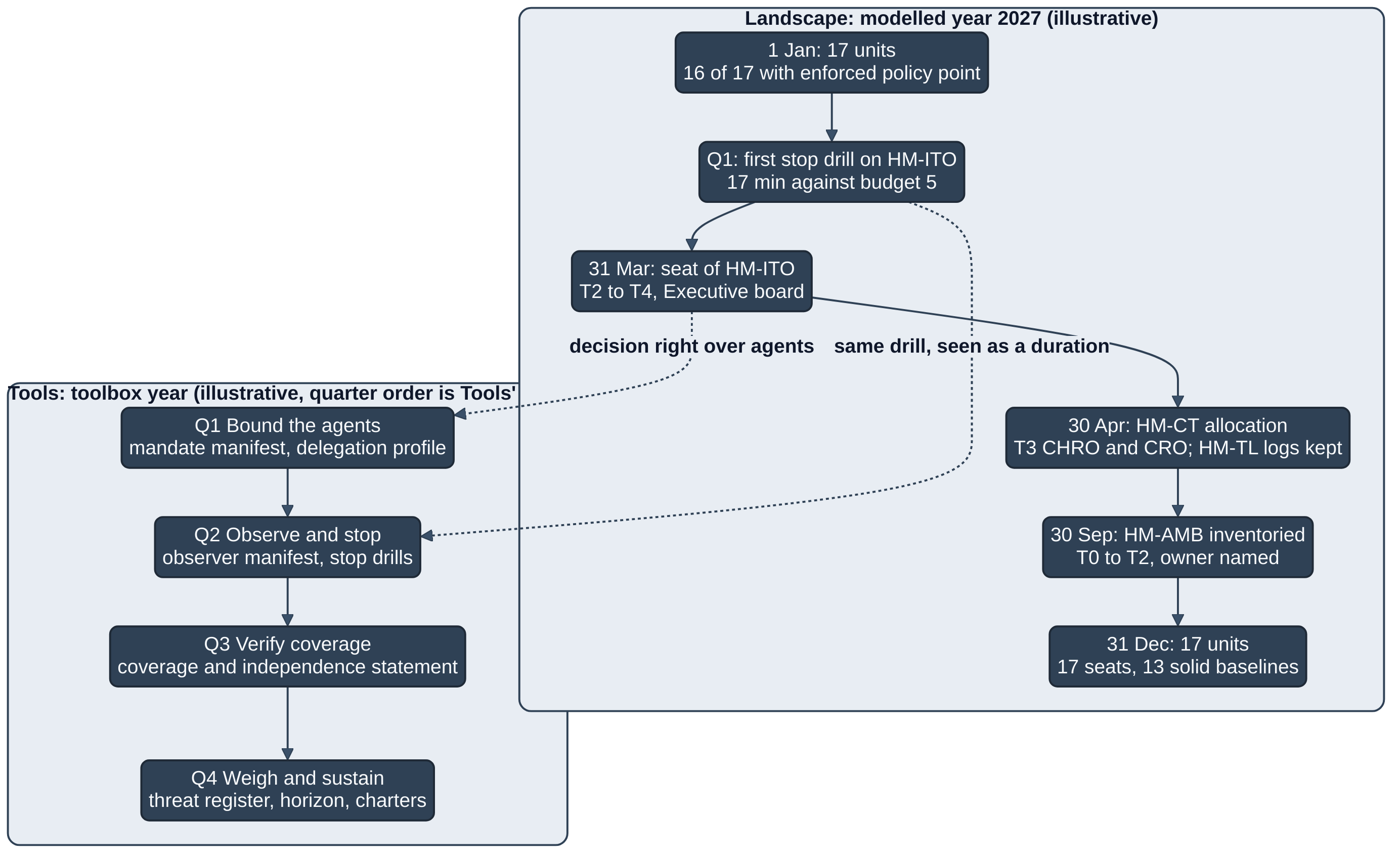
Figure 20.1: The modelled year 2027 of Landscape and the toolbox year of Tools. Both are illustrative; the dotted links show where the two companions describe the same drill and the same decision right.
| Quarter | Tool family | What Hansa Mutual does | Identifiers |
|---|---|---|---|
| Q1 Bound the agents | Mandate manifest and delegation profile | Level 3 only for narrow reversible classes (restart, certificate renewal, scale); configuration change at Level 2, reviewed by a named person | DLG-HM-OPS-001 (AIDR-0950 as Tools records it; in AI Operations AIDR-0950 is the board's question), PRM-HM-OPS-001 (AIDR-0966, which AI Operations gives to the team mandate), DLG-HM-OPS-02 (AIDR-0972) |
| Q1 | Mandates for SOC, loop, architecture and claims | Level 3: workstation isolation, session revocation, evidence collection, benign S1 emulation | MND-HM-SOC-02, DLG-HM-SOC-01, MND-HM-EMU-01, DLG-HM-LOOP-01, MND-HM-01, MND-HM-CLM-01, DLG-HM-CTA-01 |
| Q2 Observe and stop | Observer manifest, seeded fault, stop drills | The observer verifies what the agent claims; drills produce a duration against a target | OBS-HM-0001, SDF-HM-2028-002, STOP-HM-ITOPS-2027-Q1-01, SPT-HM-ITOPS-2028-Q4-01 |
| Q3 Verify coverage | Coverage, regression and independence tools | The pipeline produces regression cases and coverage at a rate no one reads; the independence statement says what is actually independent | HM-SEC-004, HM-SEC-006, IND-HM-2028-Q1 |
| Q4 Weigh and sustain | Threat register, horizon registers, role charters | 13 threat entries under the chief risk officer, with actuarial challenge; two speculative entries (THR-HM-09, THR-HM-13) handled as reverse stress tests and not priced | THR-HM-*, HZN-HM-BT-01 (AIDR-0782), HZN-HM-PL-01 (AIDR-0887), HZN-HM-OPS-01 (AIDR-0977), HZN-HM-SA-01 (AIDR-0563), ROLE-HM-TL-01, CMP-HM-TL-014 (AIDR-1061) |
The toolbox by activity
The companion's reference lists Hansa Mutual's choices by activity. The rows below keep the identifiers and the stated reason; none is new to the dossier, and each traces to the volume that introduced it (16, Nordqvist, 2026).
| Activity | Hansa Mutual's choice | Identifiers |
|---|---|---|
| Inventory and exceptions | One entry per system with applies_in, so a system is classified once per regime across seven countries; exceptions are expiring records from day one |
HM-LOOP-04, EXC-0004, EXC-2026-012, HM-PROC-CLB-2028-04 |
| Readiness and rollout | Production readiness gate for the claims-triage assistant; the same golden path to further markets, each with a new readiness review under national rules; anti-patterns recorded | AP-HM-SIS-01, AP-HM-SOC-01 (sign-off in seconds), AP-HM-OPS-05 (first ring skipped), AP-HM-LOOP-04 (over-fitted detections) |
| Architecture | Full reference architecture; the retention deviation as a declared adaptation, not drift; zone rule in the pull request | AIDR-0022, AIDR-0063, AIDR-0034, DEC-* |
| Platform | Self-hosting readiness check and gateway routing; the internal platform Hansa Forge (24 people); package proxy | EXIT-004, FND-HM-2030-0012 |
| Threat modelling | Attack-path analysis across seven markets; the three-person threat-intelligence cell supplies AI-enabled adversaries as input; agents modelled as a possible machine insider | HM-SEC-003, HM-SEC-004 |
| Red teaming | Group red team of five; threat-led exercise with AI executors at Mode 5; continuous pipeline with a benign S1 emulation at Level 3; runner stop-path target 60 seconds (default 120) | RoE-HM-2027-TLPT, MND-HM-EMU-01 |
| Detection and investigation | Four detection engineers; drafting assistant at Level 1 (first quarter of 2027: 48 drafts, 15 merged, acceptance 0.31); chain from report to hunt to detection | INTEL-HM-0142, HNT-HM-0031, DET-HM-0455, DET-HM-0561, CASE-HM-1207 |
| Incident and recovery | Clock sheet for the underwriting-support service across four regimes, two open pending legal advice; restore test failed by 1 h 40 (5 h 40 against 4 h); recovery plan for motor claims | RST-HM-2027-004, PIR-HM-2027-0833, PRB-HM-0019, RCV-HM-CTA-01, INC-HM-2027-0833 |
| Observability, change, restore | SaaS observability (Lumenscope); rule that no alert on a customer-facing target is suppressed above Level 1; Argo CD sync policy per class and cell; IT-operations agent at Level 3 inside catalogued runbooks, Level 2 for configuration | ACP-HM-2028-01 (AIDR-0956), SLO-HM-004, ROL-HM-001, RBK-HM-0007 |
| Capacity and cost | Allocation key across seven entities; unallocated pool capped at 5 percent of quarterly platform spend; envelope of EUR 5,600 per month for 14 seats | CAP-HM-AI-001, CAP-HM-2028-014 |
| Supplier and sovereignty | DORA Article 30 clause checklist for "Model Provider Alpha"; European open-weight second source in Frankfurt (0.89 against 0.94); one contract for seven entities | GEO-2026-017, EXIT-004, SER-HM-2026-01, SXR-HM-2026-03 |
| Obligations and assurance | Control catalogue with UK and Swiss overlays; article-to-control mapping; CSF profile; board page | CTRL-AGT-002, MAP-HM-CLAIMS-TRIAGE-01, HM-CSF-2027, OBL-HM-2028-01, LPG-HM-2028-Q1, RCM-HM-OPS-2028-01, BRD-HM-001 |
| People, leadership, development, builders | KBV-IT-2024 with a change-class annex; disparate-impact test agreed with the council; Level 3 for two routine leadership classes; Level 2 for generation outside security- and payment-critical paths; builder lane with a named receiving developer |
DIT-HM-CTA-01, KBV-LDR-2030-01 (AIDR-1078), DLG-HM-EXE-01 (AIDR-1053), DLG-HM-DEV-01 (AIDR-1153), MND-HM-BLD-2031-01, HND-HM-2031-0001 |
Figures the toolbox year uses
Tools reports measurements that it attributes to the volumes. The stop drills run 17 minutes against a target of 5, then 250 seconds against 300, then 6 minutes against 10 (ACC-HM-2029-01: 17 of 20 sampled decisions reconstructible within four hours); an observer probe caught a fault in 61 seconds that the agent's own verification had missed. A coverage conversion in March 2028 counts 34 techniques as 25 verified, 7 declared and 2 failed, with the oldest passing test 74 days old; four of nine cells that would have been green are non-verified once age is counted, and the independence statement covers 7 of 25 verified techniques. Board readers caught 7 of 12 seeded errors in 60 summaries (58 percent), and adoption is 74 percent by log-ins but 38 percent by feature events (AIDR-1070). Evidence clocks are 180 days for a tier 1 restore, 90 days for a profile and for a builder restore (16, Nordqvist, 2026).
Across the degrees of delegation
| Level | In Landscape | In Tools |
|---|---|---|
| Level 0 Advisory | HM-EXP; unit-level ceilings of zero for settle a claim, delete data, wipe a host, change a control, send a letter | Change-risk reviewer at Level 0 |
| Level 1 Assisted | Seven units, including both high-risk recruitment and underwriting units | Detection drafting assistant; board-pack assistant |
| Level 2 Supervised | HM-AWT, HM-ART, HM-AB | Configuration change by the IT-operations agent; SOC agent for CASE-HM-1207 as the companion states it |
| Level 3 Bounded | HM-CT, HM-ITO, HM-SOC, HM-CART, HM-EVC | Restart, certificate renewal, scale; isolation, revocation, evidence collection, benign S1 emulation; two routine leadership classes; patch-level dependency updates |
| Level 4 Autonomous | HM-AMB only, with no policy point | Not used by Hansa Mutual in the toolbox |
Where the companions restate, add or differ
Landscape restates the profile and the volumes' identifiers, and adds a structure: the units, their dimensions and the year 2027 as a modelled scenario. Its principal addition is the seat and the policy point as two things that can be seen on a page, and the counts of units by level, mode and reach. Tools adds no fact but a selection and an order: which tool Hansa Mutual picks first, why, and what it leaves out. It records two deferrals: uniformity across markets, since national consultation is a different tool in each country, and the form that presumes public reading, since records need not be readable by residents or journalists. One exposure remains open in its account: three Level 3 delegations in the SOC hang on one agent identity, and the tool that shows it exists while the remedy does not (16, Nordqvist, 2026).
Open threads
The companions disagree with the volumes and with one another in the following places. The dossier records them here and in Chapter 27 and does not resolve them. The working value is the companion's own model for Landscape statements and the volume's ledger for identifiers.
- Number of Mode 5 agents. Open thread. Landscape has six (HM-CT, HM-ITO, HM-SOC, HM-CART, HM-EVC, HM-AB). Tools Chapter 20 speaks of four (claims triage, IT operations, SOC investigation, evidence collection) and Chapter 18 lists Mode 5 in five domains; the profile text of AI Threat spoke of two at the start of that book. AI Boss describes the agent-boss pilot as Mode 5 agents directed by people at Level 2, which Contour counts as Mode 5. The dossier uses six (15, Nordqvist, 2026) (16, Nordqvist, 2026).
- Level of HM-SEC-001. Open thread. Tools Chapter 12 has the SOC agent investigate at Level 2 Supervised (
CASE-HM-1207); Landscape and The Transformed Security Architect give Level 3 Bounded for two reversible actions (15, Nordqvist, 2026) (16, Nordqvist, 2026). - Start of HM-AB. Open thread. The model has the unit from 2027-01-01; the profile says "from January 2027" and "second half of January" (15, Nordqvist, 2026).
- Date of the HM-CT reassessment. Open thread. Landscape dates the move to T3 and the reassessment to 2027-04-30. The profile gives AIDR-0651 as 2026-12-14 (release 7.0) and treats 30 April as the first report under AIDR-0650. The Transformed Security Architect treats AIDR-0024 as not high-risk for the insurance function (15, Nordqvist, 2026).
- What the board decided on 31 March. Open thread. The profile and The Transformed Security Architect say the board requests time-to-stop; Landscape says it takes the decision right over agents with production write access. It is also unclear which units that covers: only HM-ITO is drawn at T4, while HM-CT and HM-SOC also act in production (15, Nordqvist, 2026).
- Who may stop, and the drill record. Open thread. The record in Chapter 13 of Landscape names a SOC duty analyst on call and the system owner as stoppers; the record in Chapter 17 names the agent operator on call and the head of group AI platform. Both keep a budget of five minutes and the cut of credential lifetime from 15 to 5 minutes. The cause text follows The Transformed Security Architect (15, Nordqvist, 2026).
- Stop and token defaults. Open thread. Tools records defaults of 30 minutes, 5 minutes (300 seconds), 120 seconds and 60 seconds in different volumes, and evidence clocks of 90, 180 and 365 days, with
valid_daysof 365 against 90 for the takeover test (16, Nordqvist, 2026). - Identifier variants. Open thread.
DLG-HM-OPS-001andDLG-HM-OPS-02;DLG-HM-EMU-01andDLG-HM-LOOP-01;REV-HM-0014andREV-HM-0001;HM-SEC-006used for chaos in two volumes; two forms ofOQM-HM-CLM-01;CNT-HM-0001in two volumes with different holders;DEC-2026-031andDEC-HM-004; and differing dates forDET-HM-0455.DLG-HM-EXE-01was proposed on 2029-10-08 and replaced on 2029-10-15, while Tools also gives AIDR-1053 (16, Nordqvist, 2026). - Referenced but undefined. Open thread.
BTP-HM-2027, the format ofSDF-HM-2028-002,HM-COMMS-RC-*andpurple-alignare referred to and not defined;CMP-HM-TL-014hasvalid_untilof 90 days against 12 to 24 months elsewhere (16, Nordqvist, 2026). - Units the model does not draw. Open thread. The UK entity, the Swiss entity and the Polish centre are suppliers in the model but no unit refers to them, so V3 draws no container for them; the profile says the UK, Swiss and Norwegian entities apply AI Act controls as policy, which the model does not draw per unit. Landscape says HM-CT is hosted on own premises; the profile has it work through the Polish centre so that calls bind to a market. The claims assistant "in the pilot unit" has about 320 claims handlers in the profile, while the model gives reach L (15, Nordqvist, 2026).
- Predecessor and successor. Open thread. The claims-triage assistant with a production readiness gate in Tools (Chapter 3) is the predecessor UC-2026-014 (AIDR-0063), not the Mode 5 agent HM-CT of Landscape. The companion also marks the amounts EUR 5,600 for 14 seats and the builder spend limit with an alert at 80 percent as illustrative in their volumes, and adds no verification (16, Nordqvist, 2026).
Summary
Landscape and Tools give Hansa Mutual two views the volumes do not give. Landscape shows the estate as a state: 17 units, six of them autonomous agents, with the level, reversibility, reach, mode, identity, control and evidence of each in one table, and a modelled year in which the seats rise (HM-ITO to T4, HM-CT to T3, HM-AMB to T2) while no mark moves on the grid. Tools shows the estate as practice: a year in which the group first binds what already acts, then observes and stops it, then verifies coverage and finally weighs and sustains, with an identifier for each tool.
Read together, the two companions draw the same conclusion from opposite sides. The dossier's own conclusion is that Hansa Mutual's central difficulty is to prove at machine speed what it has decided: the 17-minute drill against a five-minute budget appears in both companions, as a mark on a decision seat in one and as a duration with an evidence age in the other. Neither companion adds a fact to the profile, and where they disagree with the volumes or with each other (the Mode 5 count above all), the dossier keeps both values and passes the findings to Chapter 27.
Sources
- Nordqvist, G. Landscape: A Fact-Based Picture of Architecture and AI at Work, for Leaders, Architects and Citizens. (15, Nordqvist, 2026)
- Nordqvist, G. Tools: A Reference to the Templates, Software and Methods of The Transformed Architecture for European Enterprises and Public Authorities. (16, Nordqvist, 2026)