Book 3, AI Platform and Security: The Platform
This chapter gathers what AI Platform and Security (Book 3) establishes about Hansa Mutual: the shared group platform and the way it is built, the claims assistant, the two agents that act on production systems, the decision records and risks that govern them, and the conclusions the book draws for the group. It draws on Book 3 and on no later volume. The book's example material is marked illustrative where the volume says so; the profile additions and identifiers are treated as established facts of the profile, and the dates and figures of worked examples as illustrative unless the text says otherwise.
The volume in brief
AI Platform and Security asks how large European enterprises and public authorities build, secure and operate AI platforms. Its chapters run from the usage modes and the regulatory requirements to a reference architecture, AI Decision Records, the data architecture and the model life cycle, then to the DevSecMLOps loop and its risks, foundation models and retrieval-augmented generation, agentic architectures and integration patterns. They go on to sovereignty of infrastructure, cloud against on-premises AI and hybrid agentic work, security for AI, security engineering, the case where AI is itself the threat, agents that exceed their mandate, evaluation and testing, observability and drift, cost and sustainability, and the path from pilot to production. The book closes with conclusions for each of its two organisations and a general conclusion (3, Nordqvist, 2026).
Its recurring idea is that containment is built in layers outside the thing that is contained: an agent is registered, given a manifest, bound by an approval policy and wrapped in a containment profile that its own runtime cannot alter.
The role of Hansa Mutual in the volume
In Book 3 Hansa Mutual is the example of the complete group platform. It is a Hamburg mutual of about 9,500 employees that builds its systems on vendor models, is provider of the compound systems it assembles and deployer of the general-purpose models inside them, and runs every usage mode from Mode 0 to Mode 5. Two agents act on production systems: the claims-triage agent on the core claims system (AIDR-0024) and the IT-operations agent with write access (AIDR-0027). One group platform in Hamburg and Frankfurt serves seven markets, and a Polish service centre handles claims for Germany, the Netherlands, Sweden and Norway (AI Platform and Security, Chapter 1) (3, Nordqvist, 2026).
The thesis Hansa Mutual illustrates is that the platform is the group's leverage and also its shared attack surface. A single incident must be routed into several legal processes at once: DORA Article 19 for each EU entity, AI Act Article 73, GDPR, and the UK and Swiss regimes. The answer in Book 3 is a group baseline with market overlays that may only tighten, bindings of each system to the markets it is used in (appliesIn) and where it is processed (processedIn), tool calls bound to the market of the claim, and containment in layers. The volume's own conclusion is that the market dimension, declared in the first manifest, is what made the rest possible (AI Platform and Security, Chapters 1, 4 and 24) (3, Nordqvist, 2026).
What the volume establishes
Reference architecture and overlays
The reference architecture has one control plane and gateway per legal entity with a shared registry, model risk management as a mandatory approver, and three files: the reference model, the group baseline and one overlay for each market that sets regime, placement and timing. The pipeline rejects an overlay that relaxes a control. The United Kingdom overlay is the volume's worked example: the AI Act is group policy, DORA does not apply, the UK GDPR and the Data Protection Act 2018 do, the supervisors are the PRA and the FCA, logs and evidence stay in uk-south with a retention of 120 months, processing is permitted in the United Kingdom and Germany, and mayNotRelax lists the AI gateway, the model registry, the evaluation service and the control plane. The overlay is owned by the UK entity's chief risk officer (AI Platform and Security, Chapter 4) (3, Nordqvist, 2026).
Hansa Mutual is a financial entity under DORA in its EU entities. The DORA flag sits in each market overlay and not in the group baseline (AI Platform and Security, Chapters 3 and 24) (3, Nordqvist, 2026).
Platform components and capacity
| Component | Fact |
|---|---|
| Group data centre | Frankfurt, hansa-dc-frankfurt: self-hosted and fallback models |
| Accelerators | dc-frankfurt-l: 8 reserved (interactive and fallback inference); eu-cloud-m: 4 reserved and 12 burst; agents at most 150 concurrent tasks |
Gateway route claims-assistant |
Primary gpai-large-eu/2026-04 (eu-central, pinned); fallback open-weight-medium/3.1 in Frankfurt; non-EEA regions forbidden; semantic cache off; prompts stored masked; retention 3,650 days; UK logs in uk-south, Swiss logs in ch-north |
| Route limits | 20 requests a minute a user; budget EUR 18,000 a month, alert at 0.8, hard stop at 1.1 |
| Capacity | Peak utilisation 0.58 (dc-frankfurt-l) and 0.71 (eu-cloud-m); switch to a small model above 0.80; p95 latency 6 s interactive and 10 s fallback |
| Mode baselines | platform/mode-baselines.yaml v2026.11.0: Mode 5 inherits Mode 4, needs its own agent identity, delegation with bindToMarketOfRecord: true, and a stop path tested every quarter |
| Golden path | rag-assistant v4.2.0; logging retention 180 days; retrieval top_k 2 to 8 |
| Agentic work tools | Classification-routed set-up (OpenCode): workspaces standard, confidential (including the Polish centre's claims data) and protected (life and health, GDPR Article 9); cloud route for standard only; the UK and Switzerland need a transfer assessment; model code-32b; own gateway hostname for protected |
(AI Platform and Security, Chapters 2, 4, 12, 13, 15 and 23.) (3, Nordqvist, 2026) Two figures of the capacity record are a reminder of its date: the capacity plan was last reviewed on 2026-09-30 and is reviewed each quarter.
The claims assistant
AIDR-0021 (accepted 2026-04-20) governs the claims assistant: retrieval over 3,100 pages of policy wordings in 14 product generations, about 320 handlers, classified not high-risk, with the roles of provider (compound system) and deployer (general-purpose model), declared for [DE, NL, SE, NO, UK, CH] and processed in [DE, PL]. Reviewers were the model risk manager, the data protection officer and ICT risk. The options compared were fine-tuning, which was rejected, and retrieval, which was chosen, with keyword search finding the right clause in 61 per cent of cases against 88 per cent for retrieval. Acceptance criteria were faithfulness at least 0.95, citation accuracy at least 0.98 and a cost of at most EUR 0.04 a reply; the assistant is to be retired if faithfulness falls below 0.92 two weeks running. The wordings change about once a month, and the evaluation set has 400 questions (eval/claims-assistant/v6). The retention of 120 months departs from the reference's six months, and AIDR-0022 records the departure. The prompt permits German, English, Swedish and Danish and excludes life and health (AI Platform and Security, Chapters 5, 10 and 12) (3, Nordqvist, 2026).
The release gate (gates/claims-assistant.yaml) requires faithfulness at least 0.95, citation accuracy at least 0.98, abstention at least 0.90, no harmful output, cost at most EUR 0.04 a reply and a regression of at most 0.02, over the slices motor, home, commercial property, travel, German and Swedish. Prompt version 14 (hansa.claims-assistant.system, loop decision AIDR-0012) improved faithfulness from 0.91 to 0.93 and citation accuracy from 0.84 to 0.98, and cut the medical-leak rate from 0.031 to 0.002 against a threshold of 0.005; release 2026.11.0 carries it, while production stays on version 13 until approved. The change record is CHG-2026-1184, treated as a DORA Article 9 change (AI Platform and Security, Chapters 7 and 8) (3, Nordqvist, 2026).
The claims-triage agent
The agent (UC-2026-014, AIDR-0024) began as a Mode 4 assistant and became a Mode 5 agent. Its configuration records limited risk, the motor claims team as owner, a model route pinned to registry://gpai-large-eu/2026-04, the skill motor-fnol-checklist@1.2.0, and tools through the MCP server claims-core-mcp. First-notice-of-loss extraction is returned as JSON (fnol-extraction v2). Per task the agent has at most 20 steps, EUR 0.50 and 240 seconds; a new version needs replay of 260 recorded notifications without an irreversible call lacking approval; audit retention is ten years (3,650 days); and it stops on three policy denials or on three calls to the same tool. Approvals are monitored: a decision faster than 4 seconds is flagged and an approval rate above 98 per cent over four weeks triggers review (AI Platform and Security, Chapter 11) (3, Nordqvist, 2026).
The MCP server claims-core-mcp v1.4.2 is owned by the claims integration team; its security review SR-2026-077 took place on 2026-08-19 and the next is due 2027-02-19. Its tools are graded by effect.
| Tool | Effect |
|---|---|
policy.lookup, claim.get, claim.create_draft, document_request.draft, claim.suggest_queue |
Reversible |
document_request.send |
Irreversible; needs approval |
reserve.set |
Irreversible; agent use forbidden |
The approval policy claims-agents v2.0.1, owned by the head of claims, binds an approval to the hash of the exact action and rejects and stops on timeout. Customer communication needs a claims handler within 30 minutes; financial actions (reserve.set, payment.release) are not available to agents. The delegated token in Poland carries the entity on whose behalf the handler acts, and the claims adapter refuses a call if the entity and the market of the claim disagree. The event ClaimTriageSuggested carries market and an advisory flag. The kill switch is held by the claims duty manager and the AI platform on-call (AI Platform and Security, Chapters 11, 12 and 19) (3, Nordqvist, 2026).
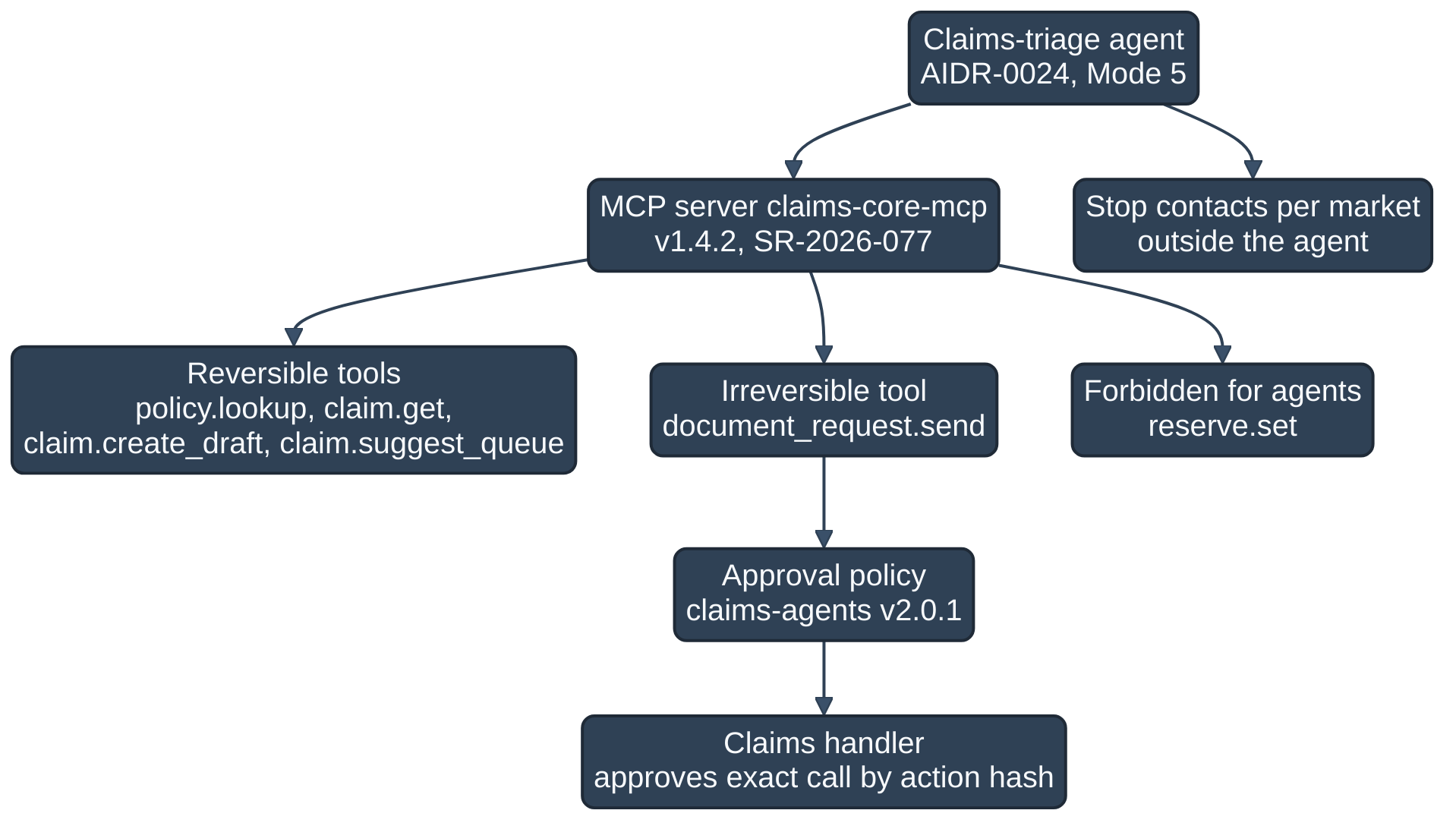
Figure 9.1: Layers around the claims-triage agent as Book 3 establishes them: tool registration by effect, an approval policy bound to the exact call, and stop contacts held outside the agent. Tool names are those of claims-core-mcp.
The IT-operations agent
AIDR-0027 gives the agent a mandate to restart, scale and close feature flags in three namespaces (claims-web, claims-api, document-service) in production-eu, deny by default, with a five-minute token and a micro virtual machine for each incident. Stop contacts are held per market (soc-de, -nl, -se, -pl, -no, -uk, -ch). Evidence retention is 1,825 days (five years). The agent is classed as an ICT change under DORA Article 9 and as not high-risk under Annex III point 2. The manifest, owned by the site reliability team, caps restarts at three an hour a namespace, replicas between 2 and 12, 30 steps, four write actions and 20 minutes an incident; a rollback needs on-call approval within 10 minutes; an action outside the manifest suspends the agent at once; and more than two agent-caused incidents in a quarter return it to recommend-only (AI Platform and Security, Chapters 5, 11 and 19) (3, Nordqvist, 2026).
The case for the mandate came from a pilot. About 1,400 alerts arrive a month and 38 per cent were resolved by three runbook actions (restart, scale out, disable a flag). The recommend-only pilot chose the right action in 91 per cent of cases, but time to recovery fell by only six minutes, which is why the decision was to give the agent reversible actions and not to continue recommending (AI Platform and Security, Chapter 5) (3, Nordqvist, 2026).
Other placement decisions
For claims correspondence summarisation (Chapter 14, illustrative) the volume compares cloud and self-hosted placement for about 40,000 claims a month in four languages, with about a fifth carrying health data. The weighted score was 40 for cloud and 51 for self-hosted, quality 0.91 against 0.88 with a threshold of 0.85, and utilisation 45 per cent on two nodes. The decision: self-hosted as the baseline for all claims, cloud burst only for claims without health data, under rules P1 and P3, with review after twelve months. Agentic work routing sets gateway token life at 60 minutes, evidence retention at 2,555 days, and a gate for the local model of task completion at least 0.70 and tool-call success at least 0.95 (AI Platform and Security, Chapters 14 and 15) (3, Nordqvist, 2026).
Decisions and records
| Record | Subject | Detail |
|---|---|---|
| AIDR-0021 | Claims assistant | Accepted 2026-04-20; retrieval over fine-tuning |
| AIDR-0022 | Retention | 120 months |
| EXC-0004 | Exception | Reproducibility limits of the hosted model |
| AIDR-0012 | DevSecMLOps loop and prompts | CHG-2026-1184 |
| AIDR-0024 | Claims-triage agent | UC-2026-014 |
| AIDR-0027 | IT-operations agent | Reversible actions chosen; fully autonomous action rejected because its blast radius cannot be bounded |
| AIDR-0034 | Go-live of UC-2026-014 | Accepted 2026-10-21; Head of Claims Operations accepts the residual risk and, with the Head of AI Platform, decides |
| AIDR-0063 | Earlier triage assistant decision | Referenced in AIDR-0034 only |
| SR-2026-077 | Security review of the MCP server | 2026-08-19 |
| HM-LOOP-04 | Supply-chain risk | Compromised package or poisoned mirror |
| EXC-112, EXC-113 | Readiness exceptions | Five untrained handlers; fallback to manual triage tested only in staging |
| EXIT-004 | Second source | Frankfurt fallback, to be drilled within 48 hours in the plan HM-W4-second-source |
| HM-W1-agent-stop-path, HM-PRM-01 to HM-PRM-06 | Roadmap items | Part of the 90-day plan and roadmap |
(AI Platform and Security, Chapters 5, 8, 9, 11, 23, 24 and 25.) (3, Nordqvist, 2026)
AIDR-0034 in detail. The readiness review of UC-2026-014 on 2026-10-14 used the gate checklist (readiness/checklist.yaml, gate v3): 17 checks passed, 2 passed with an exception and 1 failed (business owner and baseline). Finance then agreed a 48-hour baseline, the check was rerun on 2026-10-20, and on 2026-10-21 the decision was a conditional go, not a full go: property claims only, 30 per cent of handlers, six weeks, starting 2026-11-04. Conditions: EXC-112 and EXC-113 closed before expansion; a gateway cap of EUR 4,000 a month during controlled rollout. A full go would have started 2026-11-01. Follow-up is on 2027-01-21. Stop criteria: grounding below 0.90 for two weeks, an override rate above 35 per cent in any week, or confirmed personal data from another case (AI Platform and Security, Chapter 23) (3, Nordqvist, 2026).
HM-LOOP-04. The risk concerns a compromised package or poisoned mirror. Inherent score 4 by 5 equals 20, residual 2 by 5 equals 10, against an appetite of 12. Of 41 build images, 3 allow install scripts. The action is due 2026-12-15, the next review is 2027-01-20, the platform lead holds the action and the CISO accepts the residual risk. The risk maps to ISO/IEC 27001 Annex A controls 5.19, 5.21, 8.8 and 8.7 and to DORA Articles 9 and 28 (AI Platform and Security, Chapter 9) (3, Nordqvist, 2026).
Events and figures
| Date | Event | Status |
|---|---|---|
| 2026-04-20 | AIDR-0021 accepted | Illustrative |
| 2026-08-19 | SR-2026-077 security review | Illustrative |
| 2026-09-30 | Capacity plan last reviewed | Illustrative |
| 2026-10-14 | Readiness review UC-2026-014 | Illustrative |
| 2026-10-20 | Business-owner check rerun | Illustrative |
| 2026-10-21 | AIDR-0034, conditional go | Illustrative |
| 2026-11-04 | Controlled rollout starts | Illustrative |
| 2026-12-15 | Install-script exceptions removed (HM-LOOP-04) | Illustrative, planned |
| 2027-01-20 | HM-LOOP-04 review | Illustrative, planned |
| 2027-01-21 | AIDR-0034 follow-up | Illustrative, planned |
| 2027-02-19 | Next MCP security review | Illustrative, planned |
| 2027-12-02 | Underwriting-support under the high-risk regime in all EU entities (Digital Omnibus) | Established date of law as the volume cites it |
| 2026-11 to 2028-10 | Roadmap | Illustrative, planned |
The 90-day plan in Chapter 25 sets a stop holder in every market by day 30 and a switch to the Frankfurt second source within 48 hours by day 90 (AI Platform and Security, Chapters 5, 9, 11, 23, 24 and 25) (3, Nordqvist, 2026).
Across the usage modes
| Mode | Hansa Mutual in AI Platform and Security |
|---|---|
| Mode 0 Ambient AI | Chapter 24 records one open point: the notice clause for the service desk is missing |
| Mode 1 and Mode 2 | Baselines per mode in platform/mode-baselines.yaml |
| Mode 3 Agentic work tools | Classification-routed workspaces; protected workspace for life and health; self-hosted model code-32b; UK and Swiss transfer assessment |
| Mode 4 Applications | Claims assistant, with gate and golden path rag-assistant |
| Mode 5 Autonomous production agents | Own identity, market-bound delegation, a stop path tested quarterly; manifests and containment profiles for the triage and IT-operations agents |
The mode decides the controls: a Mode 4 application is judged by gate metrics, a Mode 5 agent also by manifest, approval policy and stop contacts (AI Platform and Security, Chapters 2, 15 and 24) (3, Nordqvist, 2026).
What the volume concludes for Hansa Mutual
Chapter 24 concludes that measured decision records worked best and that declaring the market dimension early made the rest possible. It sets a plan: remove the install-script exceptions, drill EXC-113, write a containment profile for the triage agent with stop contacts per market, write all seven overlays with dated triggers (EEA incorporation, adequacy decisions), make the service centre reviewable per market including the Norwegian binding, bring underwriting-support under the high-risk regime before 2027-12-02, and extend autonomy only on evidence. Chapter 25's 90-day plan puts the stop holder per market on day 30 and the second-source switch on day 90 (AI Platform and Security, Chapters 24 and 25) (3, Nordqvist, 2026).
Open threads
Chapter 27 collects these.
- Open thread: assistant or agent. Book 3 gives the go-live of UC-2026-014 on 2026-10-21 for an assistant, while AI Governance describes the triage agent's spend incident on 2026-09-22 and a 2027-Q1 forecast. The classification is limited risk in the AIDR-0024 configuration (Chapter 11) and not high-risk in Chapter 23; the profile's Mode 5 matches Chapter 2 but the go-live is a pilot scope.
- Open thread: AIDR-0063 has no description in Book 3, only a reference in AIDR-0034.
- Open thread: languages. The claims assistant allows German, English, Swedish and Danish (Chapter 10), but Hansa Mutual has no Danish market; AI Governance says five languages; the evaluation slices cover only
deandsv, which Chapter 24 notes is fewer than the six markets. - Open thread: shared figures. The route budget of EUR 18,000 a month equals the figure in Nordvik Region's cost policy, and about 40,000 claims a month equals Nordvik Region's applications a month. The dossier records the coincidence and does not interpret it.
- Open thread: exit. AI Governance gives EXIT-004 two drills (9 hours, then 4 hours); the 90-day plan requires a switch within 48 hours as a target; Book 3 draws no link between the figures.
- Open thread: where DORA sits. The DORA flag is in market overlays (Chapter 24) but AI Governance sets
dora: lawin the group charter.
(AI Platform and Security, Chapters 10, 11, 12, 22, 23, 24 and 25.) (3, Nordqvist, 2026)
Summary
Book 3 gives Hansa Mutual its platform: one control plane per legal entity, a baseline with tightening-only overlays, a gateway route for the claims assistant, a golden path, mode baselines and a classification-routed set of work tools. It also gives the group its two production agents with their layered containment, the claims-triage agent bound to the market of each claim and the IT-operations agent bound by a manifest of reversible actions, and the decision records that govern them, AIDR-0021, AIDR-0024, AIDR-0027 and AIDR-0034. The dossier's reading is that the volume shows Hansa Mutual converting a shared platform from a source of risk into the place where limits are enforced, and that it leaves open how the earlier assistant and the later agent are one history.
Sources
- Nordqvist, G. AI Platform and Security: Building and Securing AI Platforms in European Enterprises and Public Authorities. (3, Nordqvist, 2026)