Book 6, The Transformed Security Architect: The Role
This chapter gathers what The Transformed Security Architect (Book 6) establishes about Hansa Mutual: the six-person security architecture team in Hamburg, the review forum that could not keep pace with agents, the decision tiers that replaced it, the charters, mandates and competence records, and the measurements the volume reports over one year. The chapter draws on the volume's profile section, its chapters 1 to 27 and its Appendix A. Where the volume marks an event or a figure as illustrative, so does this chapter; the book is written in November 2026, so everything after that month is illustrative fiction.
The volume in brief
The Transformed Security Architect describes what has happened to the security architect, the person who designs the boundaries, policy points, containment, identity model, evidence chain and stop paths on which the conclusions of the earlier volumes depend. Its thesis is that the role is transformed, not abolished. The volume names four shifts: from documents to code (Shift 1), from gatekeeper to boundary designer (Shift 2), from periodic to continuous verification at machine speed (Shift 3) and from sole author to conductor of an AI team (Shift 4). It covers the craft, the architect's own AI team, the role in the organisation, competence and career, and the experience of the two fictional organisations over a year (6, Nordqvist, 2026).
The role of Hansa Mutual in the volume
Hansa Mutual is the volume's case for a team whose architecture is mostly code but whose forums and review could not keep pace with the agents. In autumn 2026, after the OpenAI and Hugging Face incident of July 2026 and after the threat assessment ATA-HM-2026-01, the executive board asked the group CISO to show how architecture decisions could keep pace with agents already acting in production. Three are named: the claims-triage agent, the IT-operations agent (AIDR-0027) and the SOC investigation agent HM-SEC-001, which holds Level 3 Bounded for two reversible actions. The request is recorded as AIDR-0550 (dated 2026-10-29; first report due 2027-03-31; reviewers the chief risk officer, the head of security architecture and the head of group AI platform; related to AIDR-0027, AIDR-0311 and ATA-HM-2026-01). The reason is simple: a review board that sits every fortnight cannot stand in the way of changes that agents propose daily (The Transformed Security Architect, Chapter 1) (6, Nordqvist, 2026).
The volume's thesis for Hansa Mutual is that the shifts are a sequence to repair, which it calls delegation-first. Shift 2 is a delegation problem. Shift 3 means replacing a fortnightly forum with gates and building machine speed. Shift 4 means keeping review real when agents produce more proposals than six people can read, a failure the volume calls sign-off in seconds. The binding constraints at the end of the year are review capacity among six people and the UK and Swiss regimes. The volume's own phrase for the lesson is that Hansa Mutual had to remove what Nordvik Region never built (The Transformed Security Architect, Chapter 26) (6, Nordqvist, 2026). The volume follows the team across a year in Chapter 25 and gives a 24-month plan in Chapter 26.
What the volume establishes
The team and its counterparts
The group security architecture team has six people in total, all described by role. They are the head of security architecture (ROLE-HM-SA-HEAD), three domain security architects (identity, platform and cloud, and AI), one architect embedded in the claims product line and one at the Polish service centre (ROLE-HM-SA-PL). The team reports to the group CISO, and through the CISO to the chief risk officer, with a dotted line to group enterprise architecture. The domain architect for AI holds ROLE-HM-SA-AI and the competence record CMP-HM-04; the identity domain architect holds CMP-HM-02 (The Transformed Security Architect, Chapters 1 and 16) (6, Nordqvist, 2026).
The volume names two groups of counterparts. The UK and Swiss local security officers own the mappings for those jurisdictions outside the control catalogue until AIDR-0569 brings them in as overlays. Each national entity also has a market liaison to the group platform. Other roles that recur are the chief architect, the head of group AI platform (owner of the threat THR-HM-03), the AI architects, the platform engineer on call, the SOC duty analyst, the agent operator rotas in Hamburg and at the Polish service centre, the duty manager, group legal counsel (reviewer of mappings) and internal audit, which acts as an independent reader and samples the evidence collector. The volume names no individual at Hansa Mutual.
Artefacts at the start
At the start of the year the team holds a Structurizr workspace, hansa-estate; policy as code with a baseline and market overlays at overlays/markets/<country>.yaml; and a control catalogue of about 180 controls (for example CTRL-AGT-002) mapped to ISO/IEC 27001, DORA and the AI Act. Evidence is still partly attested rather than automatic (The Transformed Security Architect, Chapters 1, 5 and 9) (6, Nordqvist, 2026).
Forums and the decision tiers
The review forum at the start is an architecture review board that meets every second week. Inside it sits a design authority, a tier 2 forum led by the chief architect, which is quorate only with a security architect present and decides on pull requests within five working days. Above it are the group AI governance board, chaired by the chief risk officer, and the executive board, which is the management body under DORA (The Transformed Security Architect, Chapters 2 and 17) (6, Nordqvist, 2026).
The volume measures the board over two quarters: 13 sessions and 187 items, of which 131 were routine (70 per cent), 41 exceptions or precedents (22 per cent) and 15 contested (8 per cent), with a median wait of 17 calendar days. After the redesign the design authority has a median of 4 working days against a target of 5, and tier 1 has a median of 9 minutes at merge (The Transformed Security Architect, Chapters 17 and 25) (6, Nordqvist, 2026).
| Tier | Forum | What it decides | Reported measure |
|---|---|---|---|
| 1 | Pipeline gate | Routine classes moved to gates after measurement in shadow | Median 9 minutes at merge |
| 2 | Design authority | Pull requests inside the board; agent-conflict resolution | Median 4 working days (target 5); review median 22 minutes |
| 3 | Group AI governance board | Autonomy levels above those delegated; overrides of the AI security architect's veto | Not reported as a figure |
| 4 | Executive board | Management-body decisions, including funding the second reviewer pool | Quarterly board page |
The tier policy is governance/decision-tiers/security-architecture.yaml, version 2.0.0, approved by the group AI governance board in December 2026 (AIDR-0558); the gates went live on 1 March 2027 and the policy's review is due on 2027-05-31. The charter never delegates four classes of decision: lock-in, data residency, operational dependency and agent conflict. Agents never approve (The Transformed Security Architect, Chapter 4) (6, Nordqvist, 2026).
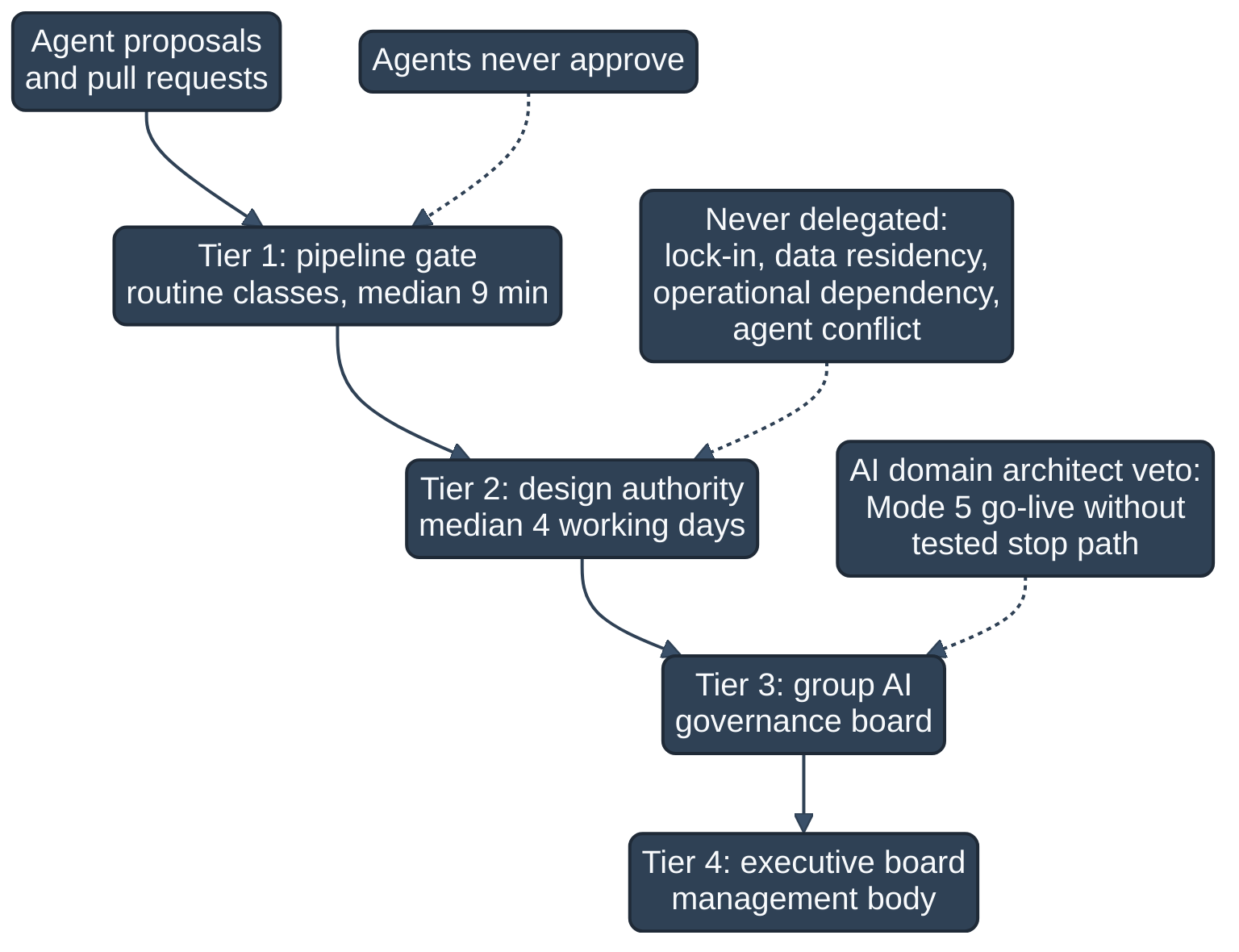
Figure 12.1: Decision tiers of Hansa Mutual's security architecture function, from the tier policy of AIDR-0558 (illustrative, effective 1 March 2027).
Charters, mandates and agents
The role charters are version 2.0.0 in roles/security-architect.yaml. The AI domain architect (ROLE-HM-SA-AI) decides the containment profile for a Mode 5 agent (five days) and conflicts between agent proposals (two days). The role has a veto on a Mode 5 go-live without a tested stop path and on an agent's autonomy level, and only the group AI governance board can override it. Charter tests are in roles/tests/charter-cases-2026.yaml; the decision-rights file is roles/decision-rights.yaml version 2026.4. The charters take effect in Germany from January 2027 and elsewhere after consultation.
The architects' own AI team (reviewer, threat modeller, policy author, evidence collector and researcher) works under the mandate manifest MND-HM-01. Version 3 grants the researcher Level 0, lets the policy author reach Level 2 and gives the evidence collector Level 3 Bounded. The mandate says never: merge to main, approve any pull request, change its own mandate, act at Level 4. The budget is at most 200 tool calls and 30 minutes per task and EUR 6,000 a month, and the mandate expires on 2027-10-31. The evidence-collection agent HM-EVC-001 is a Mode 5 workload with the identity spiffe://hansa.group/architecture/evidence-collector and read-only access. Its refresh procedure EVP-REFRESH-01 updates 40 links per run, its token lifetime was cut from 15 to 5 minutes, revocation is possible within 60 seconds and the identity is reviewed every six months (The Transformed Security Architect, Chapters 8, 12 and 13) (6, Nordqvist, 2026).
The identity domain architect designs the identities of four Mode 5 agents: claims triage, IT operations, SOC investigation and evidence collection. Entries in the control catalogue that the volume uses include CTRL-AGT-002 (tested quarterly by RT-LIB-AGT-004, with max_result_age_days: 100), CTRL-AGT-011 (market-bound tool calls), CTRL-RAG-006, CTRL-NET-004, CTRL-ICT-006, CTRL-ICT-028, CTRL-OVR-002 (AI Act Article 26, status declared), CTRL-SUP-003, CTRL-DAT-004 and CTRL-IR-007.
Works councils, local law and suppliers
Rollout of the review agents per entity waits for works council consultation in Germany and the Netherlands (BetrVG §87(1) no. 6; WOR Article 27(1)(l)) and for union consultation in Sweden (MBL §11). Model providers are ICT third-party providers in the DORA register of information. The Polish service centre runs the claims-triage agent's operation, and the agent's tool calls are bound to the market of the claim. The AI Act and DORA do not apply in the UK and Switzerland; the PRA's operational resilience rules and FINMA (guidance 08/2024, FADP Article 16) are the local mappings, and Norway applies the group's AI Act controls as policy (The Transformed Security Architect, Chapters 4, 6, 18, 20 and 26) (6, Nordqvist, 2026).
Decisions and records
The volume's decision records run from AIDR-0550 to AIDR-0569, with later additions. They are dated where the volume dates them; most 2027 dates are illustrative.
| Record | Subject | Detail |
|---|---|---|
AIDR-0550 |
The board's request | 2026-10-29; first report 2027-03-31 |
AIDR-0551 |
Shift assessment | 2026-11-24; stages 2, 1, 2, 2 |
AIDR-0552 |
Frankfurt artefact mirror | Signed allow-list after the July incident; containment profile CP-HM-ITOPS-01 |
AIDR-0553 |
Credentials | Retire credentials shared between workloads |
AIDR-0554 |
Delegated patch playbook | 2027-01-12; classes exploited-exposed and exploited-internal under HM-PATCH-SLO-2027 (mitigate 24 hours, fix 72 hours) |
AIDR-0555 |
Recovery | RCV-HM-CTA-01 and chaos experiment SCE-RC-007 on platform HM-SEC-006 |
AIDR-0556 |
Review tiers | reviews/protocol/tiers.yaml, critique agent on another model family, cap on open proposals per reviewer, 5 per cent seeded errors |
AIDR-0557 |
Guardrail ownership | The platform team implements the guardrails |
AIDR-0558 |
Tier policy | Version 2.0.0, December 2026 |
AIDR-0559 |
Board report | MGT-HM-2026-Q4 |
AIDR-0560 |
Self-assessment | Anti-pattern AP-HM-SIS-01 |
AIDR-0561 |
Conclusion | PLAN-HM-SA-2027 |
AIDR-0562, AIDR-0563 |
Apprenticeship and the 2028 hiring mix | |
AIDR-0564, AIDR-0565 |
Generated threat models as a gate; Level 3 for HM-EVC-001 |
|
AIDR-0566, AIDR-0567 |
Record terms with employee representatives; design authority approves autonomy levels in MND-HM-01 |
|
AIDR-0568 |
MAP-HM-CLAIMS-TRIAGE-01 |
Claims triage is not high-risk, following AIDR-0024 |
AIDR-0569 |
UK and Swiss overlays | OVL-UK, OVL-CH, catalogue version 4.2.0 |
AIDR-0584, AIDR-0591, AIDR-0592, AIDR-0593 |
External recruitment in Poland; every tier 1 gate reads the exceptions register; MND-HM-01 version 4; lower proposal cap |
The containment profile CP-HM-ITOPS-01 sets a ceiling of production-eu, covers the namespaces claims-web, claims-api and document-service, limits the blast radius to at most three claims services unavailable for at most 20 minutes, and allows at most four write actions. A weekly egress-probe and quarterly SPT-HM-ITOPS-* stop drills test it (The Transformed Security Architect, Chapter 7) (6, Nordqvist, 2026). The review records used as examples are REV-HM-0014 (2026-11-04, pull request 2871, a change to policy/agents/claims_triage/tools.rego adding a Dutch endpoint, reviewed in 41 minutes and approved in round 2) and REV-HM-0001 (2026-11-02, 35 minutes) in Appendix A.
The board page MGT-HM-2026-Q4 carries three decisions: D1, delegated emergency patching for the two remaining segments; D2, restore drills for five services that had none, at a cost of two engineering quarters; and D3, acceptance of the declared status for nine UK and Swiss controls until 2027-03-31 (The Transformed Security Architect, Chapter 19) (6, Nordqvist, 2026). Competence records use SA-CF version 2027.1 with 21 competence identifiers and competence/conditions.yaml, which requires two AI-03 Advanced holders for evidence collectors at Level 3. Hiring uses HP-HM-2027-01 and the exercise IX-HM-2027-01; the horizon register is HZN-HM-SA-01.
Events and figures
Established, as the volume states it: the profile (six people, about 9,500 employees, seven countries, about 180 controls) and the events of 2026. Illustrative: the 2027 sequence and every figure derived from it.
| Date | Event |
|---|---|
| Summer 2026 | Approval time on agent pull requests falls from about 11 minutes to under 30 seconds (median 28 seconds in the anti-pattern entry, rejection rate 0.01, volume 3.0 times) |
| 2026-10-29 | AIDR-0550 |
| 2026-11-02, 11-04 | REV-HM-0001, REV-HM-0014 |
| 2026-11-24 | AIDR-0551 |
| December 2026 | AIDR-0558 approved; first board page (121 verified, 52 declared, 7 failed) |
| December 2026 to February 2027 | Gates run in shadow; 57 of 61 decisions agreed, 4 diverged (3 stricter, 1 let a conditional change through) |
| 2027-01-12 | AIDR-0554; stop drill STOP-HM-ITOPS-2027-Q1-01 |
| January 2027 | The Poland post is vacant |
| 2027-03-01 | Gates live |
| 2027-03-31 | First report; time to stop reported as failed |
| March to May 2027 | Stop drill 17 minutes against 5; first chaos experiment in April aborted by an independent abort (a downstream queue at the Polish service centre was missing as a dependency), repeated and passed; UK and Swiss mappings enter as overlays (7 of 9 verified in May) |
| June 2027 | Re-drill in 4 minutes; Dutch works council consultation complete |
| 2027-06-01 | New Poland architect (CMP-HM-08; PLAN-HM-SA-PL-90, 2027-06-01 to 2027-08-29) |
| July 2027 | A tier 1 gate restores a UK logging setting to baseline despite an approved exception; found six days later (AIDR-0591) |
| August 2027 | Swedish union consultation complete |
| Autumn 2027 | Proposal volume up 40 per cent; tier 2 wait rises from 1 to 3 working days (AIDR-0593) |
| September 2027 | CMP-HM-02 reaches AI-03 Advanced; the apprenticeship begins (junior architect CMP-HM-07) |
| 2027-09-30, 10-31 | Evidence collector exception lapses; MND-HM-01 version 3 expires and version 4 takes over |
| November 2027 | First horizon register (reviewed 2027-11-19; next review 2028-11-17) |
Other figures the volume gives, all illustrative: control status 121/52/7 (verified, declared, failed) in Q4 2026 and 151/25/4 of 180 in Q3 2027; patch velocity median 31 hours and p90 118 hours against a threshold of 72 hours, with p90 61 hours in Q3 2027; containment 11 of 12 (the exception was HM-SEC-001, whose egress was too wide, fixed in January 2027); recoverability 33 of 38 drilled and 29 of 38 within target; tier 2 median review 22 minutes, rejection rate 0.17 and seeded errors caught 0.86. The stop drill had a budget of 5 minutes and a total of 17 (notice 9, decide 2, act 5, verify 1) and failed with findings F-01 to F-03; the re-drill took 4 minutes. Recovery targets are a redeploy in 90 minutes and degraded mode in 15 minutes. Charter conflict resolution fell from 9 to 2 working days, and the IT-operations stop took 22 minutes. Time spent on documents fell from 20 to 5 per cent and on forums from 25 to 8, while code rose from 10 to 17, review of AI drafts from 15 to 30, design from 20 to 25 and exercises from 5 to 10; documents and meetings together fell from 45 to 13 per cent (The Transformed Security Architect, Chapters 19, 24 and 25) (6, Nordqvist, 2026).
Across the degrees of delegation
| Actor | Level in the volume | Limit |
|---|---|---|
Researcher agent (MND-HM-01) |
Level 0 Advisory | Reads and reports |
| Policy author agent | Up to Level 2 Supervised | Proposes changes; cannot merge or approve |
Evidence collector HM-EVC-001 |
Level 3 Bounded, link refresh only | Two AI-03 Advanced architects attached; 40 links per run |
Patch playbook (AIDR-0554) |
Delegated for two exploited classes | Pipeline applies the fix, not an agent; rollback tested within 90 days |
HM-SEC-001 |
Level 3 Bounded for two reversible actions | Containment profile; egress finding fixed January 2027 |
| Any agent | Never Level 4 | Stop path first as a deny rule in the policy decision point |
Mode 5 applies to the four agents whose identities the identity architect designs; Modes 1 to 3 describe the architects' own use of enterprise-tier assistants, with sensitive material only on self-hosted models in hansa-dc-frankfurt (The Transformed Security Architect, Chapters 8, 12 and 13) (6, Nordqvist, 2026).
What the volume concludes for Hansa Mutual
The volume's decisions and lessons are these. Routine classes move to gates after measurement in shadow, and the board becomes the design authority; the lesson is named forum in the wrong place. Sign-off in seconds is treated as a design fault and not a personal one, with review tiers, a critique agent, caps, seeded errors and team-level measures agreed with the works councils and the union. Patch classes are delegated, and the stop path is written first as a deny rule. The evidence collector receives Level 3 Bounded only for link refresh. A gate rule can be wrong at scale, so gates must read the exceptions register (AIDR-0591).
The 24-month plan PLAN-HM-SA-2027 runs from 2027-10-01 to 2029-09-30. M1 is review quality. M2 extends the patch playbook to the remaining segments (p90 of 72 hours or less for two quarters). M3 allows Level 3 Bounded for further reversible drafting and evidence work, only under conditions: M1 verified, a second reviewer pool, and consultation complete in Germany, the Netherlands and Sweden; merging, mandate changes, oracle changes and irreversible actions are excluded. The decisions for the executive board are to fund the second reviewer pool and to accept the Level 3 conditions. The plan is revised if review measures fall below threshold, if the UK or Swiss regime changes or if a new Mode 5 agent arrives. AI Act Article 26 obligations for underwriting apply from 2 December 2027 (The Transformed Security Architect, Chapter 18), and a delegation-reversibility-test is planned for 2028 Q2 (The Transformed Security Architect, Chapters 23, 25 and 26) (6, Nordqvist, 2026).
Open threads
These are recorded for Chapter 27.
- Number of Mode 5 agents. The profile says two autonomous production agents with write access to core systems (claims triage and IT operations). Chapter 8 of the volume lists four Mode 5 agents, and Chapter 25's mode table says three agents drove the redesign.
- Dating of the stop drill. The identifier
STOP-HM-ITOPS-2027-Q1-01places it in the first quarter, Chapter 25 places it in quarter two (March to May), and the first report of 31 March already reports the drill as failed. - Plan metrics. Chapter 26's table speaks of a second reviewer pool and Poland in months 12 to 18 and of four AI-03 architects; the profile says the M5 target is four; the YAML excerpt in Chapter 26 has only M1 to M3.
- Median approval time. 28 seconds (Chapter 24), under 30 seconds (Chapter 14) and seconds (Chapter 25); the anti-pattern entry gives the period as 2026 Q3.
- Mandate version format.
MND-HM-01is written version 3 and 4, not in full semantic form as Nordvik Region's are. - Token lifetime. 15 minutes at the start and 5 minutes after the first drill, yet
CP-HM-ITOPS-01already has per-call credentials of 5 minutes. - Two review records.
REV-HM-0014(41 minutes) andREV-HM-0001(35 minutes) are different examples, not a conflict. - UK logging exception. Handled under the group's data-protection procedure; the outcome is not described.
- Team size. Held at six despite the vacancy; a second Polish architect is conditional on funding and a growing queue (
AIDR-0563).
Summary
Book 6 gives Hansa Mutual a six-person security architecture team whose problem is not a lack of code but a forum that meets every fortnight while agents propose changes daily. The volume's answer is a four-tier decision structure, with gates for routine classes, a design authority for the rest and two boards above, and four classes of decision that are never delegated. It adds charters with vetoes, a mandate for the architects' own agents that forbids merging and approving, and competence records that tie higher agent autonomy to evidenced human skill. The measurements, all illustrative after 2026, show a median board wait of 17 calendar days replaced by 9 minutes at the gate and 4 working days at the design authority, a first stop drill that took 17 minutes against 5, and a rejection rate and seeded-error catch that keep review honest. Review capacity among six people remains the binding constraint, and nine open threads show where the volume disagrees with itself.
Sources
- Nordqvist, G. The Transformed Security Architect: Role, Craft and Career in the Age of AI in European Enterprises and Public Authorities. (6, Nordqvist, 2026)