Hansa Mutual at a Glance
Hansa Mutual is a mutual insurance group headquartered in Hamburg, Germany, operating in seven countries, with about 9,500 employees. This chapter puts the organisation on one page and then widens each line of that page into a table: what it is, what it sells, how large it is, where it operates, what character the series gives it, what its AI estate looks like in outline, which usage modes it uses and which it deliberately does not, and how it differs from the sibling organisation Nordvik Region. The facts come from the profile of the organisation in AI Governance (Book 2), which every later volume reuses, and from the profile additions that Books 3 to 14 and Landscape make. Facts of the profile are established; the figures of worked examples and every event from 2027 onward are illustrative, and the chapter says which is which.
Hansa Mutual on one page
| Line | Fact | Status and source |
|---|---|---|
| What it is | A mutual insurance group headquartered in Hamburg | Established (2, Nordqvist, 2026) |
| Business | Property and casualty, motor, and in some markets life and supplementary health insurance | Established (2, Nordqvist, 2026) |
| People | About 9,500 employees; about 2 million people served | Employees established; people served from the Landscape model (15, Nordqvist, 2026) |
| Footprint | Seven countries: Germany, the Netherlands, Sweden, Poland, Norway, the United Kingdom, Switzerland | Established (2, Nordqvist, 2026) |
| Legal setting | Four EU entities, one EEA entity, two entities outside the EU and EEA | Established (15, Nordqvist, 2026) |
| Platform | One shared AI platform run by group IT in Hamburg, with models self-hosted in the group data centre in Frankfurt (hansa-dc-frankfurt) |
Established (3, Nordqvist, 2026) |
| Capacity and footprint | The group owns its capacity: hansa-dc-frankfurt with about 2.8 MW installed IT power and a power usage effectiveness (PUE) of about 1.38, burst capacity in Cloud A and hosted model providers; the group reports energy and carbon under CSRD, with location-based and market-based figures side by side |
Illustrative, as of 2032 (14, Nordqvist, 2026) |
| Governance | A group AI governance board chaired by the chief risk officer, reporting to the executive board in Hamburg, the management body for DORA | Established (2, Nordqvist, 2026) |
| AI estate | Systems in every usage mode from Mode 0 to Mode 5, and agents that act on production systems | Established in outline; the count varies by volume |
| Character | Commercially driven, strong engineering capacity, shared platform, strict financial-sector supervision | Established (2, Nordqvist, 2026) |
| Leverage | The platform, not the contract; Hansa Mutual mostly builds | Established (2, Nordqvist, 2026) |
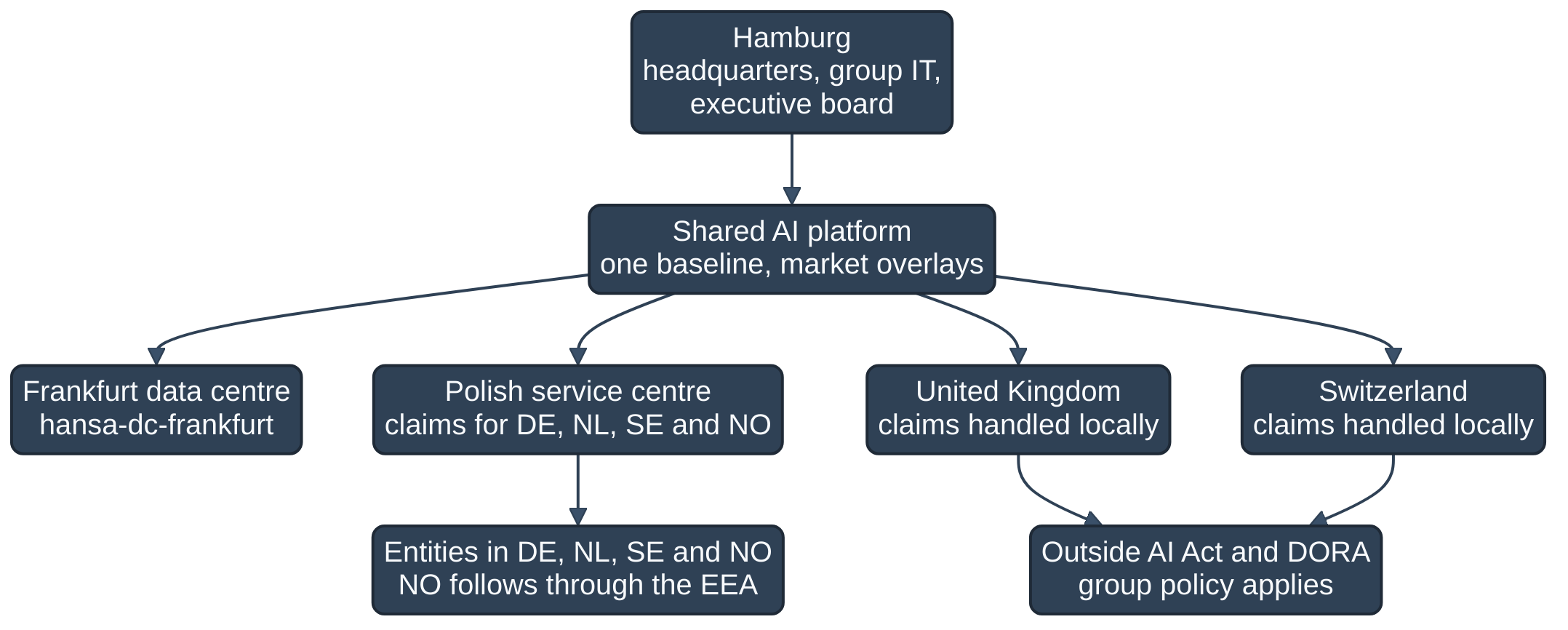
Figure 2.1: The footprint of Hansa Mutual in outline. The shared platform in Hamburg and Frankfurt serves all seven markets; the Polish service centre handles claims for four of them; the UK and Swiss entities handle claims locally but use the platform in Germany. Source: AI Governance, Chapter 1 and the profile of the example organisations.
What Hansa Mutual is and what it sells
Hansa Mutual is a mutual insurance group: it is owned by and run for its members rather than by outside shareholders. The profile gives its lines of business as property and casualty and motor insurance everywhere, and life and supplementary health insurance in some markets (2, Nordqvist, 2026). AI Governance, Chapter 1 describes it as the book's "builder in seven jurisdictions" (2, Nordqvist, 2026). Landscape adds a figure that the other volumes do not need: about 2 million people served, a number the model of the organisation carries and the profile now confirms (15, Nordqvist, 2026).
The mutual form shows in the governance that AI Leader describes in its own year, where the supervisory board has twenty members, half of them chosen by the members' representative assembly and half by the employees, a composition that the volume marks as illustrative and leaves its writer to verify against law (11, Nordqvist, 2026). Chapter 3 of this dossier treats the governance bodies in full.
Size and shape
The profile gives the workforce by function and by country. Both splits sum to the group total, and both come from AI Boss, which needed them to discuss who is managed by what (7, Nordqvist, 2026).
| Function | Approximate staff | Country | Approximate staff |
|---|---|---|---|
| Claims | 3,600 (of whom about 1,400 at the Polish service centre) | Germany | 4,600 |
| Sales and distribution | 2,100 | Poland | 1,700 |
| Underwriting | 1,100 | Netherlands | 900 |
| IT | 1,300 | United Kingdom | 800 |
| Corporate | 1,400 | Sweden | 600 |
| Switzerland | 500 | ||
| Norway | 400 | ||
| Total | 9,500 | Total | 9,500 |
Established, profile of Book 7. Claims handlers work in teams of 15 to 25 under team leaders. Sellers include employed field sellers and contact-centre staff with variable pay (7, Nordqvist, 2026). About 715 of the 9,500 hold a management post, one in 13, in six levels from the chief executive to the staff, with about 28 function and country heads, about 160 department heads and about 520 team leaders (11, Nordqvist, 2026).
Group IT has about 1,300 people under the group CIO. It holds Group Infrastructure and Cloud (about 420), Group Site Reliability and Incident Management (about 95), the Group Service Desk (about 140), the product lines' application operations teams (about 310) and the group AI platform team. Group Application Development, about 480 people, reports to the same CIO (10, Nordqvist, 2026) (12, Nordqvist, 2026). Open thread: the parts of Group IT that AI Operations lists add up to about 965 before the AI platform team, and adding the 480 of AI Developer exceeds the 1,300 of the group total, so the volumes do not say whether Group Application Development is counted inside it (Chapter 27). The security organisation includes a group SOC of about 38 people, a red team of five, a threat-intelligence cell of three and a detection-engineering team of four (8, Nordqvist, 2026), and a team of six security architects (6, Nordqvist, 2026). Chapters 3 and 7 treat these units.
Illustrative figures of scale. AI Operations gives the group IT budget as about EUR 310 million a year, of which about EUR 140 million is infrastructure and operations, about EUR 48 million cloud consumption, about EUR 6.5 million observability, about EUR 11 million managed services and about EUR 9 million AI inference and platform. These are labelled illustrative and carry no evidence age beyond the year of the volume (10, Nordqvist, 2026). AI Environment gives a later figure for the same line: AI inference and platform cost about EUR 17 million in the 12 months to August 2032, against EUR 9 million in the profile of 2028, with the IT-operations agent keeping its cap of EUR 6,000 a month (illustrative) (14, Nordqvist, 2026).
Where it operates
| Country | Entity and role | Position |
|---|---|---|
| Germany | Group headquarters, group IT, the shared AI platform | EU |
| Netherlands | Insurance subsidiary | EU |
| Sweden | Insurance subsidiary | EU |
| Poland | Claims and operations service centre | EU |
| Norway | Insurance subsidiary | EEA, not EU |
| United Kingdom | Insurance subsidiary | Outside the EU and EEA |
| Switzerland | Insurance subsidiary | Outside the EU and EEA |
Established (2, Nordqvist, 2026). The shape of the footprint decides much of what follows. The Polish service centre processes claims for the German, Dutch, Swedish and Norwegian entities; the UK and Swiss entities keep claims handling in their own countries but use the group platform in Germany, so their data crosses a border to reach it (2, Nordqvist, 2026). The group data centre in Frankfurt hosts the self-hosted and fallback models (3, Nordqvist, 2026); AI Environment gives it about 2.8 MW of installed IT power, above the 500 kW threshold at which the group reports as an operator, and puts burst capacity in a cloud region called Cloud A (placeholder: Ireland) and analytics and disaster recovery of claims core in Cloud B (placeholder: France) (14, Nordqvist, 2026). The group platform is funded centrally and charged to the entities, with showback each quarter and chargeback each year (2, Nordqvist, 2026). Chapter 4 sets out what the seven jurisdictions mean in law.
The organisation is built on a hub and spoke: the platform and enabling teams sit in group IT in Hamburg, use cases are owned in the subsidiaries, each entity has a market liaison to the group platform, and employee-representation consultation is owned by the entity, with a rollout gate per entity before a system that can monitor employees goes live there (2, Nordqvist, 2026).
Character, advantages and disadvantages
The profile characterises Hansa Mutual as "commercially driven, with strong engineering capacity and a shared group platform, operating under strict financial-sector supervision" (2, Nordqvist, 2026).
| As the series states it | |
|---|---|
| Advantages | Scale, skills and the ability to build |
| Disadvantages | Legal fragmentation across seven jurisdictions; the tension between one group platform and national requirements; more complex data flows; a larger attack surface from its use of agents |
| Core risks | Legal fragmentation, operational resilience and the agency it grants to agents |
| Leverage | The platform: Hansa Mutual mostly builds, so it carries provider obligations as well as deployer obligations |
| Discipline (Book 5) | Supervisory challenge |
Established (2, Nordqvist, 2026) (5, Nordqvist, 2026). Each later volume restates the thesis for its own subject. In AI Platform and Security the leverage is the platform itself, and the shared platform also gives a shared attack surface (3, Nordqvist, 2026). In AI Red Team Hansa Mutual is the "large, mature defender" whose question is how to give AI bounded autonomy at machine speed while showing supervisors, works councils and its management body that people remain in command (4, Nordqvist, 2026). In AI Operations its distinguishing mark is a deployed Mode 5 agent with write access to production under DORA as direct law, and "Hansa can prove more and has more to lose" (10, Nordqvist, 2026).
The AI estate in a paragraph
Hansa Mutual builds on vendor models and is both provider and deployer of its own systems under the AI Act. Its estate runs from ambient AI in licensed software and approved enterprise chat tools, through embedded workplace assistants and agentic engineering tools, to built applications (a claims assistant, a claims correspondence assistant, an underwriting-support model for life and health, a detection-engineering assistant and others) and to Mode 5 agents that act on production systems: the claims-triage agent on the core claims system and the IT-operations agent with write access to production. The group data centre in Frankfurt hosts the self-hosted models, and a DevSecMLOps loop with prompt records governs change (2, Nordqvist, 2026) (3, Nordqvist, 2026). The underwriting-support model is classed as high-risk under Annex III point 5(c) of the AI Act (2, Nordqvist, 2026). Chapter 5 lists every system with its mode, owner and decision record.
The count of systems depends on the volume and on the date. Landscape draws 17 AI uses for the year 2027, and it counts them by mode as one in Mode 0, one in Mode 1, one in Mode 2, two in Mode 3, six in Mode 4 and six in Mode 5 (15, Nordqvist, 2026). The 17 are illustrative: the model renders them from a file, not from measurement.
Open thread. The number of Mode 5 agents is two in the profile of AI Governance and AI Threat (the claims-triage agent and the IT-operations agent), three in one table of The Transformed Security Architect and four in a list of the same volume (adding the SOC investigation agent and the evidence-collection agent), and six in Landscape (adding continuous automated red teaming and the agent-boss pilot), while Tools names four (2, Nordqvist, 2026) (5, Nordqvist, 2026) (6, Nordqvist, 2026) (15, Nordqvist, 2026) (16, Nordqvist, 2026). The volumes were written in sequence, and each counted the agents that its own subject needed. Chapter 27 records the thread, and the dossier uses the count of the volume it is describing.
Across the usage modes
Hansa Mutual is the series' example of an organisation that uses every mode. The table gives one illustrative anchor per mode; Chapter 5 gives the full register.
| Mode | Hansa Mutual's use | Where established |
|---|---|---|
| Mode 0 Ambient AI | AI in licensed software across seven markets; later inventoried and given an owner (head of the group AI platform) from 2027-09-30 in the Landscape model | AI Governance, Chapter 2; Landscape |
| Mode 1 Conversational assistants | Approved enterprise tiers; consumer endpoints blocked at the proxy | AI Governance, Chapter 2; Landscape |
| Mode 2 Embedded workplace assistants | Assistants embedded in the office suite across the group | AI Governance, Chapter 2 |
| Mode 3 Agentic work tools | Engineering tools in a classification-routed hybrid set-up, where sensitive information is handled only by self-hosted models; a platform engineering team of 14 seats | AI Governance, Chapter 16A; AI Platform and Security, Chapter 15 |
| Mode 4 Built AI applications | Claims assistant (AIDR-0021), claims correspondence assistant, underwriting-support model, detection-engineering assistant | AI Governance, Chapters 4 and 16 |
| Mode 5 Autonomous production agents | Claims-triage agent (AIDR-0024), IT-operations agent (AIDR-0027) and, in later volumes, further agents | AI Governance, Chapter 2; AI Platform and Security, Chapter 5 |
Established or labelled illustrative by the volume cited (2, Nordqvist, 2026) (3, Nordqvist, 2026) (15, Nordqvist, 2026). The profile's contrast with Nordvik Region is that Hansa Mutual "uses every mode and must contain the risk of Modes 3 and 5" (2, Nordqvist, 2026).
What it uses and what it deliberately leaves out
An at-a-glance picture of an organisation that builds would mislead if it showed only what the organisation runs. The volumes establish a set of things Hansa Mutual deliberately does not do, and these are as much part of its profile as its systems.
| Left out | Rule or decision | Source |
|---|---|---|
| Level 4 Autonomous for irreversible or offensive actions | The SOC agent's Level 3 Bounded actions are two reversible ones; Level 4 is never used for offensive or irreversible actions; the delegation schema rejects Level 4 | AI Red Team, Chapter 28; AI Blue, Chapter 4 |
| Agents deciding about named people | Level 4 is never used for a decision about a named person's employment, pay, discipline or access to work; the people class is not delegated | AI Boss, Chapter 32; AI Leader, Chapter 8; AI Developer, Chapter 8 |
| Agent-initiated financial settlement | The tool reserve.set is forbidden for agent use; payment release is not available to agents |
AI Platform and Security, Chapter 11 |
| A response agent in the SOC | Response actions run as playbooks, not through an agent | AI Blue, Chapter 13 |
| A coding agent that merges or deploys by itself | No coding agent merges to a protected branch or deploys on its own | Profile of AI Developer |
| Emotion and affect inference on staff | Affect and voice analysis in recruitment is off group-wide, including in the UK and Switzerland; wellbeing analytics is off pending an agreement | profile of AI Boss; AI Leader, Chapter 21 |
| A chief AI officer | The executive board decided against the post in March 2029 and gave the duties to the group AI governance board and the head of the group AI platform | AI Leader, Chapter 15 |
Established or labelled illustrative by the volume cited (3, Nordqvist, 2026) (4, Nordqvist, 2026) (7, Nordqvist, 2026) (8, Nordqvist, 2026) (11, Nordqvist, 2026) (12, Nordqvist, 2026). The pattern is that Hansa Mutual builds control around the AI it already runs (its own identity, a permission manifest, a stop path outside the runtime) before it considers more autonomy (4, Nordqvist, 2026).
How it differs from Nordvik Region
The series chose its two organisations to differ in the ways that matter for governing AI. The profile states the contrasts directly, and later volumes add to them (2, Nordqvist, 2026).
| Dimension | Nordvik Region | Hansa Mutual |
|---|---|---|
| Kind | A regional public authority in a Nordic EU member state | A mutual insurance group headquartered in Hamburg |
| Size | About 6,000 employees, about 450,000 residents | About 9,500 employees, about 2 million people served |
| Jurisdictions | One, under public law | Seven, under financial-sector supervision |
| Core risk | Residents' rights and public trust | Legal fragmentation, operational resilience and the agency granted to agents |
| Leverage | The contract: it mostly deploys and procures | The platform: it mostly builds and is a provider as well as a deployer |
| Modes | Avoids Modes 3 and 5 for now | Uses every mode and must contain Modes 3 and 5 |
| Engineering capacity | Limited, a small platform team | Strong, with a group platform |
| Advantage | A single legal regime, a clear public mandate, openness | Scale, skills, the ability to build |
| Disadvantage | Limited engineering capacity, long procurement cycles, lock-in | Fragmentation, platform versus national requirements, a larger attack surface |
Established (2, Nordqvist, 2026). Landscape compresses the contrast into one sentence: Nordvik Region's question is usually "may we", and Hansa Mutual's is "in which of seven ways must we" (15, Nordqvist, 2026). The sibling dossier Nordvik Region gathers the other half of the pair.
Status of the facts on this page
The page rests on three kinds of fact. The profile (headcounts, footprint, lines of business, character, governance) is established. The systems and their decision records are established as identifiers; their dates and figures are illustrative where the volume says so. The narrated years after 2026 are fiction written in November 2026, so every statement of the form "in 2029 the organisation did X" is an illustration of what a response could look like, not a record. Chapter 23 gives the figures and their evidence age, and Chapter 21 the chronology.
Summary
Hansa Mutual is a mutual insurance group in Hamburg with about 9,500 employees in seven countries, four EU, one EEA and two outside the EU and EEA, selling property and casualty, motor and, in some markets, life and supplementary health insurance. It is characterised as commercially driven, strong in engineering, run on a shared group platform and strictly supervised. Its advantage is the ability to build; its disadvantages are legal fragmentation, a larger attack surface and the tension between one platform and national rules. It uses every usage mode and runs Mode 5 agents on production systems, and it leaves out, on stated rules, Level 4 for irreversible or personal decisions, agent-initiated settlement, a merging coding agent, emotion inference on staff and a chief AI officer. The count of its Mode 5 agents differs from volume to volume and is recorded as an open thread. The dossier's own conclusion from this chapter is that Hansa Mutual is best read as the series' case for control at scale: its leverage and its risk are the same platform, and every later volume tests how much autonomy that platform can bear.
Sources
- Nordqvist, G. AI Governance: Governing Artificial Intelligence in European Enterprises and Public Authorities. (2, Nordqvist, 2026)
- Nordqvist, G. AI Platform and Security: Building and Securing AI Platforms in European Enterprises and Public Authorities. (3, Nordqvist, 2026)
- Nordqvist, G. AI Red Team: AI as an Active Part of Cyber Defence in European Enterprises and Public Authorities. (4, Nordqvist, 2026)
- Nordqvist, G. AI Threat: Are the Dystopias Coming True? Evidence, Risk and Response for European Enterprises and Public Authorities. (5, Nordqvist, 2026)
- Nordqvist, G. The Transformed Security Architect: Role, Craft and Career in the Age of AI in European Enterprises and Public Authorities. (6, Nordqvist, 2026)
- Nordqvist, G. AI Boss: When Artificial Intelligence Manages People in European Enterprises and Public Authorities. (7, Nordqvist, 2026)
- Nordqvist, G. AI Blue: How Artificial Intelligence Transforms the Blue Team in European Enterprises and Public Authorities. (8, Nordqvist, 2026)
- Nordqvist, G. AI Operations: How Artificial Intelligence Transforms IT Operations in European Enterprises and Public Authorities. (10, Nordqvist, 2026)
- Nordqvist, G. AI Leader: How Leadership Roles Change When AI Is Used Broadly in European Enterprises and Public Authorities. (11, Nordqvist, 2026)
- Nordqvist, G. AI Developer: How the Developer Role Changes When AI Is Used Broadly in European Enterprises and Public Authorities. (12, Nordqvist, 2026)
- Nordqvist, G. AI Environment: Designing AI for the Greatest Benefit and the Least Environmental Harm in European Enterprises and Public Authorities. (14, Nordqvist, 2026)
- Nordqvist, G. Landscape: A Fact-Based Picture of Architecture and AI at Work, for Leaders, Architects and Citizens. (15, Nordqvist, 2026)
- Nordqvist, G. Tools: A Reference to the Templates, Software and Methods of The Transformed Architecture for European Enterprises and Public Authorities. (16, Nordqvist, 2026)