Book 2, AI Governance: The Foundations
This chapter gathers what AI Governance (Book 2 of The Transformed Architecture) establishes about Hansa Mutual: the role the group plays in the book, the profile as first set down, the identifiers, decisions, events and figures of its worked examples, and the conclusions the book draws for the group. AI Governance is the base on which every later volume builds, and it is the volume in which Hansa Mutual first appears, so the chapter is also the place where the group's governance model is stated in full. The chapter draws on the volume's own profile and on its chapters, and on no other volume. Where AI Governance distinguishes the established profile from its illustrative worked examples, so does the chapter.
The volume in brief
AI Governance asks how large European enterprises and public authorities govern artificial intelligence. It does so through its own idea of governance as code: policy, risk, assurance and economics expressed in files that a pipeline can check, so that a decision about an AI system is a record with an owner, a date and an expiry and not a statement in a slide deck. Its early chapters set out the usage modes (Mode 0 Ambient AI to Mode 5 Autonomous production agents), the European regulatory landscape and the fundamental principles. The middle of the book treats the prerequisites for AI, geopolitics and model origin, procurement and vendors, risk management, governance as code, trustworthy AI and assurance. Its later chapters turn to organisational design, decision forums, competence, change, management as code and the economics of AI, and to public-sector AI. The book closes with case studies, anti-patterns, best practices, future trends and a conclusion for each of its two running organisations. It also introduces the three labels (observable, expected, speculation) that later volumes use for every statement about the future, and the AI Decision Record that later volumes number in their own ranges (2, Nordqvist, 2026).
The volume follows two fictional organisations through every chapter: Nordvik Region, a regional public authority, and Hansa Mutual. The pair are chosen to differ. The Region works under one jurisdiction and public law and mostly procures; Hansa Mutual works under seven jurisdictions and financial supervision, and builds (2, Nordqvist, 2026).
The role of Hansa Mutual in the volume
Hansa Mutual is the book's builder in seven jurisdictions. It is a mutual insurance group headquartered in Hamburg with about 9,500 employees, whose systems are built on vendor models. It is both provider of the compound systems it assembles and deployer of the general-purpose models inside them under the AI Act, and it uses all six usage modes, Mode 0 to Mode 5. Two of its systems are Mode 5 agents: the claims-triage agent and the IT-operations agent, which has write access to production. Its underwriting-support model for life and health is high-risk under Annex III point 5(c) of the AI Act. A shared group platform in Hamburg and Frankfurt serves all seven markets (AI Governance, Chapter 1) (2, Nordqvist, 2026).
The thesis that Hansa Mutual illustrates is that governance as code must hold together one basic policy across jurisdictions with different law. The AI Act is law in Germany, the Netherlands, Sweden and Poland, and group policy in Norway (until the Act is incorporated into the EEA Agreement), the United Kingdom and Switzerland; DORA is law in the EU entities. The volume's answer is a group baseline with national overlays that may only tighten controls, never relax them, and evidence that is projected per supervisor. The group's leverage is the platform. Its risks are legal fragmentation, operational resilience under DORA and the room for action given to agents. Unlike Nordvik Region, it has no public-law transparency duties, but it meets equivalent demands from supervisors and customers, market by market (AI Governance, Chapters 1 and 23) (2, Nordqvist, 2026).
The table shows where the volume's chapters use Hansa Mutual, as far as the volume itself records. Chapters not listed (for example Chapters 3, 10, 15, 17, 18, 19 and 22) give Hansa Mutual no fact that the dossier carries beyond the profile.
| Chapter of AI Governance | What Hansa Mutual contributes |
|---|---|
| 1 Introduction | The profile: footprint, supervisors, governance board, platform; retention of 120 months (AIDR-0022); charter governance/charter.yaml v1.3.0 |
| 2 LLM usage modes | The two Mode 5 agents and their limits (UC-2026-014, AIDR-0024; AIDR-0027) |
| 4 Fundamental principles | Market overlays; the claims assistant; exception EXC-0004 |
| 5 Prerequisites for AI | The claims assistant as the worked case of readiness and cost per answer |
| 6 Geopolitics and model origin | Model-origin assessment GEO-2026-017; exit plan EXIT-004 |
| 7 Procurement and vendors | Exit strategy for "Model Provider Alpha"; register of information ROI-2026-031 |
| 8 AI risk management | Risk entry RISK-2026-031; drift indicators for the claims assistant |
| 9 AI governance as code | Waiver WAIVER-2026-007; contract review draft |
| 11 Assurance and audit | Incident INC-2026-0457 |
| 12 Organisational design | Hub-and-spoke model; market liaisons; ENG-2026-09 |
| 13 Decision forums | The AI governance board, its voting members and its decisions (DEC-2026-031) |
| 14 Competence and roles | Operator rota, evaluation engineers, localised training |
| 16 Management as code | Portfolio and entity reporting; UC-2026-031; EXC-2026-012; INC-2026-118 |
| 16A Governing AI economics | Cost envelopes, showback, spend incident SPD-2026-007, DEC-2026-044 |
| 20 Anti-patterns | The invoice-enquiry agent and its limits |
| 21 Best practices | UC-2026-052, motor claims summarisation |
| 23 Conclusions for Nordvik and Hansa | The governance conclusion for Hansa Mutual and its 24-month plan |
The sentence about each chapter rests on the volume's chapter references in the dossier's working notes (2, Nordqvist, 2026).
What the volume establishes
The footprint and the legal setting
The footprint is established as a fact of the profile, and every later volume reuses it.
| Country | Entity and role | Supervisor (illustrative in the profile) |
|---|---|---|
| Germany | Group headquarters, group IT, the shared AI platform | BaFin |
| Netherlands | Insurance subsidiary | DNB and AFM |
| Sweden | Insurance subsidiary | Finansinspektionen |
| Poland | Claims and operations service centre | KNF |
| Norway | Insurance subsidiary (EEA, not EU) | Finanstilsynet |
| United Kingdom | Insurance subsidiary | PRA and FCA |
| Switzerland | Insurance subsidiary | FINMA |
Business lines are property and casualty, motor and, in some markets, life and supplementary health insurance. The EU-wide instruments (AI Act, GDPR, DORA, Solvency II) apply directly in the EU entities, but supervision, enforcement and penalties are national. The UK and Swiss entities sit outside the AI Act and DORA, and Norway follows through the EEA with a lag. The Polish service centre handles claims for Germany, the Netherlands, Sweden and Norway; the UK and Swiss entities handle claims locally but use the group platform in Germany, so their data crosses a border to reach it and transfers from the EU rely on adequacy decisions (AI Governance, Chapters 1 and 23) (2, Nordqvist, 2026).
Governance and organisation
The AI governance board is a tier 3 forum chaired by the chief risk officer, who must consent to its decisions, and it reports to the executive board in Hamburg, the management body for DORA purposes. Each subsidiary board keeps its own legal duties. Voting members are the chief operating officer, the chief financial officer, the head of claims, the head of underwriting, the head of AI platform and the chief architect; the data protection officer, the chief information security officer, the head of internal audit and the head of model risk are advisory. The organisation is hub and spoke: platform and enabling teams sit in group IT in Hamburg, use cases are owned in the subsidiaries, each entity has a market liaison (compliance_de, _nl, _se, _no, _uk, _ch), and consultation with employee representatives is owned by the entity, which also owns a rollout gate before any system that can monitor employees goes live (AI Governance, Chapters 12 and 13) (2, Nordqvist, 2026).
The group owns the competence framework and the platform roles. The operator rota for the claims-triage agent sits at the Polish service centre; evaluation engineers and operators of the IT-operations agent (AIDR-0027) sit in Hamburg; each entity has its own oversight officers and localises training (German, Dutch, Swedish, Polish, Norwegian and English). The platform is funded centrally and charged to the entities, with showback each quarter and chargeback each year (AI Governance, Chapters 14, 16 and 16A) (2, Nordqvist, 2026).
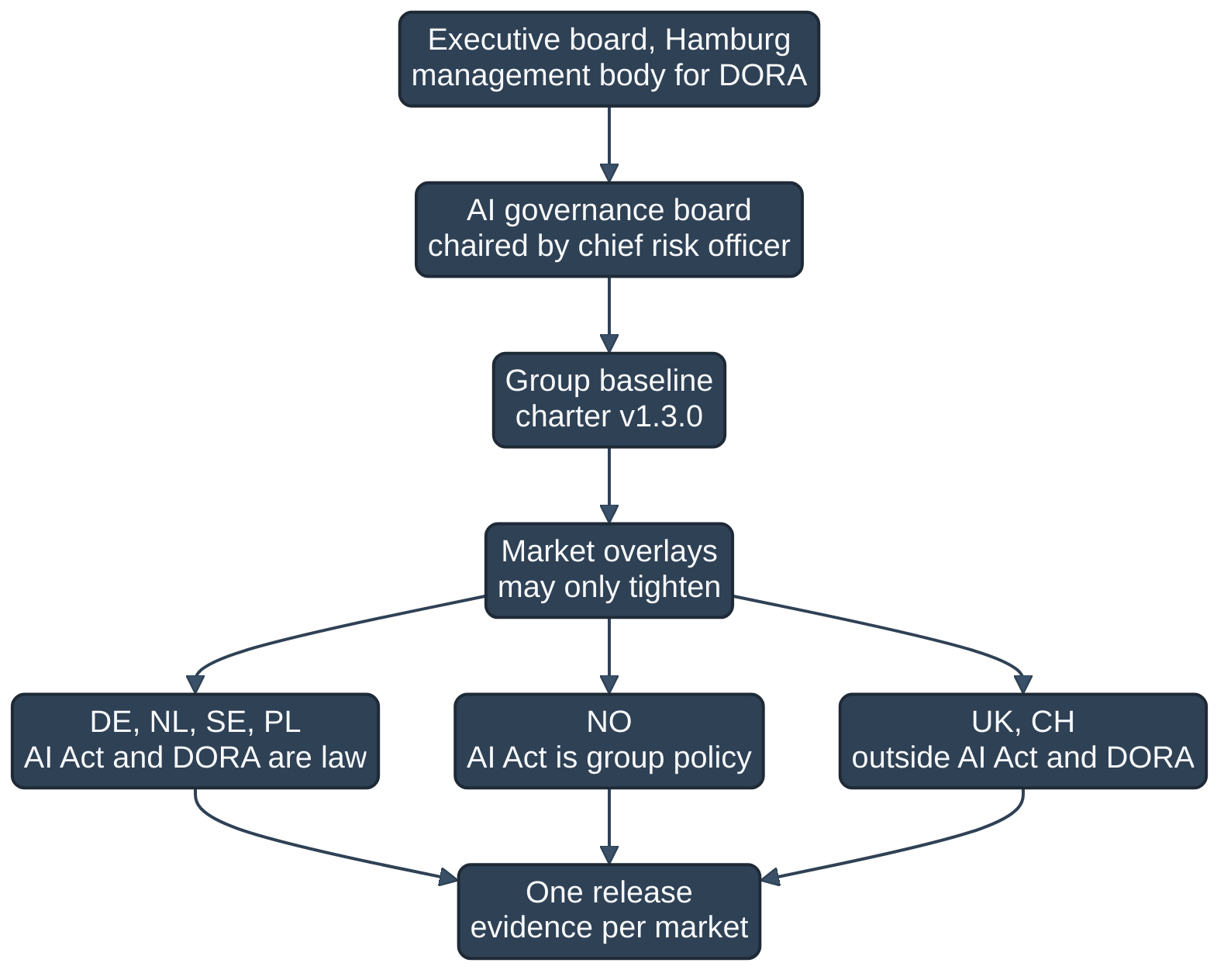
Figure 8.1: The governance model that AI Governance establishes for Hansa Mutual: one baseline, overlays that may only tighten, and evidence per market. The grouping of the markets follows the legal setting of the profile.
Systems and their placement
The volume's systems are placed on the usage modes as follows.
| System | Identifier | Mode | Notes |
|---|---|---|---|
| Claims assistant | AIDR-0021 | 4 | Retrieval-augmented generation over policy wordings; limited risk; declared for [DE, NL, SE, NO, UK, CH], processed in [DE, PL]; excludes life and health; about 320 handlers in the pilot |
| Claims correspondence drafting assistant | UC-2026-031 (AIDR-0147 in Chapter 16) | 4 | Scaling; exception EXC-2026-012 |
| Claims-triage agent | UC-2026-014, AIDR-0024 | 5 | Formerly an assistant; approved through change review CR-2026-118; may not approve payments; at most 400 actions an hour; human approval for reserve changes |
| IT-operations agent | AIDR-0027 | 5 | Write access to production; a recommend-only pilot came first |
| Underwriting-support model | (profile) | 4 | High-risk, Annex III point 5(c); health triage pilot UC-2026-044 (AIDR-0212) |
| Platform engineering tools | (Chapter 16A) | 3 | 14 seats in Hamburg; sensitive information handled only by self-hosted models |
The group data centre in Frankfurt (hansa-dc-frankfurt) hosts the self-hosted and fallback models. Claims assistant and triage events are market-bound: tool calls and credentials of the triage agent are tied to the market of each claim, and the ClaimTriageSuggested event carries a market attribute (AI Governance, Chapters 2, 4, 16 and 16A) (2, Nordqvist, 2026).
Decisions and records
AI Governance is where the group's record families begin. The table collects them with the decision each carries.
| Record | Subject | What it records |
|---|---|---|
| AIDR-0021 | Claims assistant | Retrieval chosen before fine-tuning; excludes life and health |
| AIDR-0022 | Evidence retention | 120 months |
| EXC-0004 | Principles exception | Time-limited exception, approved 2026-06-02, expires 2027-06-01, for an externally hosted model; approved by the chief risk officer; compensating controls instead of ignoring principle P3 |
| RISK-2026-031 | Risk register | Entry for claims-wording-assistant |
| VND-2025-118 | Vendor contract | Contract of the claims assistant's model supplier |
| DC-WORDING-004 | Data contract | Policy-wording data |
| GEO-2026-017 | Model-origin assessment | Self-hosted Example-Coder-32B, from a Chinese developer, approved with controls (egress denied, no tools) |
| EXIT-004 | Exit plan | Classification of claims correspondence; drilled in April and October 2026 |
| ROI-2026-031 | Register of information | DORA register entry |
| WAIVER-2026-007 | Waiver | Claims-triage provenance; 2026-08-20, expires 2026-11-20 |
| EXC-2026-012 | Funding exception | Granted 2026-09-11, expires 2026-12-11 |
| DEC-2026-031 | Board minute | Health underwriting triage assistant UC-2026-044 (AIDR-0212, PR-1187), 2026-10-14 |
| DEC-2026-044 | Board minute | Document extraction UC-2024-012 (PR-1263), 2026-11-11 |
| EXIT-007 | Exit plan | Document extraction; draft due 2026-12-15 |
| EXC-2026-021 | Exception | Conditional hosted renewal for document extraction |
| ENG-2026-09 / UC-2026-022 | Engagement | Repair estimate review assistant; sponsor Head of Motor Claims |
| UC-2026-052 | Use case | Motor claims summarisation |
| RA-2026-04 | Risk appetite | Group risk appetite statement |
(AI Governance, Chapters 1, 4, 6, 7, 9, 13, 16 and 16A.) (2, Nordqvist, 2026)
Four decisions carry the volume's lessons for Hansa Mutual and deserve a sentence each.
- EXC-0004. The group did not ignore principle P3 where it could not meet it. It recorded a time-limited exception with compensating controls and an expiry date.
- GEO-2026-017. A self-hosted Chinese open-weight model was approved with controls, while a hosted service from the same developer would have been refused. The lesson the volume draws is that origin matters less than how the model is run.
- DEC-2026-031. The board approved the health underwriting triage pilot with conditions, restricted to 20 per cent of new health applications in Sweden, with a review on 2027-02-10. The data protection officer recorded a dissent on a 24-month retention period, and the head of claims was conflicted and stood aside.
- DEC-2026-044. For document extraction the board chose a hybrid: rules-based extraction for structured forms, a bounded open-weight pilot for the rest, and a 12-month hosted renewal with conditions. The lesson is that missing evidence produces "approve with conditions", not a refusal and not a clean approval.
Events and figures
The profile is established. The worked examples that carry the dates and figures below are marked Illustrative example in the volume, and a number of them lie after the November 2026 writing date. The table separates the two, and the volume's own labelling governs.
Dated events
| Date | Event | Status |
|---|---|---|
| 2026-04 | First EXIT-004 drill, 9 hours (GPU quota too low) | Illustrative |
| 2026-06-02 | EXC-0004 approved | Illustrative |
| 2026-06-12 | Exit rehearsal against Model Provider Alpha | Illustrative |
| 2026-06-18 | Charter v1.3.0 approved | Illustrative |
| 2026-08-20 | WAIVER-2026-007 granted | Illustrative |
| 2026-09-01 to 2026-11-24 | ENG-2026-09, a 12-week engagement | Illustrative |
| 2026-09-10 | Contract review, draft v3 | Illustrative |
| 2026-09-11 | EXC-2026-012 granted | Illustrative |
| 2026-09-22 | Spend incident SPD-2026-007 (ICT incident INC-2026-0412) | Illustrative |
| 2026-10 | Second EXIT-004 drill, 4 hours | Illustrative |
| 2026-10-08 | Board review of the spend incident | Illustrative |
| 2026-10-14 | DEC-2026-031 | Illustrative |
| 2026-10-20 | GEO-2026-017 | Illustrative |
| 2026-11-03 | Risk report for October 2026 generated | Illustrative |
| 2026-11-11 | DEC-2026-044 | Illustrative |
Looking forward, the volume schedules the following: EXIT-007 draft on 2026-12-15; end of UC-2025-019 on 2026-12-31; a triage forecast window for 2027-Q1 (2027-01-04 to 2027-04-04); EXIT-007 rehearsal on 2027-02-05 and signature on 2027-02-09; review of DEC-2026-031 on 2027-02-10; next review of DEC-2026-044 on 2027-02-17; contract renewal on 2027-03-31; review of GEO-2026-017 on 2027-04-20; lapse of the board charter on 2027-06-30; and the date from which the high-risk regime applies, 2027-12-02 (the Digital Omnibus, Regulation (EU) 2026/1744). A roadmap, HM-GOV-RM-2026, runs from 2026-11 to 2028-10 (AI Governance, Chapters 6, 7, 9, 12, 13, 16, 16A and 23) (2, Nordqvist, 2026).
Figures
The figures are those of the volume's worked examples and are illustrative unless stated.
Claims correspondence assistant (UC-2026-031). Baseline handling time 14.2 minutes and complaint rate 0.021; target 9.0 minutes; realised in 2026-Q3 9.6 minutes and 0.020. Platform fee EUR 4,200 a month; use-case budget EUR 310,000; 2027 envelope EUR 540,000, with a forecast of EUR 410,000, 470,000 and 560,000 (earlier forecast error +14 per cent). Cost per reply EUR 0.21 at the median and 0.47 at the ninetieth percentile, with a ceiling of 0.60. 1,900 handlers have access. Quality floor: complaint rate at most 0.024; override rate between 0.05 and 0.20. Scaling is limited to 2 of 5 claims regions (AI Governance, Chapters 16 and 16A) (2, Nordqvist, 2026).
Claims assistant (AIDR-0021). EUR 0.031 a reply at pilot against a budget of EUR 0.04; faithfulness 0.96; a golden set of 400 questions; 0.94 correctness and 0.97 citation precision in Swedish, German and English. Policy-wording drift indicators: ungrounded answers at most 0.01 and superseded citations 0 (AI Governance, Chapters 5, 8 and 11) (2, Nordqvist, 2026).
Triage agent, 2027-Q1 forecast (illustrative). 1,500 claims a day; 2.6 actions per claim; a mean of 145,000 tokens per action; an 8 per cent retry rate; a 70/30 mix of compact and large models at a blended EUR 1.339 per million tokens. Scenarios EUR 61,900, 74,500 and 89,200. Envelope EUR 6,500 a week and EUR 84,500 a quarter; daily cap EUR 1,300; cost per completed action p50 EUR 0.18, p90 EUR 0.41, ceiling EUR 0.60. The 2026-Q3 forecast ran 13 per cent low (AI Governance, Chapter 16A) (2, Nordqvist, 2026).
Spend incident SPD-2026-007. On 2026-09-22 a release of the claims-core API added a mandatory field and the agent retried every failed routing action. The hard cap stopped the loop after 6,184 attempted actions, of which 194 were completed, at EUR 965; 418 claims were routed manually and none missed its deadline. The soft alert fired at 09:52, the stop came at 10:14 and the owner answered at 10:31. Corrective actions set a retry budget of two per action and a circuit breaker of 20 validation errors in 60 seconds (AI Governance, Chapter 16A) (2, Nordqvist, 2026).
Allocation. Showback for 2026-Q3 totalled EUR 818,000: Germany EUR 268,000 plus 61,200 fixed; the Netherlands and Sweden EUR 152,000 plus 46,800; Poland EUR 31,000 plus 18,000; Norway, the United Kingdom and Switzerland EUR 157,000 plus 54,000; and EUR 30,000 unallocated, which is 38 per cent below the previous quarter. The fixed control-plane cost is EUR 180,000 a quarter, split Germany 34, the Netherlands 14, Sweden 12, Poland 10, Norway 10, the United Kingdom 12 and Switzerland 8 per cent, and the unallocated pool is capped at 5 per cent. The Mode 3 envelope is EUR 5,600 a month for 14 seats (cost centre GRP-IT-4120), about EUR 400 a seat (AI Governance, Chapter 16A) (2, Nordqvist, 2026).
Document extraction. It makes up 6 per cent of AI spend. The four options carry three-year costs of EUR 1.9 to 2.4 million (renew the hosted service), 2.1 to 2.9 million, 1.5 to 1.8 million and 3.1 to 3.4 million (continue manual extraction), with median unit costs of 0.11, 0.09 to 0.19, 0.04 to 0.14 and 0.52. The price-rise cap is 8 per cent a year; the open-weight pilot is capped at 15 per cent of unstructured volume; 70 per cent of volume is structured (AI Governance, Chapter 16A) (2, Nordqvist, 2026).
Exit and supply. EXIT-004: secondary source 0.89 against the primary 0.94, with a threshold of 0.80 raised to 0.90 on switching, six replicas and about 40 minutes. Provider Alpha: exit in four weeks, moderation in two, maximum tolerable outage 72 hours, evaluation 0.93 against 0.92, 11 templates changed; the contract review found 4 clauses missing and 8 gaps against DORA Article 30 (AI Governance, Chapters 6 and 7) (2, Nordqvist, 2026).
Other. INC-2026-0457: 37 answers, 72 hours, Sweden. Motor claims summarisation (UC-2026-052): about 180 handlers, review time down from 26 to 15 minutes. Retention 120 months. Invoice-enquiry agent: 12 tool calls a session and EUR 40 a day (AI Governance, Chapters 2, 11, 20 and 21) (2, Nordqvist, 2026).
Across the usage modes
The volume treats Hansa Mutual as the one organisation that uses every mode, so it is the best source for how governance differs by mode.
| Mode | Hansa Mutual in AI Governance |
|---|---|
| Mode 0 Ambient AI | Licensed software with embedded AI; a notice clause for the service desk is the open point recorded in Book 3 |
| Mode 1 Conversational assistants | Approved enterprise tiers only |
| Mode 2 Embedded workplace assistants | Across the group |
| Mode 3 Agentic work tools | Platform engineering, 14 seats; EUR 5,600 monthly envelope; hosted premium models disabled at the hard cap while self-hosted models stay available |
| Mode 4 Applications | Claims assistant (AIDR-0021), correspondence assistant (UC-2026-031), underwriting-support model |
| Mode 5 Autonomous production agents | Claims-triage agent (limits: no payment approval, 400 actions an hour, human approval for reserve changes); IT-operations agent (AIDR-0027, recommend-only pilot first) |
The consequences of the mode appear in the controls: Mode 4 systems carry cost-per-answer and quality gates, Mode 5 systems carry rate limits, spend caps, stop authority and market-bound credentials (AI Governance, Chapters 2 and 16A) (2, Nordqvist, 2026).
What the volume concludes for Hansa Mutual
Chapter 23 of AI Governance draws the group's conclusion in four moves. First, there is one group baseline, and overlays may add controls but never remove them. Second, each market has a named holder of the stop, so that an agent can be halted by someone in the market where it acted. Third, contract gaps against DORA Article 30 are closed and exit plans are rehearsed. Fourth, the pace of rollout is set by consultation in each country, not by the platform. The volume gives a plan of 24 months, the roadmap HM-GOV-RM-2026, running from November 2026 to October 2028 (AI Governance, Chapter 23) (2, Nordqvist, 2026).
The lessons recorded along the way are consistent with that conclusion: exit plans work only if rehearsed (the first EXIT-004 drill in April took nine hours and exposed a GPU quota too low, the second in October switched in four hours); origin matters less than how a model is run (GEO-2026-017); missing evidence leads to approval with conditions (DEC-2026-044); and a hard cap at the gateway, not an alert, stopped the retry loop in SPD-2026-007 (AI Governance, Chapters 6 and 16A) (2, Nordqvist, 2026).
Open threads
AI Governance disagrees with itself, or with later volumes, in several places. The dossier states both values and does not choose; Chapter 27 collects them.
- Open thread: the stale-terms incident has three versions. INC-2026-0457 (37 answers, 72 hours, Sweden; Chapter 11), INC-2026-118 (41 hours, 312 drafts; Chapter 16) and "212 clauses" (Chapter 23). Whether these are one event is not stated.
- Open thread: two exit strategies. Chapter 6 describes EXIT-004 as a primary US model in a hyperscaler's EU region with an open-weight secondary at 0.89; Chapter 7 describes a strategy for Model Provider Alpha rehearsed on 2026-06-12. How they connect is unclear.
- Open thread: claims assistant details. It is "limited" risk but excludes life and health; the pilot unit is about 320 handlers against about 180 handlers for UC-2026-052 (a different system); Chapter 4's languages are five, and the profile lists six markets.
- Open thread: identifiers. UC-2026-031 is AIDR-0147 in Chapter 16 but the profile gives no AIDR; the early triage assistant's AIDR-0063 and AIDR-0034 appear only in the profile; Chapter 23 speaks of a recommend-only pilot behind AIDR-0027, which the profile assigns to the IT-operations agent.
- Open thread: waiver length. WAIVER-2026-007 runs 92 days (2026-08-20 to 2026-11-20), over the 90-day limit stated in Chapter 13.
- Open thread: approval speed. Chapter 25 says the triage agent flags approvals made in under four seconds; Chapter 10 does not describe the mechanism.
- Open thread: system naming. DEC-2026-031 concerns a "health underwriting triage assistant" (UC-2026-044, AIDR-0212); the profile calls the system the underwriting-support model.
- Open thread: consultation status. Chapter 12 records Germany done, the Netherlands in progress, Sweden done, Norway not started, the United Kingdom done and Switzerland not started; the plan of Chapter 23 says to complete consultation in the Netherlands, Norway and Switzerland.
(AI Governance, Chapters 4, 6, 7, 10, 11, 12, 13, 16, 23 and 25.) (2, Nordqvist, 2026)
Summary
AI Governance sets the frame in which all later volumes place Hansa Mutual: a Hamburg mutual of about 9,500 employees in seven jurisdictions, which builds on vendor models, uses every usage mode, runs two Mode 5 agents and one high-risk underwriting-support model, and governs them through a group baseline, overlays that only tighten, and a board chaired by the chief risk officer. The volume supplies the group's first record families (AIDR-0021, AIDR-0022, EXC-0004, GEO-2026-017, EXIT-004, DEC-2026-031 and DEC-2026-044) and a set of figures, mostly illustrative, on cost, quality and incidents. Its conclusion for the group is a 24-month plan built on one baseline, market-level stop holders, rehearsed exits and consultation-paced rollout. The dossier's reading is that the volume treats governance as something the group does through records with owners and expiry dates, and that its open threads are mostly of identifier and version, not of substance.
Sources
- Nordqvist, G. AI Governance: Governing Artificial Intelligence in European Enterprises and Public Authorities. (2, Nordqvist, 2026)