Book 13, Vibe to Dev: The Builder
This chapter gathers what Vibe to Dev (Book 13) establishes about Hansa Mutual: the builder, Katarzyna Nowak, and the tool she built; the tier at which the group places it; the twelve steps with their gates and dates; the independent oracle that found a rule the assistant's own tests did not; the takeover test; the lane that the group provides; the legal frame; and the conclusions the volume draws for the group. It draws on Vibe to Dev, Chapters 1 to 25, on its build log BUILDS.md and on the builder profile it adds to the example-organisation file (13, Nordqvist, 2026). Chapter 18 of this dossier covers the development organisation from which the lane comes, and Chapter 7 the group's resilience picture.
The status of the facts is this. The builder profile is established. The volume runs from September to December 2031, written in November 2026, and every date, name of a record, measure and quotation of the build is illustrative fiction. The volume states that its measures are before-and-after comparisons without a control group (its Chapters 23 and 24), and the chapter repeats that (13, Nordqvist, 2026).
The volume in brief
Vibe to Dev is a step-by-step guide for a person who is not a developer and builds software with an AI assistant. Its thesis has five parts. The gap between vibe coding and professional development is a set of habits and not a gift, and twelve steps cover it: Step 1 Intent, Step 2 Tier, Step 3 Workshop, Step 4 Specification, Step 5 Design, Step 6 Build, Step 7 Prove, Step 8 Secure, Step 9 Ship, Step 10 Run, Step 11 Own and Step 12 Hand over, each ending in a gate met by showing an artefact. Structure is proportionate, and the four tiers of AI Developer, Chapter 19 (A personal, B team, C business, D project) set how much of each step applies; Tier D is not a citizen build. A professional result passes the takeover test: a named colleague can, in a working day, run it, change it and ship the change, and switch it off and restore it. AI may draft, generate, explain and, within a mandate, execute, but may not own and may not be the only judge of its own work (the stewardship principle Name, Understand, Revert, and the independent test oracle). Both sides close the gap: the builder by habits, the organisation by sandboxes, templates, golden paths, a register and receiving developers, with claims resting on evidence (13, Nordqvist, 2026).
The role of Hansa Mutual in the volume
Hansa Mutual is the regulated, multi-country, large-scale organisation of the volume, set against Nordvik Region, the public authority. The builder is Katarzyna Nowak, team leader of a motor claims team in the Polish service centre, with ten years of claims handling and not a developer. Her build claims-doc-check lists the documents missing from each motor property-damage claim and drafts a request in the claimant's language for the handler to review and send; the tool decides nothing and sends nothing. The volume uses Hansa to show four things. The tier is C from day one because claim identifiers can be linked to injured parties, which makes them personal data, and the group's data protection officer, Dr. Sabine Vogel, narrowed the scope to property damage (injury claims are outside because free-text fields may hold health data, GDPR Article 9; AIDR-1251). A gate fell: the independent oracle (Marek Zieliński's case glass-03) found a rule error that the assistant's 18 tests did not see, because the assistant had copied the motor_collision rule to motor_glass and written a test that agreed with its own copy. The risk lies in scale: a tool from one team in one country is evidence about that team, and new markets need a new specification, a new oracle and their own receiving developer. And the data path is the rule: the production export is read only by the pipeline identity (13, Nordqvist, 2026).
What the volume establishes
The people
| Person | Role |
|---|---|
| Katarzyna Nowak | builder; owner OWN-HM-2031-0001; learning plan BLP-HM-2031-01, part of a claims analytics development path towards data analyst in claims operations and not towards the development organisation |
| Marek Zieliński | deputy (senior claims handler); oracle owner (25 cases, with a quality sample from Kaczmarek's office); read the intent back on 2031-09-17 and showed two meanings of "complete"; ran the rollback rehearsal on 2031-11-12 and the restore test on 2031-11-14; explain-it-back drill on 2031-12-03 |
| Joanna Kaczmarek | head of claims operations; approves the build record and the specification, takes the tier decision with the data protection officer, protects time for the quality sample |
| Tomasz Wrona | Group Application Development; the Polish receiving developer; reviewer (RVW-HM-2031-0001, 2031-11-12); ran the takeover test on 2031-12-09; coach |
| Dr. Sabine Vogel | the group's data protection officer, unnamed before this volume; screened the scope on 2031-10-20 (AIDR-1251) |
| Dr. Philipp Reinhardt; Rainer Lehmann | head of Group Application Development, who provides the lane; the group CIO, decider according to Chapter 24 |
The group's claims rule owner, unnamed, confirmed on 2031-11-10 that glass claims never require an accident report. The pilot team's handlers handled 212 claims in September and 198 in December (13, Nordqvist, 2026).
The problem and the build
Motor property-damage claims arrive with attachments (photographs, a police or accident report, a repair estimate); handlers spend time finding out what is missing and writing request letters, and the delay is the main cause of long handling times. The build is a Python 3.12 command-line tool of about 450 lines in four modules (rules.py, check.py, drafts.py, cli.py) with 18 tests. Its input is claims_export.csv from claims core SVC-HM-001, five columns (claim_id, claim_type, doc_types_received, country, language) and never a free-text field. Claim types in scope are motor_collision, motor_parking_damage and motor_glass; motor_injury is written as OUT_OF_SCOPE. Output is missing.csv (values COMPLETE, MISSING, OUT_OF_SCOPE) and one draft per MISSING claim in drafts/CLAIMID.txt, from templates in Polish, German and English. The rules in rules.yaml are:
| Claim type | Required documents |
|---|---|
motor_collision |
photos, accident report, repair estimate |
motor_parking_damage |
photos, repair estimate |
motor_glass |
photos, repair estimate |
The never-do list says the tool never decides damage, never ranks handlers or claimants, never sends anything itself, never writes to claims core, never reads free text, and logs only claim identifiers and counts. Synthetic data in data/synthetic/claims_synthetic.csv use identifiers from SYN-0001. The tool calls no model at run time. It runs on a handler's request as the pipeline job claims-doc-check run in the claims analytics workspace; the job's identity reads the production export, not the builder and not the assistant; and the pipeline deletes missing.csv and drafts/ after 30 days (GDPR Article 5(1)(e)) (13, Nordqvist, 2026).
Tier
The tier decision on 2031-09-18 was C, with the gate (the screening) met on 2031-10-20. It is not D, because the tool ranks no one, decides nothing and feeds no high-risk AI system; the handler decides and sends. The decision records are AIDR-1251 (2031-10-20; the narrowed scope needs no data protection impact assessment under GDPR Article 35), and the architecture decision records 0001-property-damage-only and 0002-draft-only. Chapter 2 of the volume describes BLD-HM-2031-0001 as starting at Tier C on 2031-09-15, which is the date the record opened; the gate itself fell later (an open thread) (13, Nordqvist, 2026).
The lane and the assistant
Group Application Development provides a builder lane in the claims analytics workspace from October 2031 (AIDR-1250, adopted 2031-10-13; LANE-HM-2031-01): an approved assistant at Mode 2 and 3 within a mandate, synthetic claim exports, the group pipeline, and a named receiving developer per market, Tomasz Wrona for Poland. Production exports are read only by the pipeline identity. The lane's logs identify named builders, and use was agreed with the works council in Hamburg before activation under the interim agreement. The lane is allocated about 0.4 of a full-time post in its first quarter (illustrative), with a monthly spending limit per builder for the assistant and an alarm at 80 % (illustrative). The builder's assistant works under MND-HM-BLD-2031-01 (AIDR-1252, 2031-10-27) with a ceiling of Level 3 Bounded; Mode 5 is not for builders and Level 4 is not used. The mandate has the same form as Nordvik Region's: read the repository and synthetic data, edit on a branch, run tests; never production data, the rules file AGENTS.md, the pipeline configuration, tests/oracle/ or the mandate itself (13, Nordqvist, 2026).
The earlier artefact
In summer 2031 Nowak had made a first prototype in a hosted natural-language app builder, with its sharing set to "anyone with the link" and about 40 rows of real export data pasted in, and no access log. She described it to Kaczmarek and closed the link herself on 2031-09-12, and the data protection officer was informed. The same day an assistant wrote a script of about 90 lines from her dictated rules, run on a workstation against 30 invented rows. The volume does not describe an incident record or an assessment of a personal data breach, and the tool existed without a contract (13, Nordqvist, 2026).
Decisions and records
The volume's records for the build are these, with the extract's dates.
| Record | Date and content |
|---|---|
BLD-HM-2031-0001 |
build record, opened 2031-09-15 |
SPC-HM-2031-0001 |
specification, approved 2031-10-30 |
MND-HM-BLD-2031-01 |
mandate, AIDR-1252, 2031-10-27 |
OWN-HM-2031-0001 |
ownership; owner Nowak, deputy Zieliński, sunset 2033-08-31, next review 2032-03-02 |
RUN-HM-2031-0007, -0011 |
agent run records |
RVW-HM-2031-0001 |
review by Wrona, 2031-11-12 |
CHG-HM-2031-0001, VER-HM-2031-0001 |
change and verification records |
PRV-HM-2031-0001 |
provenance, 2031-11-13 |
RBK-HM-2031-0001 |
runbook, 2031-11-13; contact order Nowak, Zieliński, workspace support, Wrona for code changes |
RST-HM-2031-0001 |
restore test, 2031-11-14, Zieliński, 18 minutes against 30, expires 2032-02-12; production export and workspace backups outside scope |
HND-HM-2031-0001, TKT-HM-2031-0001, LANE-HM-2031-01, BREG-HM, BLP-HM-2031-01 |
handover pack, ticket, lane, the builder register and the learning plan |
| AIDR-1250, -1251, -1252 | lane (2031-10-13), data protection screening (2031-10-20), mandate (2031-10-27) |
Supporting files are docs/mandate.yaml, docs/platform-supported.md and promotion_criteria. Step artefacts are the intent (Chapter 5), the tier decision (Chapter 6) and the anti-pattern check (Chapter 22). The Nordvik Region file permit-by-tier.yaml has no Hansa counterpart in the volume (Chapter 20). The lane's gate rule is that a step is finished when its artefact is shown, and that exceptions are not approved by the builder (13, Nordqvist, 2026).
Events and figures
The twelve steps in dates
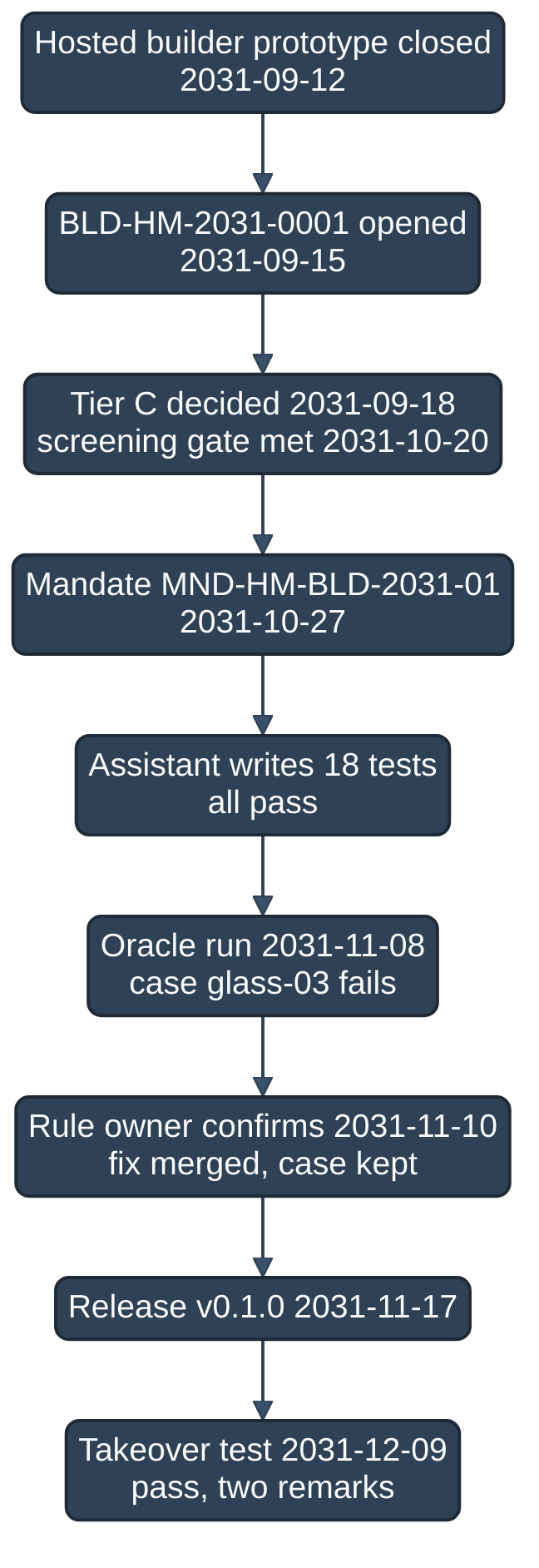
Figure 19.1: The build of claims-doc-check, from the closed prototype to the takeover test. Dates and outcomes are illustrative.
| Step | Date | What was shown |
|---|---|---|
| 1 Intent | 2031-09-17 | intent read back by Zieliński; the September baseline (6.8 days) did not exist when the intent was written, so method, source and an expiry date were recorded |
| 2 Tier | 2031-10-20 | tier C (decided 2031-09-18); screening by the data protection officer, AIDR-1251 |
| 3 Workshop | 2031-10-27 | mandate and AIDR-1252; clone-and-restore done by Zieliński |
| 4 Specification | 2031-10-30 | SPC-HM-2031-0001 approved |
| 5 Design | 2031-11-03 | one page: four modules, one input, two outputs, no network, only claim identifiers in logs (GDPR Article 25) |
| 6 Build | 2031-11-06 | rules.py, check.py, drafts.py with tests |
| 7 Prove | 2031-11-12 | 25 oracle cases; review by Wrona |
| 8 Secure | 2031-11-13 | logs only claim identifiers; dependency policy; provenance; Wrona checks two dependencies and runs a secret scan; no secrets because the pipeline holds access |
| 9 Ship | 2031-11-12 | rollback rehearsal by Zieliński, 12 minutes against 30, valid to 2032-02-10; release v0.1.0 to the pilot team on 2031-11-17 |
| 10 Run | 2031-11-14 | restore test, 18 minutes |
| 11 Own | 2031-12-03 | explain-it-back drill |
| 12 Hand over | 2031-12-04 and 2031-12-09 | Nowak writes the pack on 12-04; takeover test on 12-09 |
On 2031-11-08 the oracle's first run failed on glass-03: the expected value was COMPLETE and the tool returned MISSING and a request for an accident report, while the assistant's 18 tests were green. On 2031-11-10 the claims rule owner confirmed the rule and the fix was merged, and the case became a regression case, a week before the first release. Nowak is quoted, illustratively and as written for the volume, "The assistant had written me eighteen passing tests and a wrong rule. What found it was Marek, who has handled glass claims for years". She also reworded two request letters that would have read like accusations (13, Nordqvist, 2026).
The takeover test
The takeover test of 2031-12-09, run by Wrona, passed with two remarks. R1: the README lacked the oracle cases in its section on changes, closed on 2031-12-12. R2: an unknown language falls back silently to English; count the fallbacks; due 2032-01-13 and open. The change task was to accept video as an alternative to photographs for motor_parking_damage. The item time was 5 hours 50 minutes; the parts took 10, 20, 25, 105, 40, 30, 15 and 40 minutes for T1 to T8, and the volume derives about 65 minutes for T9 and T10 together. The pilot team had used the tool for three weeks before the test and Wrona had reviewed the code. The lesson the volume draws is to let the receiving developer see the work before test day and to have someone other than the builder use the tool before the test, because the test found things the builder could not see (13, Nordqvist, 2026).
Figures
| Figure | Value | Note |
|---|---|---|
| Median calendar days from registration to complete file, pilot team | 6.8 (September 2031, 212 claims); 5.1 (December 2031, 198 claims, about four weeks after release) | before and after, no control group; season and other changes uncontrolled; valid for the month measured; remeasure within 90 days |
| Tests | 18 by the assistant; 25 oracle cases | the oracle by Zieliński and a quality sample |
| Code and data | about 450 lines; three languages; five columns | one rule adjusted (glass-03) |
| Rollback rehearsal; restore | 12 minutes against 30; 18 minutes against 30 | 90-day validity; files deleted after 30 days |
| Invented and real rows | 30 invented (workstation script); about 40 pasted (hosted builder) |
All of Hansa's figures are illustrative (13, Nordqvist, 2026).
Plan
The 90-day plan starts 2032-02-02 with a review on Friday 2032-04-30. Nowak and Zieliński close R2 and hold the first 90-day review on 2032-03-02, extend the oracle with real exceptions from the pilot team (written by the quality sample, not the assistant), run the restore and the explain-it-back drill, and decide with Wrona whether a second pilot team is ready. Evidence dates ahead: 2032-01-13 (R2), 2032-02-10 and 2032-02-12 (rollback and restore evidence), 2032-03-02 (ownership review), 2032-12-09 (the takeover test valid to) and 2033-08-31 (sunset) (13, Nordqvist, 2026).
Across the usage modes and degrees of delegation
| Element | Mode | Level | Note |
|---|---|---|---|
| Builder's assistant in the lane | 2 and 3 | ceiling Level 3 Bounded under MND-HM-BLD-2031-01 |
cannot write to tests/oracle/, AGENTS.md, pipeline configuration or the mandate |
claims-doc-check at run time |
calls no model | not applicable | a rule-based tool |
| Hosted app builder, summer 2031 | outside the register | none | closed 2031-09-12 |
| Mode 5 | not for builders | Level 4 not used |
Legal frame
The volume's Chapter 19 relies on GDPR and the DORA register. The EU entities are financial entities; DORA Article 9(4)(e) and Delegated Regulation (EU) 2024/1774 Article 17, on independent approvers of change, call for controlled change, so the pipeline job is the controlled change and the receiving developer the independent approver. Whether the lane's assistant needs its own entry in the register of information is open and belongs to the group's ICT third-party risk team. Hansa, as a private insurer, is outside Directive (EU) 2016/2102, whether the customer portal falls under the European Accessibility Act is a question for the lawyers, and claims-doc-check is internal. The works agreement is called KBV-IT-2024-DE (Hamburg), with the interim agreement with the works council; the learning plan and competence record are handled under it and not used for assessment or pay (13, Nordqvist, 2026).
What the volume concludes for Hansa Mutual
The volume's Chapter 24 draws three conclusions for the group. First, resist the pull of scale: 198 claims in one team is evidence about that team, and a new market means a new specification, a new oracle, its own receiving developer and its own screening. Second, the oracle is a role with a name, time and a successor and not a service from a deputy; Zieliński is both deputy and oracle owner, which is acceptable now and brittle as builds multiply. Third, hold the scope: injury claims stay out, since a new screening would raise the tier, and the decision (AIDR-1251) is not to be reopened in corridor conversation (13, Nordqvist, 2026).
Four leader decisions follow (Lehmann, Reinhardt and Kaczmarek; AIDR numbers not assigned): an expansion rule, in the order specification, oracle, receiving developer, data protection screening, with no exception approved by the builder; the oracle as a role; a fixed rule for the data path with a named auditor; and a written notice to the works councils (Betriebsrat, ondernemingsraad or union body) in each market's language before any second market takes the tool, since the rights differ between Germany, the Netherlands and Sweden and a Polish pilot decides none of them. The group should stop citing 6.8 to 5.1 days as a result without several months and a comparison, stop settling scope questions in the corridor, and stop writing oracle cases last. The lesson on DORA is that a change record with an independent reviewer and a fallback is the evidence an auditor asks for, and that the pilot team's release is a change in the group's own sense (13, Nordqvist, 2026).
Open threads
These are collected in Chapter 27.
- R2. Chapter 24 plans to close R2 (due 2032-01-13) in weeks 1 to 4 of a plan that starts on 2032-02-02, after the due date; R2 is marked open and not as a gate failure.
- The hosted prototype. About 40 rows of real data were pasted into a hosted builder with an open link; the data protection officer was informed, but no incident record, no breach assessment and no access log is described, and the tool existed without a contract (Chapters 2 and 20).
- Tier dates. The tier decision is dated 2031-09-18, the screening gate 2031-10-20, and Chapter 2 says the build "starts at Tier C" on 2031-09-15.
- Ceiling. The builder's assistant has a ceiling of Level 3 Bounded in the lane, whereas AI Developer has one Level 3 class only (dependency updates, Chapter 18 of this dossier). The works agreement draft of that volume bars reports per named developer, whereas the lane's logs identify named builders.
- Names and identifiers.
KBV-IT-2024-DE (Hamburg)againstKBV-IT-2024andKBV-IT-2024-DEV-01;RST-HM-2031-0001is reused with a different meaning in AI Developer (the rehearsal of 2031-01-08). - Works councils. Chapter 24 asks for written notice before a second market, while AI Developer has Polish and Dutch representatives who have already asked for the same terms and an unsigned annex.
- Register. Whether the lane's assistant has its own entry in the DORA register of information is open (Chapter 19).
- Baseline. The September baseline of 6.8 days did not exist when the intent was written (Chapter 5).
- Measure. The only comparison is before and after; the group is to stop citing it as a result.
Summary
Our conclusions are three. First, Vibe to Dev gives Hansa Mutual its smallest and most exactly dated build: one builder, one tool of about 450 lines, one named oracle owner and one receiving developer, with every step shown by an artefact; the build is a worked case of the stewardship principle at the scale of a single team. Second, its central episode is the case that the assistant's own 18 tests could not see and a handler with years of glass claims could, which fixes the oracle as a person who is not the builder and does not use the assistant. Third, the volume leaves three weak points that the dossier records and does not resolve: an oracle owner who is also the deputy, a prototype that touched real data without a record, and a measure that rests on one before-and-after comparison. The steps Step 7 Prove, Step 11 Own and Step 12 Hand over carry most of the evidence. All dates after November 2026 are illustrative.
Sources
- Nordqvist, G. Vibe to Dev: From Vibe Coding to Professional Software, Step by Step, for Builders Who Are Not Developers, in European Enterprises and Public Authorities. (13, Nordqvist, 2026)