Systems and Usage Modes
This chapter is the register of the AI estate of Hansa Mutual: every system and use case that the fourteen volumes of the series give the group, with its usage mode (Mode 0 Ambient AI to Mode 5 Autonomous production agents), its degree of delegation, its risk class where a volume states one, its owner, the record that decided it and the volume in which it first appears. It draws on AI Governance (Book 2), AI Platform and Security (Book 3) and AI Red Team (Book 4) for the first estate, on AI Boss (Book 7) to Vibe to Dev (Book 13) for the systems that arrive later, and on Landscape for the one place where the whole estate is drawn at once. The chapter is organised so that it can be looked up: a table of the seventeen units of the landscape model, a table of the systems that model does not draw, a table by usage mode, and a table of how the estate grows from volume to volume.
Two kinds of fact appear here and the chapter keeps them apart. The existence of a system, its mode and its owner are facts of the profile that the volumes establish. The dates, counts and outcomes of 2027 and later are illustrative: the volumes mark their own examples as illustrative fiction written in November 2026, and Landscape models 2027 as a scenario year, not a forecast (15, Nordqvist, 2026). Where two volumes count the same thing differently, the chapter gives both values and marks an Open thread for Chapter 27.
How the estate is counted
Hansa Mutual is the series' builder. It runs on supplier models, is both provider and deployer under the AI Act for its own composite systems, uses all six usage modes and owns the platform on which most of its systems run (AI Governance, Chapter 1) (2, Nordqvist, 2026). Its group platform in Hamburg and Frankfurt serves seven markets, and the group data centre hansa-dc-frankfurt hosts self-hosted and fallback models (AI Platform and Security, Chapter 1) (3, Nordqvist, 2026).
The estate has no single count in the fourteen volumes. Landscape gives the nearest thing to a census: a landscape model of 17 units, valid on 1 January 2027 and again on 31 December 2027, drawn with the Contour notation. A unit is one use of AI, drawn as one mark with seven dimensions: autonomy level, reversibility tier, reach, usage mode, identity, control and evidence. The model is generated in a pipeline from the group's registers, so that a unit missing from a register is missing from the picture (Landscape, Chapters 4 and 14) (15, Nordqvist, 2026). The units are mostly operated by the group itself. Four are operated by a supplier: conversational assistants, recruitment screening, embedded workplace assistants and ambient AI. Thirteen sit inside the group's own boundary and four outside the EU (Landscape, Chapters 4 and 16) (15, Nordqvist, 2026).
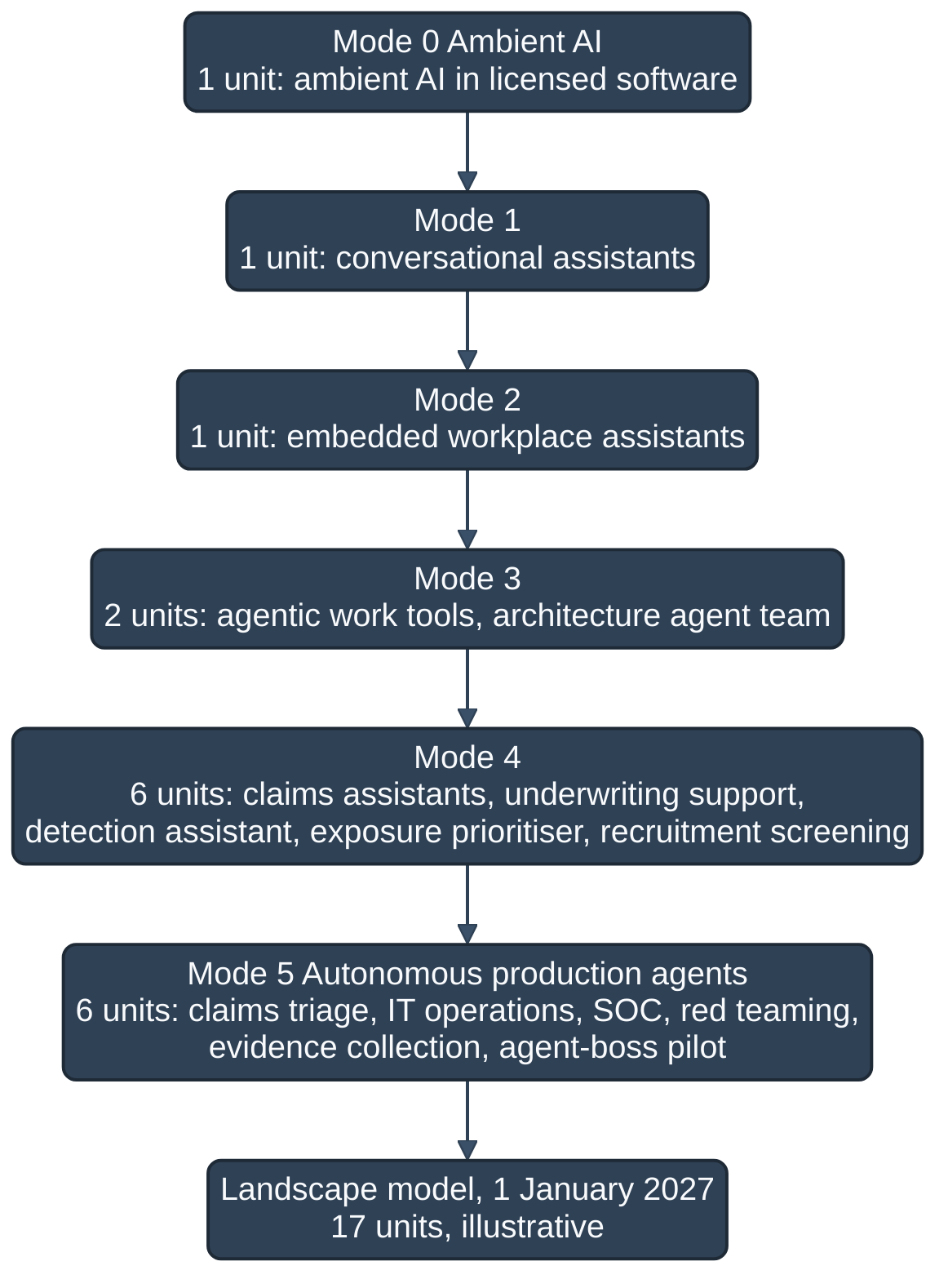
Figure 5.1: The 17 units of the Hansa Mutual landscape model by usage mode, 1 January 2027 (illustrative).
The register of 17 units
Table 5.1 lists the units of the landscape model. "Level" is the highest degree of delegation the model records for the unit; "R" is the reversibility tier from R1 (reversible at once) to R3. "Seat" is the decision tier and holder: the person or body that holds the decision right over the unit. Where a volume gives an identifier, the table quotes it.
| Id | Unit | Mode | Level | R | Seat (tier, holder) | Records and identifiers | Since |
|---|---|---|---|---|---|---|---|
| HM-CA | Claims assistant, retrieval over policy wordings, six markets | 4 | 1 | R2 | T2 Head of claims | AIDR-0021, EXC-0004 | 2025-09 |
| HM-CC | Claims correspondence assistant | 4 | 1 | R2 | T2 Head of claims | EXIT-004 | 2026-01 |
| HM-CT | Claims-triage agent: routes claims and allocates them to individuals | 5 | 3 (route 3, allocate 3, settle a claim 0) | R2 | T2 Head of claims, then T3 chief HR officer and chief risk officer from 2027-04-30 | UC-2026-014, AIDR-0024, -0034, -0063, -0651, DLG-HM-CTA-01 |
2026-04 |
| HM-UW | Underwriting-support model, life and health | 4 | 1 | R3 | T2 Head of underwriting | high-risk, Annex III point 5(c) | 2025-11 |
| HM-ITO | IT-operations agent with write access to production | 5 | 3 (restart 3, change configuration 2, delete data 0) | R3 | T2 Head of group AI platform, then T4 executive board from 2027-03-31 | AIDR-0027, -0552, -0554 | 2026-02 |
| HM-SOC | SOC investigation agent HM-SEC-001 |
5 | 3 (enrich 4, isolate workstation 3, revoke session 3, wipe host 0) | R2 | T2 Group CISO | AIDR-0311 | 2026-08 |
| HM-DET | Detection-engineering assistant HM-SEC-002 |
4 | 1 | R1 | T2 Head of detection engineering | AIDR-0312 | 2026-08 |
| HM-CART | Continuous automated red teaming HM-SEC-004 |
5 | 3 | R2 | T2 Group CISO (rules of engagement) | AIDR-0314 | 2026-10 |
| HM-EXP | Exposure-management prioritiser HM-SEC-005 |
4 | 0 | R1 | T2 Group CISO | evidence attested | 2026-10 |
| HM-AWT | Agentic work tools for engineering, classification-routed | 3 | 2 | R2 | T2 Head of group AI platform | routing policy | 2025-10 |
| HM-ART | Architecture review agent team | 3 | 2 | R2 | T2 Head of security architecture | MND-HM-01, AIDR-0556, -0567, -0592 |
2026-09 |
| HM-EVC | Evidence-collection agent HM-EVC-001, read-only identity |
5 | 3 (read 4, refresh link 3, change a control 0) | R1 | T2 Head of security architecture | AIDR-0565 | 2026-11 |
| HM-AB | Agent-boss pilot: two teams direct an intake and a recovery agent | 5 | 2 | R2 | T2 Team leader, named decider | AIDR-0652, MND-HM-CLM-01, DLG-HM-AB-01 |
2027-01 |
| HM-TL | Recruitment screening and video interview support, Poland and Germany | 4 | 1 | R3 | T3 Chief HR officer | DLG-HM-REC-01, high-risk Annex III point 4(a) |
2025-03 |
| HM-EWA | Embedded workplace assistants, group-wide | 2 | 1 | R1 | T3 Group CIO | tenant policy | 2025-06 |
| HM-CONV | Conversational assistants on approved tiers | 1 | 1 | R1 | T3 Group CIO | acceptable use policy | 2025-01 |
| HM-AMB | Ambient AI inside licensed software, seven markets | 0 | 4 | R2 | T0, then T2 Head of group AI platform from 2027-09-30 | no record at first | 2024-01 |
Table 5.1: The 17 units of the Hansa Mutual landscape model, 1 January 2027 (illustrative; source: (15, Nordqvist, 2026), Chapter 4 and the model).
Table 5.1 draws on the landscape model and on the identifiers of the volumes that decided each unit (15, Nordqvist, 2026). Four features of the table repay a second look. First, every unit with Level 3 delegation has an enforced policy point outside the model; the model gives a red outline to a Level 3 unit that lacks one, and none of Hansa's Level 3 units has it. Second, the model counts the levels as one at Level 0, seven at Level 1, three at Level 2, five at Level 3 and one at Level 4, the last being ambient AI, whose Level 4 is a property of software that the group does not control. Third, the six Extra Large units by reach are the claims-triage agent, the underwriting-support model, the IT-operations agent, the embedded workplace assistants, the conversational assistants and ambient AI. Fourth, over the year 2027 the model records no movement on the grid: the same 17 units stand on 31 December. What moves are the seats, as the next section shows (Landscape, Chapters 15 and 18) (15, Nordqvist, 2026).
The seats that move in 2027
The landscape model records four changes of control in its scenario year, all of them changes of who holds the decision, none of them a change of mark position. On 31 March 2027 the executive board takes the decision right over agents with write access to production, and the seat of the IT-operations agent rises from tier T2 to T4, after the first stop drill, in which stopping took 17 minutes against a budget of 5. On 30 April 2027 the allocation function of the claims-triage agent is re-assessed under Annex III point 4(b) and its seat rises to T3, held jointly by the chief HR officer and the chief risk officer; the same day the recruitment-screening supplier's logs are kept, and the evidence baseline of that unit turns from attested to automatic. On 30 September 2027 ambient AI is inventoried for the first time, receives an owner in the head of the group AI platform and has its notice clauses entered in the register of information under DORA. On 30 September 2027 the exemption that let the evidence-collection agent run without a competence record also ends (Landscape, Chapters 15 and 18) (15, Nordqvist, 2026) (The Transformed Security Architect, Chapter 25) (6, Nordqvist, 2026).
Systems that the model does not draw
The landscape model is deliberately a snapshot of 17 units. The volumes name further systems, versions and use cases that either predate or follow the snapshot, sit below its level of detail, or belong to a book that gives them a different grain. Table 5.2 lists them, with the volume that first establishes each.
| System or use case | Mode | Level | Risk class and note | Owner or decider | Record | First volume |
|---|---|---|---|---|---|---|
Claims correspondence drafting assistant, UC-2026-031 |
4 | scaling | not stated; scaling limited to 2 of 5 claims regions | Head of Claims Operations (budget owner) | AIDR-0147, EXC-2026-012 | Book 2 |
Health underwriting triage assistant, UC-2026-044 |
not stated | pilot limited to 20 % of new health applications in Sweden | underwriting support (high-risk model) | decision DEC-2026-031, approved with conditions; the data protection officer dissented on 24-month retention |
AIDR-0212, PR-1187 | Book 2 |
Document extraction, UC-2024-012 |
not stated | not stated | hybrid decision: rules for structured forms, open-weight pilot of at most 15 % of unstructured volume, hosted renewal for 12 months | AI governance board, DEC-2026-044; exit plan owner head of procurement |
EXIT-007, EXC-2026-021, PR-1263 |
Book 2 |
Motor claims summarisation, UC-2026-052 |
not stated | not stated | about 180 handlers; review time cut from 26 to 15 minutes | not stated | not stated | Book 2 |
Repair estimate review assistant, UC-2026-022 |
not stated | not stated | sponsor Head of Motor Claims | engagement ENG-2026-09 | ENG-2026-09 | Book 2 |
| Invoice-enquiry agent | not stated | 12 tool calls per session, EUR 40 per day | not stated | not stated | not stated | Book 2 |
| Platform engineering team hybrid use | 3 | not stated | 14 seats, sensitive material to self-hosted models only | Head of Platform Engineering | envelope EUR 5,600 per month | Book 2 |
HM-SEC-003 AI red-teaming programme |
not stated | not stated | tests claims assistant, claims-triage agent, IT-operations agent | group CISO | AIDR-0313 | Book 4 |
HM-SEC-006: continuous security chaos engineering in Book 4 (RoE-HM-2027-SCE); alert-triage agent in Book 8 (MND-HM-SOC-01), closing two alert classes at Level 3 with 5 % sampling |
5 in Book 8 | 3 for two classes, 2 for the third | not stated | class owners | AIDR-0765 (policy CLOSE-HM-SOC) |
Books 4 and 8 |
HM-SEC-007 hunting agent |
5 | 2, read-only | not stated | SOC lead | AIDR-0762 | Book 8 |
Critique agent, MND-HM-SOC-05 |
not stated | 0, read-only, second model family | not stated | SOC lead | MND-HM-SOC-05 |
Book 8 |
| TalentLens screening module | 4 | 1 | high-risk, Annex III point 4(a) | chief HR officer | AIDR-0676 | Book 7 |
| Sales-performance score | 4 | 0 as a pay input | recorded Level 0, decisive in practice in one Dutch unit | head of sales HR | DLG-HM-SPS-01 |
Book 7 |
| Board-pack assistant | 4 | 1 | limited risk | not stated (the board secretary checks the summaries) | AIDR-1052, MND-HM-LDR-01 |
Book 11 |
HM-OPS-002 incident assistant |
4 | 1 | not stated | not stated | AIDR-0951 | Book 10 |
HM-OPS-003 change-risk reviewer |
4 | 0 | not stated | not stated | AIDR-0952 | Book 10 |
HM-OPS-004 capacity and FinOps agent |
4 | 1 | not stated | MND-HM-OPS-004; capacity record CAP-HM-2028-014 |
AIDR-0953, MND-HM-OPS-004 |
Book 10 |
HM-OPS-005 alert-correlation observer |
4 | 0 | not stated | not stated | AIDR-0957 | Book 10 |
HM-OPS-006 scribe |
4 | 1 | not stated | not stated | AIDR-0955 | Book 10 |
HM-DEV-001 IDE assistant (CodeMeridian) |
2 | not stated | 340 licences from January 2030 | Reinhardt, group application development | AIDR-1151 | Book 12 |
HM-DEV-002 test-draft assistant |
4 | 1 | not stated | not stated | AIDR-1152 | Book 12 |
HM-DEV-003 legacy explainer |
4 | 0 | pilot with four of twelve mainframe developers | not stated | AIDR-1162 | Book 12 |
claims-doc-check, a builder's tool, Tier C |
no model at run time | drafts only | personal data, property damage only | builder Katarzyna Nowak, deputy Marek Zieliński | BLD-HM-2031-0001, AIDR-1251 |
Book 13 |
| Builder lane assistant | 2 and 3 | cap 3 | no Mode 5 for builders | Group Application Development | AIDR-1250, -1252 | Book 13 |
Table 5.2: Systems and use cases named by the volumes that the 17-unit model does not draw (some facts illustrative; sources: (2, Nordqvist, 2026), (4, Nordqvist, 2026), (7, Nordqvist, 2026), (8, Nordqvist, 2026), (10, Nordqvist, 2026), (11, Nordqvist, 2026), (12, Nordqvist, 2026), (13, Nordqvist, 2026)).
The table is a lookup, not a census, and cells marked "not stated" are cells in which the volumes give no value; the dossier does not supply one. Several rows describe versions of units that Table 5.1 already holds. The SOC and operations agents are the clearest: HM-SEC-001 appears in Book 4 as a Mode 5 investigation agent, in Book 8 as the first of a team of five SOC agents, and in Book 9 as a system the purple loop tests but does not include (AI Red Team, Chapter 1) (4, Nordqvist, 2026) (AI Blue, Chapter 13) (8, Nordqvist, 2026) (AI Purple, Chapter 14) (9, Nordqvist, 2026).
Three agents and one board decision
Four Mode 5 systems are enough to show what the estate means in practice, and they are the ones that the later volumes keep returning to.
The claims-triage agent (UC-2026-014, AIDR-0024) was a Mode 4 assistant and became a Mode 5 agent. It works from the Polish service centre; its tool calls and credentials are bound to the market of the claim it handles; its events carry the market and an advisory flag. Its limits are that it may not approve payments, may act at most 400 times an hour and needs a human to approve reserve changes. The MCP server claims-core-mcp (version 1.4.2, security review SR-2026-077) gives it reversible tools such as policy.lookup, claim.get, claim.create_draft, document_request.draft and claim.suggest_queue, one irreversible tool (document_request.send) that needs a claims handler's approval bound to the action hash, and one tool, reserve.set, that agents may never use (AI Governance, Chapter 16) (2, Nordqvist, 2026) (AI Platform and Security, Chapter 11) (3, Nordqvist, 2026). AI Boss adds the part nobody had asked about: the agent allocates claims to individual handlers in Germany, and the allocation function is therefore, under AIDR-0651 of 14 December 2026, re-classified as high-risk under Annex III point 4(b), while the insurance function stays classified as not high-risk (AI Boss, Chapter 6) (7, Nordqvist, 2026).
The IT-operations agent (AIDR-0027, later HM-OPS-001 in Book 10) may restart, scale and close feature flags in three namespaces (claims-web, claims-api and document-service) in production-eu. It is deny-by-default, has a five-minute token in Book 3, runs in a microVM per incident and has stop contacts per market. Its manifest allows at most three restarts per hour per namespace, two to twelve replicas, 30 steps, four write actions and 20 minutes per incident, and any action outside the manifest suspends it. It is classified as an ICT change under DORA Article 9 and not as high-risk (AI Platform and Security, Chapters 5, 11 and 19) (3, Nordqvist, 2026). AI Operations gives it a budget ceiling of EUR 6,000 a month and six agent roles in all around it (AI Operations, Chapter 16) (10, Nordqvist, 2026).
The SOC investigation agent HM-SEC-001 has its own workload identity (wi-hm-sec-001), runs on a self-hosted open-weight model (MDL-SEC-014, version 2.3.1) and is classed tier 0 for criticality. It sits at Level 2 Supervised by default and holds Level 3 Bounded for two reversible actions, isolating a managed workstation and revoking sessions, under AIDR-0311 (AI Red Team, Chapters 4, 6 and 9) (4, Nordqvist, 2026). Chapter 7 returns to it.
The board decision that links them is AI Threat's: the group runs "two autonomous production agents with write access to core systems", and a supervisory question about them led to the threat register of Chapter 7 (AI Threat, Chapters 1 and 33) (5, Nordqvist, 2026).
Across the usage modes
The estate differs by mode in what it can break and in who holds the stop. Table 5.3 sets the modes side by side with what the volumes establish for Hansa Mutual. The counts are those of the landscape model.
| Mode | Units in the model | Typical systems | Ceiling the volumes record | What is specific to Hansa Mutual |
|---|---|---|---|---|
| 0 Ambient AI | 1 | AI inside licensed software, the supplier's monitoring in managed operations | Level 4 (not controlled by the group) | No policy point can be placed inside a supplier's product; the group registers, assigns an owner and adds notice clauses to DORA contracts; the service-desk notice clause was missing in Book 3 |
| 1 Conversational | 1 | Approved enterprise tiers, consumer tools blocked at the proxy | Level 1 | Consumer tools are blocked at the proxy; for SOC analysts policy AIUP-HM-SOC-01 requires one case in five to be handled unassisted |
| 2 Embedded | 1 | Workplace assistants, IDE assistant (340 licences) | Level 1 | The Konzernbetriebsrat contests whether the board-pack assistant lies outside KBV-IT-2024 |
| 3 Agentic work tools | 2 | Engineering tools routed by classification, architecture agent team | Level 2 | Sensitive material only on self-hosted models in Frankfurt; confidential workspaces include the Polish centre's claims data |
| 4 Built or procured systems | 6 | Claims assistants, underwriting support, detection assistant, recruitment screening | Level 1 | Two of the six are high-risk; Hansa is provider of the underwriting-support model |
| 5 Autonomous production agents | 6 | Claims triage, IT operations, SOC, red teaming, evidence collection, agent-boss pilot | Level 3 (Level 2 for the pilot) | Each has its own identity, a manifest, a policy point outside the model and a stop path; none is allowed Level 4 |
Table 5.3: Hansa Mutual across the usage modes (illustrative; sources: (15, Nordqvist, 2026), Chapters 4 and 6; (3, Nordqvist, 2026), Chapter 24; (8, Nordqvist, 2026), Chapter 12; (11, Nordqvist, 2026), Chapter 22).
What Book 14 adds: a footprint record for each use
AI Environment (Book 14) does not add a system to the estate. It adds a way of recording what each existing use costs in energy and carbon, a footprint record (FPR-*), and an environmental budget (EBG-*) for the uses that act. It reuses six of the group's systems and adds one model-scope record. All figures are illustrative and carry the date of measurement (14, Nordqvist, 2026).
| Record | Use and mode | Volume as Book 14 states it | What the record holds |
|---|---|---|---|
FPR-HM-0001 |
Claims assistant, SVC-HM-007, Mode 4 |
About 1.1 million questions a month, about 2,900 active handlers | Two labelled values that are never added: 0.996 Wh a question at the node boundary on an evaluation set (measured 2032-10-18) and 3.91 Wh before and 2.42 Wh after the levers at rack-IT boundary on a sentinel pool (measured 2032-10-28) |
FPR-HM-0002 |
Claims-triage agent, SVC-HM-002, Mode 5 |
About 140,000 claims a month, about nine model calls a claim | Bottom-up 2.3 Wh and 0.81 g a claim; top-down about 21 Wh and 10.3 g; a gap of about 13 times that Book 14 treats as a finding (measured 2032-10-06) |
FPR-HM-0003 |
Claims correspondence assistant, Mode 4 | About 210,000 letters a month in the markets' languages | Classification-routed hybrid, hosted models for non-sensitive and self-hosted for sensitive routes; exit plan EXIT-004 |
FPR-HM-0004 |
Underwriting support, SVC-HM-008, Mode 4, high-risk |
About 11,000 assessments a month | Rack-level energy only; no record written at the end of the year |
FPR-HM-0005 |
IT-operations agent, HM-OPS-001, Mode 5 with write access to production |
About 2,400 runs a month; cap EUR 6,000 a month | A cost cap and nothing else; no record written at the end of the year |
FPR-HM-0006 |
Agentic engineering tools, Mode 3 | About 700 licensed users, about 38,000 sessions a month | Estimate from gateway tags only |
FPR-HM-0007 |
claims-route-classifier v2032.2, about one billion parameters, used by FPR-HM-0003 |
11 training runs, 240 accelerator hours in the final run (1,420 in all) | 0.62 kWh per accelerator hour, PUE 1.38, 880 kWh IT, 1,215 kWh facility, 425 kg location-based (85 kg market-based, 20 per cent of electricity unmatched); 0.087 g a use over 24 months |
Table 5.4: Footprint records of the Hansa Mutual estate (illustrative; sources: (14, Nordqvist, 2026), Chapters 5, 6, 8, 15 and 24 and its Appendix A).
The records change how the estate is read. The agent with nine calls a claim is the one whose footprint depends most on the direction of counting, and Book 14's conclusions ask for budgets and stop drills before footprints for the two Mode 5 agents. The mandate of the triage agent (MND-HM-ENV-0001, AIDR-1365, active after a drill on 2032-11-29) sets its delegation at Level 3 for starting a run on a registered event and for retry within a limit, and at Level 0 for spawning, scheduling, provisioning, changing its own limits or meters, and publishing a claim (14, Nordqvist, 2026). Chapter 19A gives the records and decisions in full.
How the estate changes from Book 2 to Book 14
The estate is not designed once. Each volume adds what its subject needs, and the additions, taken together, are a growth record of the group's AI use. Table 5.5 gives them in the order of the volumes, with the period each volume covers.
| Volume | Period | What the volume adds to the estate |
|---|---|---|
| Book 2, AI Governance | 2026 | Claims assistant (AIDR-0021, about 320 handlers in the pilot), claims correspondence assistant, claims-triage agent, IT-operations agent, underwriting-support model; the governance board and the group baseline with market overlays |
| Book 3, AI Platform and Security | 2026 | Containment layers: MCP registration, manifests, approval policy, containment profile; golden path rag-assistant 4.2.0; readiness gate for UC-2026-014; go-live AIDR-0034 on 2026-10-21 |
| Book 4, AI Red Team | 2027 | HM-SEC-001 to HM-SEC-006; the security AI estate and its autonomy ceiling |
| Book 5, AI Threat | 2026 to 2027 | The threat register THR-HM-01 to THR-HM-13, oversight metric OQM-HM-CLM-01, provenance checks AIDR-0421, callback verification CVP-HM-2026-01 |
| Book 6, The Transformed Security Architect | 2026 to 2027 | Architecture agent team under MND-HM-01, evidence-collection agent HM-EVC-001 |
| Book 7, AI Boss | 2026 to 2027 | Allocation re-classified as high-risk, TalentLens, sales score, the pilot HM-AB-PILOT-01 with its intake and recovery agents (wl-hm-clm-intake, wl-hm-clm-recovery) |
| Book 8, AI Blue | 2027 | SOC agent team of five, with HM-SEC-006 and HM-SEC-007, playbooks PBK-HM-ISOLATE-01, PBK-HM-REVOKE-01, PBK-HM-COLLECT-01 |
| Book 9, AI Purple | 2028 | Seven loop mandates MND-HM-EMU-01 to -07, with the runner at Level 3 for the lowest safety class, S1 |
| Book 10, AI Operations | 2028 to 2029 | HM-OPS-001 to HM-OPS-006, the observer OBS-HM-0001, the alert-correlation policy ACP-HM-2028-01 |
| Book 11, AI Leader | 2029 to 2030 | Board-pack assistant, executive delegation DLG-HM-EXE-01 (Level 3 for travel under EUR 2,500 and for board scheduling) |
| Book 12, AI Developer | 2030 to 2031 | IDE assistant, test-draft assistant, legacy explainer, the one Level 3 class for patch-level dependency updates |
| Book 13, Vibe to Dev | 2031 | The builder lane, claims-doc-check |
| Book 14, AI Environment | 2032 to 2033 | Footprint records FPR-HM-0001 to -0007, environmental budgets EBG-HM-0001 to -0006, the mandate MND-HM-ENV-0001 for the triage agent, the claims-route-classifier as a measured model |
Table 5.5: Growth of the Hansa Mutual AI estate by volume (illustrative from 2027; sources: the volumes named).
One feature of the growth is worth stating as the book's own observation. The estate gets larger in every volume and its autonomy ceiling does not. Level 3 appears in Book 3 for the operations agent, rises to the SOC, red-team and evidence agents in Books 4 and 6, is delegated to the executive for two routine classes in Book 11 and to one dependency-update class in Book 12, and Level 4 is absent from every Mode 5 system. In the same period the number of named stop holders grows and the stop drill target stays at five minutes: the target does not move, the evidence that it is met does (AI Operations, Chapter 29) (10, Nordqvist, 2026) (AI Developer, Chapter 8) (12, Nordqvist, 2026).
What the estate deliberately does not contain
The volumes are as explicit about what Hansa Mutual does not do as about what it does. The following exclusions are stated facts, each with the volume that fixes it.
- No general-purpose AI model on the market. Hansa is provider of composite systems and deployer of general-purpose models, but delivers no general-purpose model to others and so carries no systemic-risk duties (AI Threat, Chapter 19) (5, Nordqvist, 2026).
- No Level 4 for an irreversible, personal or security-critical action. The delegation schema for the SOC rejects Level 4, the executive profile excludes it, the builder's assistant never reaches it (AI Blue, Chapter 4) (8, Nordqvist, 2026) (AI Leader, Chapter 8) (11, Nordqvist, 2026) (Vibe to Dev, Chapter 24) (13, Nordqvist, 2026).
- No agent that sets reserves or releases payments.
reserve.setandpayment.releaseare not available to agents (AI Platform and Security, Chapter 11) (3, Nordqvist, 2026). - No M3 consequence above Level 1. No system raises a decision about a named person's pay, discipline or employment above Level 1 Assisted; the sales score is Level 0 and TalentLens Level 1 (AI Boss, Chapter 32) (7, Nordqvist, 2026). The Open thread below records that
DRF-HM-01is written with a ceiling of Level 2. - No affect or voice analysis in recruitment. It is off group-wide, including in the United Kingdom and Switzerland, and is verified after each release (AI Boss, Chapter 6) (7, Nordqvist, 2026).
- No wellbeing or collaboration analytics. Switched off group-wide in AIDR-0670 and again in AIDR-1071, pending an agreement (AI Boss, Chapter 14) (7, Nordqvist, 2026) (AI Leader, Chapter 21) (11, Nordqvist, 2026).
- No response agent in the SOC. Actions run as playbooks, not as an agent's own choice (AI Blue, Chapter 13) (8, Nordqvist, 2026).
- No coding agent that merges or deploys on its own. The one Level 3 class is merged by the pipeline after a human approves the class (AI Developer, Chapter 4) (12, Nordqvist, 2026).
- No chief AI officer. The executive board decided against one in March 2029 (AIDR-1051, filed in October 2029) and gave the tasks to the group AI governance board and the head of the group AI platform; the decision is reviewed in March 2031 (AI Leader, Chapter 15) (11, Nordqvist, 2026).
Open threads
The register has seams that the volumes leave open. They are collected for Chapter 27.
- Number of Mode 5 agents. AI Governance and AI Threat speak of two autonomous production agents; AI Red Team adds a third,
HM-SEC-001; The Transformed Security Architect lists four Mode 5 agents in one chapter and says three drove the redesign in another; Landscape counts six; Tools (Chapter 20) says four (2, Nordqvist, 2026) (4, Nordqvist, 2026) (6, Nordqvist, 2026) (15, Nordqvist, 2026) (16, Nordqvist, 2026). The dossier uses six as its working value, because the landscape model is the only place where each is individually drawn, and notes that the agent-boss pilot is a Mode 5 unit at Level 2 in the model while AI Boss describes it as agents directed by people. - Level of
HM-SEC-001. Level 2 Supervised in Book 3's baseline and in Book 5's assessment, Level 3 for two actions in AIDR-0311 (status "proposed" in one chapter), Level 3 for three actions in Book 8 (isolation, session revocation and evidence collection) and a fifth delegation in the schema of Book 8, Chapter 4. Working value: Level 3 for two actions as in the landscape model, with the Book 8 variants recorded. - Classification of the claims-triage agent. Limited risk in the agent's manifest, "not high-risk" in the readiness review, high-risk for the allocation function from AIDR-0651, and
highRisk: falsein an incident record of Book 4 (AI Platform and Security, Chapters 11 and 23) (3, Nordqvist, 2026) (AI Boss, Chapter 6) (7, Nordqvist, 2026). - Footprint of the triage agent.
FPR-HM-0002is about 13 times higher counted top-down than bottom-up at one boundary, and about nine times as first quoted in Wh at two boundaries (21 against 2.3 Wh); the likely cause, idle capacity, is not measured.FPR-HM-0002names Katrin Ohlsen as owner in Book 14's tables and Anja Weiß in its Appendix A record (OT-HM-75, OT-HM-84) (14, Nordqvist, 2026). - Dating of the triage go-live. Book 3 dates the conditional go-live of
UC-2026-014to 2026-10-21 with a start on 2026-11-04 as an assistant, while Book 2 records a spend incident of the triage agent (SPD-2026-007) on 2026-09-22 and a forecast for 2027-Q1 (AI Governance, Chapter 16A) (2, Nordqvist, 2026). - Identifier
HM-SEC-006. Book 4 uses it for continuous security chaos engineering, Book 8 for the alert-triage agent. - Mode of
HM-SEC-002. Level 1 Assisted at Mode 4 in Book 4 and Mode 5 identity at Level 1 in Book 8. - Languages of the claims assistant. Book 3 permits German, English, Swedish and Danish although Hansa has no Danish market; Book 2 says five languages; the evaluation slices cover
deandsvonly (AI Platform and Security, Chapters 10 and 24) (3, Nordqvist, 2026). - Level ceiling in
DRF-HM-01. The file allows "any: L2_Supervised" for decisions about people while the text and the plan say no system exceeds Level 1 Assisted (AI Boss, Chapters 30 and 32) (7, Nordqvist, 2026). - Restore-overwrite. The Level of this class is given as Level 1 Assisted in the profile, as "not delegated" in two chapters of Book 10 and as Level 1 in a third (AI Operations, Chapters 10, 16, 29 and 30) (10, Nordqvist, 2026).
Summary
The Hansa Mutual estate is, at its fullest drawing, 17 units across all six usage modes, six of them Mode 5, and a longer list of systems below that grain. What the volumes establish for it is, in this chapter's own conclusion, a consistent shape. The group builds, so most units run on its own platform in Frankfurt and have their own identities, manifests and policy points; it grows its estate in every volume; and it holds the autonomy ceiling at Level 3 for reversible actions while everything about people stays at Level 1 or below. The estate has two kinds of weakness that the volumes name. One is at the edge, where ambient AI in a supplier's product cannot be fitted with a policy point and the group can only register it and write notice clauses. The other is in the counting, where the same system has different levels, classes and numbers in different volumes. Both are open threads and neither is resolved in this dossier.
Sources
- Nordqvist, G. AI Governance: Governing Artificial Intelligence in European Enterprises and Public Authorities. (2, Nordqvist, 2026)
- Nordqvist, G. AI Platform and Security: Building and Securing AI Platforms in European Enterprises and Public Authorities. (3, Nordqvist, 2026)
- Nordqvist, G. AI Red Team: AI as an Active Part of Cyber Defence in European Enterprises and Public Authorities. (4, Nordqvist, 2026)
- Nordqvist, G. AI Threat: Are the Dystopias Coming True? Evidence, Risk and Response for European Enterprises and Public Authorities. (5, Nordqvist, 2026)
- Nordqvist, G. The Transformed Security Architect: Role, Craft and Career in the Age of AI in European Enterprises and Public Authorities. (6, Nordqvist, 2026)
- Nordqvist, G. AI Boss: When Artificial Intelligence Manages People in European Enterprises and Public Authorities. (7, Nordqvist, 2026)
- Nordqvist, G. AI Blue: How Artificial Intelligence Transforms the Blue Team in European Enterprises and Public Authorities. (8, Nordqvist, 2026)
- Nordqvist, G. AI Purple: How Red and Blue Learn Together When AI Joins the Loop in European Enterprises and Public Authorities. (9, Nordqvist, 2026)
- Nordqvist, G. AI Operations: How Artificial Intelligence Transforms IT Operations in European Enterprises and Public Authorities. (10, Nordqvist, 2026)
- Nordqvist, G. AI Leader: How Leadership Roles Change When AI Is Used Broadly in European Enterprises and Public Authorities. (11, Nordqvist, 2026)
- Nordqvist, G. AI Developer: How the Developer Role Changes When AI Is Used Broadly in European Enterprises and Public Authorities. (12, Nordqvist, 2026)
- Nordqvist, G. Vibe to Dev: From Vibe Coding to Professional Software, Step by Step, for Builders Who Are Not Developers, in European Enterprises and Public Authorities. (13, Nordqvist, 2026)
- Nordqvist, G. AI Environment: Designing AI for the Greatest Benefit and the Least Environmental Harm in European Enterprises and Public Authorities. (14, Nordqvist, 2026)
- Nordqvist, G. Landscape: A Fact-Based Picture of Architecture and AI at Work, for Leaders, Architects and Citizens. (15, Nordqvist, 2026)
- Nordqvist, G. Tools: A Reference to the Templates, Software and Methods of The Transformed Architecture for European Enterprises and Public Authorities. (16, Nordqvist, 2026)