Book 4, AI Red Team: Defence with AI
This chapter gathers what AI Red Team (Book 4) establishes about Hansa Mutual: the security organisation and tooling it gives the group, the security AI systems HM-SEC-001 to HM-SEC-006, the autonomy decisions around them, the incidents and exercises of its worked examples, and the conclusions the book draws. It draws on Book 4 and on no later volume. The book's example material is illustrative throughout unless the text says otherwise, and its events lie in 2027, after the November 2026 writing date of the dossier; the chapter says so again where it matters.
The volume in brief
AI Red Team asks how large European enterprises and public authorities use AI in cyber defence. It is organised by the six Functions of NIST CSF 2.0 (Govern, Identify, Protect, Detect, Respond, Recover) and covers all 22 Categories, each seen through the three focus areas of the NIST Cyber AI Profile: securing AI systems, AI-enabled cyber defence, and thwarting AI-enabled attacks. Red teaming with AI and of AI runs through every Function, and security chaos engineering verifies them continuously. The book gives the series its autonomy levels, Level 0 Advisory to Level 4 Autonomous, applied per action and not per agent, and its rule that Level 4 is never used for offensive or irreversible actions. Its chapters cover the threat landscape, the CSF with an AI focus, a reference architecture, context and risk strategy, roles and autonomy, policy and rules of engagement, oversight and supply chain, asset management, threat modelling, vulnerability and exposure, adversary emulation, red teaming of AI systems, identity and access, awareness, data and platform security, infrastructure resilience, the AI-assisted SOC, detection and deception, incident management, reporting, recovery, security chaos engineering and purple teaming (4, Nordqvist, 2026).
The role of Hansa Mutual in the volume
Hansa Mutual is the book's large, mature defender: a Hamburg mutual with a 24-hour security operations centre, a red team, detection engineering and incident response across seven markets. The question it stands for is how to give AI bounded autonomy at machine speed while proving to supervisors, works councils and the management body that people remain in command. It uses all usage modes, owns the platform and builds. Its thesis in the volume is that autonomy is a property of each action, not of an agent. The SOC investigation agent HM-SEC-001 is a Mode 5 system with its own workload identity that may act at Level 3 Bounded on two reversible actions, while every other action is Level 2 and data deletion is Level 0. The group built control around the AI it already had (its own identity, a permission manifest, a stop path outside the runtime) before it considered more autonomy. The main problems are input controlled by an attacker, the quality of human approvals and legal fragmentation. Detect is the group's strongest Function at the end of the book (AI Red Team, Chapters 1, 27 and 28) (4, Nordqvist, 2026).
What the volume establishes
Security organisation and tools
The group chief information security officer sits in Hamburg and reports to the chief risk officer, with a dotted line to the group AI governance board. The group SOC runs 24 hours from Hamburg and the Polish service centre, working follow-the-sun with the UK entity for the late shift. The UK and Swiss entities have local security officers who report to the group CISO. The teams are a red team of five, a threat-intelligence cell of three, detection engineering of four (detections as code) and an incident-response team for seven markets. The tools are a group SIEM with SOAR, endpoint detection and response, cloud security posture management and breach-and-attack simulation (AI Red Team, Chapters 12 and 27) (4, Nordqvist, 2026).
The German entity has been identified by its competent authority for threat-led penetration testing under DORA, run under TIBER-DE (illustrative), with the rules of engagement RoE-HM-2027-TLPT. Works councils in Germany, the Netherlands and Sweden must be consulted before any security tool that can monitor employees, so HM-SEC-001 is rolled out entity by entity. The group AI governance board, chaired by the chief risk officer, sets ceilings; the executive board approves the risk appetite and is the management body for DORA, and receives a quarterly ICT risk report generated from the inventory, the register of information and the purple backlog. The group has zero appetite for undeclared autonomy and for unevaluated model changes. Every security AI service is entered in the register of information with an exit plan, and every model change is tested against the group's own evaluation set before production; the provider's Article 55 evidence is an input, not a substitute (AI Red Team, Chapters 1, 5, 8, 12 and 27) (4, Nordqvist, 2026).
The security platform shares the group AI platform in Frankfurt (hansa-dc-frankfurt), which also holds an immutable backup vault and a clean-room recovery segment with its own identity provider. Security AI processes data only in Frankfurt, and market overlays decide where telemetry is processed; UK and Swiss telemetry follow their own transfer rules. The group's threat profile is kept by the threat-intelligence cell in Hamburg and stresses AI-generated lures and synthetic-media impersonation against claims payments and payment approvals (AI Red Team, Chapters 2 and 16) (4, Nordqvist, 2026).
The security AI systems
| Identifier | System | Mode | Autonomy and notes |
|---|---|---|---|
HM-SEC-001 |
SOC investigation agent | 5 | Own workload identity (wi-hm-sec-001, spiffe://hansa.group/soc/hm-sec-001); AIDR-0311; Level 2 Supervised by default; Level 3 Bounded for isolating a managed workstation and revoking sessions; disabling an account and blocking an indicator at Level 2; enrich-and-summarise at Level 4 (read-only); model MDL-SEC-014, self-hosted open-weight v2.3.1; criticality tier 0 |
HM-SEC-002 |
Detection-engineering assistant | 4 | Level 1 Assisted; AIDR-0312 |
HM-SEC-003 |
AI red-teaming programme | not stated | Targets the claims assistant, the claims-triage agent and the IT-operations agent; AIDR-0313; containment test plan HM-SEC-003-CT-ITOPS-07 under RoE-HM-2027-AIRT-03 |
HM-SEC-004 |
Continuous automated red teaming | not stated | AIDR-0314 |
HM-SEC-005 |
Exposure prioritiser | 4 | Level 0 Advisory |
HM-SEC-006 |
Continuous security chaos engineering | not stated (planned Mode 4) | Safety policy HM-SEC-006-boundaries with RoE-HM-2027-SCE |
At the start of the book the group's security AI is vendor AI in endpoint and email (Mode 0), embedded assistants in SOAR and ticketing (Mode 2), coding agents for detection engineers in isolated ranges (Mode 3) and HM-SEC-001. All security staff have Mode 1 on an approved tier, and HM-SEC-002, -005 and -006 plan at Mode 4 without credentials to the estate. The group's own AI estate is also described: the claims assistant, the claims-triage agent, the underwriting-support model (high-risk, Annex III point 5(c), with Hansa Mutual as provider) and the IT-operations agent with write access to production (AIDR-0027), all on the Frankfurt platform (AI Red Team, Chapters 1, 6, 12, 13, 19, 25 and 27) (4, Nordqvist, 2026).
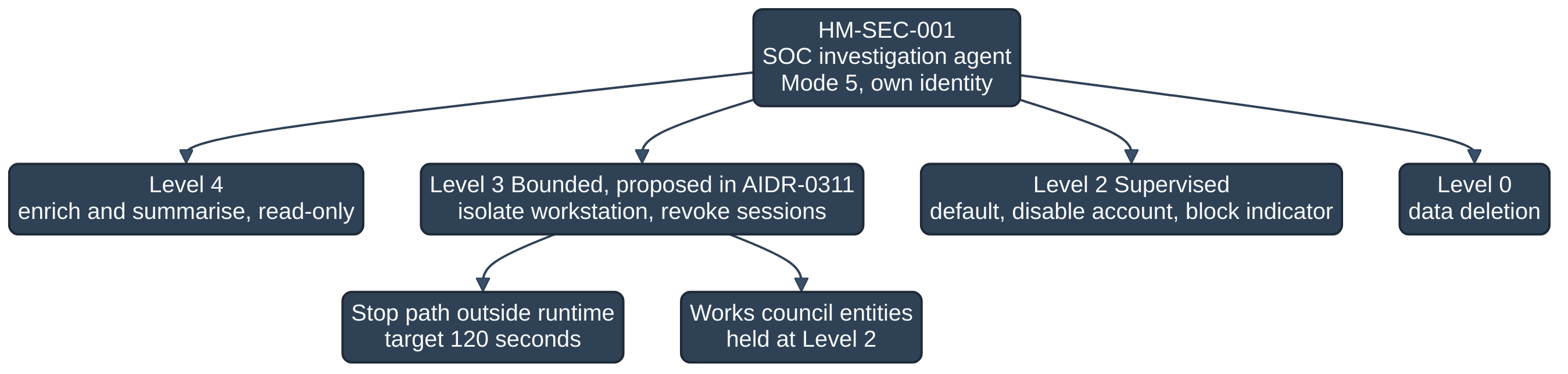
Figure 10.1: Autonomy per action for HM-SEC-001 as AI Red Team establishes it. Level 3 appears as proposed in AIDR-0311 (Chapter 6) and as in force in Chapters 18, 21 and 27; the figure shows the proposal and Chapter 27 shows the open thread.
Controls and parameters
The volume attaches many files to HM-SEC-001. The containment profile agents/hm-sec-001/containment.yaml sets a maximum token lifetime of 5 minutes, 40 steps, 5 proposed actions and 30 minutes of wall-clock time. The degradation modes HM-SEC-001-degradation v1.1.0 are normal, bounded-suspended, advisory and manual. The permission manifest v2.1.0 sets a token lifetime of 15 minutes and at most 10 actions an hour. The containment catalogue allows at most 10 actions an incident and 20 an hour, with automatic release after 4 hours. AIDR-0311 has a ceiling of 3, a stop target of 120 seconds, at most 5 workstations an hour and two entities pending works council agreement. The risk appetite HM-RAS-SECAI v2.1.0 (approved by the executive board on 2027-01-20) sets at most 5 targets an hour, a missed-threat rate of at most 0.02 and a false-containment rate of at most 0.01. The credential profile is hm-sec-001-credentials (AI Red Team, Chapters 4, 5, 6, 14, 17, 18 and 21) (4, Nordqvist, 2026).
The CSF profile is HM-CSF-2027, with gap actions PRG-2027-012 and PRG-2027-031 in the categories GV.OC and DE.AE and controls CTRL-GOV-001, CTRL-GOV-004, CTRL-SOC-012 and CTRL-GW-007. The patching policy HM-PATCH-SLO-2027 v2.1.0 sets classes of exploited-exposed (mitigate within 24 hours, fix within 72), exploited-internal (7 days), likely-exposed with an exploit prediction score of at least 0.5 (7 days) and routine (90 days), a target of 0.95 and agents.mayApplyFixesInProduction: false. The approval policy hm-approvals-synthetic-media v1.3.0 (APR-01, APR-02 and APR-04) asks for a call-back and a second approver above EUR 10,000 and at every payee change, with a cooling-off of 24 hours on payee changes; the threat-profile entry HM-TP-004 adds detection within 15 minutes of an approval that bypasses the call-back and a payment hold playbook within 30 minutes of a report (AI Red Team, Chapters 2, 3, 5, 11 and 14) (4, Nordqvist, 2026).
Decisions and records
| Record | Subject |
|---|---|
| AIDR-0311 | Autonomy ceiling for HM-SEC-001 (Level 3 for two actions) |
| AIDR-0312 | Detection-engineering assistant HM-SEC-002 |
| AIDR-0313 | AI red-teaming programme HM-SEC-003 |
| AIDR-0314 | Continuous red teaming HM-SEC-004 |
| AIDR-0024, AIDR-0027 | Claims-triage agent and IT-operations agent, targets of HM-SEC-003 |
| HM-TP-004 | Threat-profile entry (label observable; links RT-LIB-SE-004, DET-HM-0212, DET-HM-0219, RISK-2027-031); next review 2027-03-31; owner group CISO |
| HM-TLPT-2027-S2 | Emulation plan with TI-HM-2027-04, PM-RT-2027-02, DET-AD-012, DET-AD-014, DET-ID-031, CTRL-DLP-003 |
| HM-DEC-0042 | Decoy register (PB-DEC-003, SCE-DE-019) |
| IQ-CTA-003, RT-LIB-CTA-019, CTRL-AGT-002 | Impact query, library entry and control used in incident work |
| RP-HM-CLM-001, RTS-2027-0533-CLM | Recovery plan for claims and its restore test |
| RTS-CTA-2027-001 | Restore test record of Chapter 23 (recovering AI systems) |
| HM-COMMS-RC-012 | Recovery communication |
| PS-HM-2027-Q3, RoE-HM-2027-PURPLE | Purple session and its rules of engagement |
| SCE-GV-006, SCE-DE-014 | Chaos experiments |
(AI Red Team, Chapters 2, 6, 12, 13, 19, 20, 22, 23, 24, 25 and 26.) (4, Nordqvist, 2026)
The decisions that matter are these. Identity was separated from capability: HM-SEC-001 received its own identity, permission manifest and stop path before any Level 3, so the board could debate specific actions and approve Level 3 for two. The input of an attacker is handled by architecture (a permission manifest and a policy point outside the model) and not by a better prompt, and Level 3 requires independent corroboration from a deterministic detection. Level 2 approvals given within seconds are flagged as possible rubber-stamping and answered by interface changes and training. The agent as subject of an investigation is treated as an insider without an assumption of intent, and the subject does not investigate itself (AI Red Team, Chapters 6, 15, 20 and 27) (4, Nordqvist, 2026).
Events and figures
All dates below are illustrative fiction placed after the dossier's writing date.
| Date | Event |
|---|---|
| 2027-01-20 | HM-RAS-SECAI approved by the executive board |
| 2027-03-04 | Asset record of HM-SEC-001 verified; STIX report on credential misuse against insurance claims portals (with PIR-2027-04) |
| 2027-03-09 02:41 (+01:00) | Incident HM-INC-2027-0142 declared: the claims-triage agent processed injected document content via the Polish service centre; stopped 02:44; classified 02:58; 37 claims rerouted; markets DE, NL, SE, NO; parser logs kept only 7 days |
| 2027-03-09 02:40Z | Incident INC-HM-2027-0412 declared: a stolen service-account credential at the Polish centre read claims data for DE, NL, SE and UK customers and reached the feature store of the underwriting-support model; AI Act 15-day clock, GDPR 72 hours, DORA |
| 2027-03-31 | Next review of HM-TP-004 |
| Quarterly | Purple sessions (PS-HM-2027-Q3 as the example) |
At the first reconciliation of the asset record the group found a connector, a URL-reputation service, that a vendor update had added; the allow-list is now generated from the asset record. The July 2026 incident involving OpenAI and Hugging Face is cited as the reason for own identity and a stop path (AI Red Team, Chapters 2, 9, 19, 20, 21, 26 and 27) (4, Nordqvist, 2026).
TLPT stage S2 (HM-TLPT-2027-S2): steps S2-2 and S2-3 were done in under a minute; the alert was queued as medium and triaged after 47 minutes, and the remedy followed within ten minutes. The lesson is that the detection was not missing but its severity assumed human pace (Chapter 12). Security chaos engineering (HM-SEC-006): the actuator credential lives 30 minutes; in production at most 1 per cent of targets, 3 concurrent experiments and 30 minutes a run; in test 20 per cent; 20 safe runs in test before production; a window of Monday to Thursday, 08:00 to 16:00; sealed from the SOC for 60 minutes. It found a silent failure: a log source at the Polish centre stopped forwarding after an upgrade (Chapters 25 and 27). Red teaming of AI (HM-SEC-003) found an escape path through a deployment service account on the IT-operations agent, which must revoke credentials within 5 minutes with a token life of 15 minutes (Chapter 13).
Recovery. RP-HM-CLM-001 sets a recovery time objective of 240 minutes and a recovery point objective of 15 minutes. RTS-2027-0533-CLM (for incident INC-HM-2027-0533) accepted 212 of 212 checks, measured 205 minutes, and lost 40 minutes of data, which exceeds the recovery point objective. The recovery message release target is 60 minutes, and return to service after recommend-only operation takes 5 working days with a tolerance of 0.02. Reporting clocks: AI Act 15 days, GDPR 72 hours, classification window 60 minutes (AI Red Team, Chapters 21, 22, 23 and 24) (4, Nordqvist, 2026).
Across the degrees of delegation
| Level | Hansa Mutual in AI Red Team |
|---|---|
| Level 0 Advisory | Exposure prioritiser HM-SEC-005; data deletion by HM-SEC-001 |
| Level 1 Assisted | Detection-engineering assistant HM-SEC-002 |
| Level 2 Supervised | Default for HM-SEC-001; disable account; block indicator; entities pending works council agreement |
| Level 3 Bounded | Isolate managed workstation; revoke sessions (HM-SEC-001) |
| Level 4 Autonomous | Read-only enrichment and summaries only; never for offensive or irreversible actions |
The point that the book makes with the table is that the same agent holds different levels for different actions, and that the group moves an action up a level only on evidence (AI Red Team, Chapters 6, 12 and 28) (4, Nordqvist, 2026).
What the volume concludes for Hansa Mutual
Chapter 27 gives the conclusion. Containment times for credential theft fell sharply after Level 3 Bounded; continuous chaos engineering found a silent failure; and the group could argue about specific actions because identity was separate from capability. Works council consultation slowed the rollout and improved the design. The Level 3 decision remains contested: business owners want more automation and the chief risk officer wants a board decision. The 24-month plan runs in three steps. In months 0 to 6 the group reruns HM-SEC-003 after every model change and blocks release at injection thresholds, and measures approval quality for each Level 2 action. In months 6 to 12 it extends Level 3 by one further reversible action only after six months of Level 3 operation without unintended containment, includes HM-SEC-006 in the next TIBER-DE test and tests the stop path from the attacker's side. In months 12 to 24 it brings the UK and Swiss entities into the same reporting-clock configuration and issues a quarterly recoverability report (AI Red Team, Chapter 27) (4, Nordqvist, 2026).
Open threads
Chapter 27 collects these.
- Open thread: three incident identifiers.
HM-INC-2027-0142(Chapters 20 and 23),INC-HM-2027-0412(Chapter 21) andINC-HM-2027-0533(Chapter 22) differ in format and the first two coincide in time (2027-03-09, 02:41+01:00 and 02:40Z). - Open thread: Level 3 limits. Rate limits vary: 5 workstations an hour (Chapter 6), 5 targets an hour (Chapter 5), 10 actions an hour (Chapter 18), 20 an hour in the containment catalogue (Chapter 21). Token life is 5 minutes (Chapter 4) or 15 minutes (Chapters 13, 14 and 18).
- Open thread: Level of HM-SEC-001. Level 2 Supervised in Chapters 4, 5, 9 and 17; Level 3 for two actions in AIDR-0311 (status proposed in Chapter 6) and in Chapters 18, 21 and 27; Chapter 5 allows Level 3 only once evidence supports it. Chapter 1 says the agent can isolate a workstation without waiting for approval, while Chapter 27 holds works council entities at Level 2.
- Open thread: names. The owner is "head of the group SOC" in the profile,
group-soc-leadin Chapter 9 andhead-of-group-socin Chapter 6. One action is "disable-session-token" in Chapter 5 and "revoke-user-sessions" oridp.revoke-sessionsin AIDR-0311 and the manifest. - Open thread: chaos levels. Chapter 25 speaks of production Level 3 for proven experiment types, while the profile names HM-SEC-006 as AI-planned without levels.
- Open thread: risk class of the triage agent. Chapter 20 gives
highRisk: false; Chapter 21 states that the UK and Switzerland have no AI Act duty while Hansa Mutual is provider of the underwriting-support model.
(AI Red Team, Chapters 1, 4, 5, 6, 9, 13, 14, 17, 18, 20, 21, 22, 23, 25 and 27.) (4, Nordqvist, 2026)
Summary
AI Red Team shows Hansa Mutual as a defender that gives AI bounded autonomy per action. It supplies the security organisation, the six security AI systems HM-SEC-001 to HM-SEC-006 with AIDR-0311 to AIDR-0314, the controls and parameters around them, three incident and exercise narratives set in 2027, and a 24-month plan that moves autonomy up only on evidence. The dossier's reading is that the volume treats identity, manifests and the stop path as preconditions of autonomy and not as consequences of it, and that its open threads concern parameters and names more than design.
Sources
- Nordqvist, G. AI Red Team: AI as an Active Part of Cyber Defence in European Enterprises and Public Authorities. (4, Nordqvist, 2026)