Decisions and Records
Hansa Mutual is, in the series, an organisation that decides in writing. Every volume adds records to its file: AI Decision Records, mandate manifests, delegation profiles, incident records, drill records, works-council agreements. This chapter groups them. It shows how the AI Decision Record series is numbered and what question each volume put to the board, lists the other record families and what each is for, sets out who decides what and in what time, and then tells in four themes the decisions that shaped the organisation, including the ones that were declined. It draws on all fourteen volumes. The complete list of identifiers is Appendix A, which is generated from the ledger; this chapter does not repeat it. As in Chapter 21, a record dated on or before 16 November 2026 is established and a later one is illustrative; every record of 2027 and after is illustrative.
The AI Decision Record series
The AI Decision Record, AIDR, is the series' own decision artefact. Each volume reserves a block of one hundred numbers and the two fictional organisations share the block. From AI Blue onwards Hansa Mutual takes the upper half: AIDR-0750 to AIDR-0799 in Book 8, AIDR-0850 to AIDR-0899 in Book 9, AIDR-0950 to AIDR-0999 in Book 10, AIDR-1050 to AIDR-1099 in Book 11, AIDR-1150 to AIDR-1199 in Book 12 AIDR-1250 to AIDR-1299 in Book 13 and AIDR-1350 to AIDR-1399 in Book 14 (Nordvik Region has AIDR-1300 to AIDR-1349) (8, Nordqvist, 2026) (9, Nordqvist, 2026) (10, Nordqvist, 2026) (11, Nordqvist, 2026) (12, Nordqvist, 2026) (13, Nordqvist, 2026). The same holds for the blocks AIDR-0550 to AIDR-0599 in Book 6 and AIDR-0650 to AIDR-0699 in Book 7 (6, Nordqvist, 2026) (7, Nordqvist, 2026). Earlier volumes number differently: Hansa's records in AI Governance and AI Platform and Security run from AIDR-0012 to AIDR-0063, in AI Red Team from AIDR-0311 to AIDR-0314, and in AI Threat between AIDR-0411 and AIDR-0470 (2, Nordqvist, 2026) (3, Nordqvist, 2026) (4, Nordqvist, 2026) (5, Nordqvist, 2026).
Most volumes begin with one question put to the board, and the answer is a later record. The table lists them. The pattern is the backbone of the dossier: each volume is, in effect, the answer to a board question, written as a year of evidence.
| Volume | Opening record | Asked by, of whom | First report | Answer or plan |
|---|---|---|---|---|
| AI Threat (5) | ATA-HM-2026-01, terms of reference AIDR-0411 |
Risk committee of the executive board, of the CRO (October 2026): does AI loss of control belong in the ORSA? | Annual ORSA, and on trigger | AIDR-0412: AI threat enters the ORSA in three forms (5, Nordqvist, 2026) |
| The Transformed Security Architect (6) | AIDR-0550, 2026-10-29 |
Executive board, of the group CISO: can architecture decisions keep pace with agents? | 2027-03-31 | AIDR-0561 and PLAN-HM-SA-2027 (6, Nordqvist, 2026) |
| AI Boss (7) | AIDR-0650, 2026-11-23 |
Executive board, of the CHRO and CRO: a group policy for AI in management | 2027-04-30 | DRF-HM-01, AIDR-0657, AIDR-0677, AIDR-0682; plan AIDR-0690 (7, Nordqvist, 2026) |
| AI Blue (8) | AIDR-0750, 2026-11-24 |
Requester not given in the extract; reviewers the CRO, the head of detection engineering and the chair of the AI governance board | 2027-04-30 | AIDR-0767; plan AIDR-0793 (8, Nordqvist, 2026) |
| AI Purple (9) | AIDR-0850, 2028-01-18 |
Board: does continuous automated red teaming make the quarterly purple session redundant? | 2028-04-30 | AIDR-0891 (no), AIDR-0896; plan AIDR-0899 (9, Nordqvist, 2026) |
| AI Operations (10) | AIDR-0950, 2028-09-19 |
Risk committee, of the group CIO: may the agent's autonomy extend to rollback and failover? | 2029-03-31 | Conditional answer in three parts; plan AIDR-0999 (OPL-HM-2029-01) (10, Nordqvist, 2026) |
| AI Leader (11) | AIDR-1050, 2029-09-17 |
Chief executive, of the CHRO, CRO and group CIO: a leadership profile | 2030-04-30 | AIDR-1097 plan (2030-09-09); HZN-HM-2030-01 (11, Nordqvist, 2026) |
| AI Developer (12) | AIDR-1150, 2030-09-23 |
Requester not given in the extract | 2031-04-28, two days early | DLG-HM-DEV-01 (AIDR-1153); plan AIDR-1182 (12, Nordqvist, 2026) |
| Vibe to Dev (13) | AIDR-1250, 2031-10-13 (builder lane) |
Group Application Development provides the lane | Plan review 2032-04-30 | AIDR-1251, AIDR-1252; four leadership decisions without numbers (13, Nordqvist, 2026) |
| AI Environment (14) | AIDR-1350, 2032-09-27 (the register and the Count rule; counting AI inside Scope 2 and 3 delegated to Dr. Verena Lindner) |
Requester not given in the extract | Register snapshot 2032-12-13 | AIDR-1379 (2032-12-14): a metered fortnight on the Frankfurt rack before any statement on the triage agent (14, Nordqvist, 2026) |
AI Governance and AI Platform and Security have no single opening question. Their first decision records are AIDR-0021 (the claims assistant, accepted 2026-04-20) and AIDR-0012 (the development loop and its prompts), and the earliest board-level date in the extracts is the board review of 2026-10-08 (2, Nordqvist, 2026) (3, Nordqvist, 2026).
The other record families
Around the AI Decision Record grows a set of families, each with a prefix. They are issued by different owners and live in different repositories, but they chain: a use case is approved by a decision, bounded by a mandate, graded by a delegation profile, tested by a drill, and revised by a finding.
| Family | First volume | What it records, with examples |
|---|---|---|
| Use cases, exceptions, exits | 2, 3 | Use cases UC-2026-014 (triage), -031 (correspondence), -044 (health underwriting triage), -052, -022; decisions DEC-2026-031, -044; time-limited exceptions EXC-0004, EXC-2026-012, -021, EXC-112, -113; WAIVER-2026-007; model origin GEO-2026-017; exit plans EXIT-004, -005, -007; engagement ENG-2026-09 (2, Nordqvist, 2026) (3, Nordqvist, 2026) (12, Nordqvist, 2026) |
| Risk and threat | 3, 4, 5 | RA-2026-04; HM-LOOP-04 (poisoned package risk, residual 10 against appetite 12); ATA-HM-2026-01; the threat register THR-HM-01 to THR-HM-13; HM-RAS-SECAI; HM-TP-004; SXR-HM-2026-03; CVP-HM-2026-01 (call-back verification) (3, Nordqvist, 2026) (4, Nordqvist, 2026) (5, Nordqvist, 2026) |
| Mandates and delegation | 3, 6 to 13 | Mandate manifests MND-HM-01, -SOC-01 to -05, -EMU-01 to -07, -CLM-01, -OPS-001, -LDR-01, -DEV-01, -DEV-02, -BLD-2031-01; delegation profiles DLG-HM-CTA-01, -REC-01, -SPS-01, -AB-01, -SOC-01, -EMU-01, -LOOP-01, -OPS-001, -EXE-01, -DEV-01; registers DRF-HM-01, DRF-HM-SOC-01, DRF-HM-LOOP-01, DRR-HM-001; containment CP-HM-ITOPS-01, CP-HM-SOC-01 (6, Nordqvist, 2026) (7, Nordqvist, 2026) (8, Nordqvist, 2026) (9, Nordqvist, 2026) (10, Nordqvist, 2026) (11, Nordqvist, 2026) (12, Nordqvist, 2026) (13, Nordqvist, 2026) |
| Roles, competence, plans | 6 to 13 | Role charters ROLE-HM-* (for example ROLE-HM-SA-AI, ROLE-HM-TL-01, ROLE-HM-SOC-01, ROLE-HM-CEO-01, ROLE-HM-DEV-01); competence records CMP-HM-*; plans PLAN-HM-SA-2027, -MGT-2027, -BT-2027, -LOOP-2028, OPL-HM-2029-01; horizon registers HZN-HM-* (6, Nordqvist, 2026) (7, Nordqvist, 2026) (8, Nordqvist, 2026) (9, Nordqvist, 2026) (10, Nordqvist, 2026) (11, Nordqvist, 2026) (12, Nordqvist, 2026) |
| Incidents, problems, findings | 2 to 13 | INC-HM-*, PIR-HM-*, spend incident SPD-2026-007, problem PRB-HM-0019, findings FND-HM-* (2, Nordqvist, 2026) (8, Nordqvist, 2026) (9, Nordqvist, 2026) (10, Nordqvist, 2026) (12, Nordqvist, 2026) |
| Tests, drills, exercises | 4 to 13 | Stop-path records SPT-HM-ITOPS-*, STOP-HM-ITOPS-*; restore tests RST-HM-*; dark days DKD-HM-*; game days SDF-HM-*; emulation EMU-HM-*, purple sessions PRP-HM-*, regression cases REG-HM-*; tabletops TTX-HM-*; rules of engagement RoE-HM-* (5, Nordqvist, 2026) (6, Nordqvist, 2026) (8, Nordqvist, 2026) (9, Nordqvist, 2026) (10, Nordqvist, 2026) |
| Evidence and coverage claims | 5 to 12 | Coverage COV-HM-0112, independence IND-HM-2028-Q1, LPG-HM-2028-Q1, BTP-HM-2027-Q3, oversight quality OQM-HM-*, evaluation EVL-HM-2028-03, adoption and value ADP-HM-*, AVR-HM-2030-01, board pages MGT-HM-2026-Q4, BRD-HM-001, accountability ACC-HM-* (5, Nordqvist, 2026) (8, Nordqvist, 2026) (9, Nordqvist, 2026) (10, Nordqvist, 2026) (11, Nordqvist, 2026) (12, Nordqvist, 2026) |
| People decisions and works agreements | 7 to 12 | MDR-HM-0001, -0070; contestation CNT-HM-0001; disparate-impact tests DIT-HM-*; KBV-IT-2024 with annexes -OPS, -SOC-04, -SOC-05, -DEV-01; KBV-LDR-2030-01; TCH-HM-CLM-01; leadership decisions LDR-HM-* (7, Nordqvist, 2026) (8, Nordqvist, 2026) (10, Nordqvist, 2026) (11, Nordqvist, 2026) (12, Nordqvist, 2026) |
| Environmental records | 14 | Footprint FPR-HM-0001 to -0007; benefit BEN-HM-0001, -0002; budgets EBG-HM-0001 to -0006; claim CLM-HM-0001; placement PLC-HM-0001; supplier disclosure SDR-HM-0001 to -0003 and comparison sheet HCS-HM-2032-11; hardware lifecycle HWL-HM-0001; model choice MCR-HM-0001; watch list WCH-HM-0001; mandate MND-HM-ENV-0001 and delegation DLG-HM-ENV-0001; role charter ROLE-HM-ENV-02; clause family HM-PROC-ENV-01 to -10; the register file register/environment-hm.yaml (illustrative) (14, Nordqvist, 2026) |
| Services, changes, engineering records | 10 to 13 | Services SVC-HM-001 to -008, objectives SLO-HM-*, runbooks RBK-HM-*, changes CHG-HM-*, capacity CAP-HM-*, observer OBS-HM-*; specification SPC-, ownership OWN-, verification VER-, review RVW-, run RUN-, provenance PRV-; builds BLD-, hand-over HND-, lane LANE-HM-2031-01 (10, Nordqvist, 2026) (12, Nordqvist, 2026) (13, Nordqvist, 2026) |
Two features of the numbering matter for reading. Hansa Mutual numbers its change records from CHG-HM-6000 in AI Operations, while CHG-HM-5521 and CHG-PL-2291 belong to earlier volumes. And renumbering happens: AI Boss notes that some of its AI Decision Records were renumbered, and AI Blue changed an incident identifier after editorial review, which is why Chapter 21 lists the incident identifiers of 9 March 2027 side by side and Chapter 27 records the rest (7, Nordqvist, 2026) (8, Nordqvist, 2026).
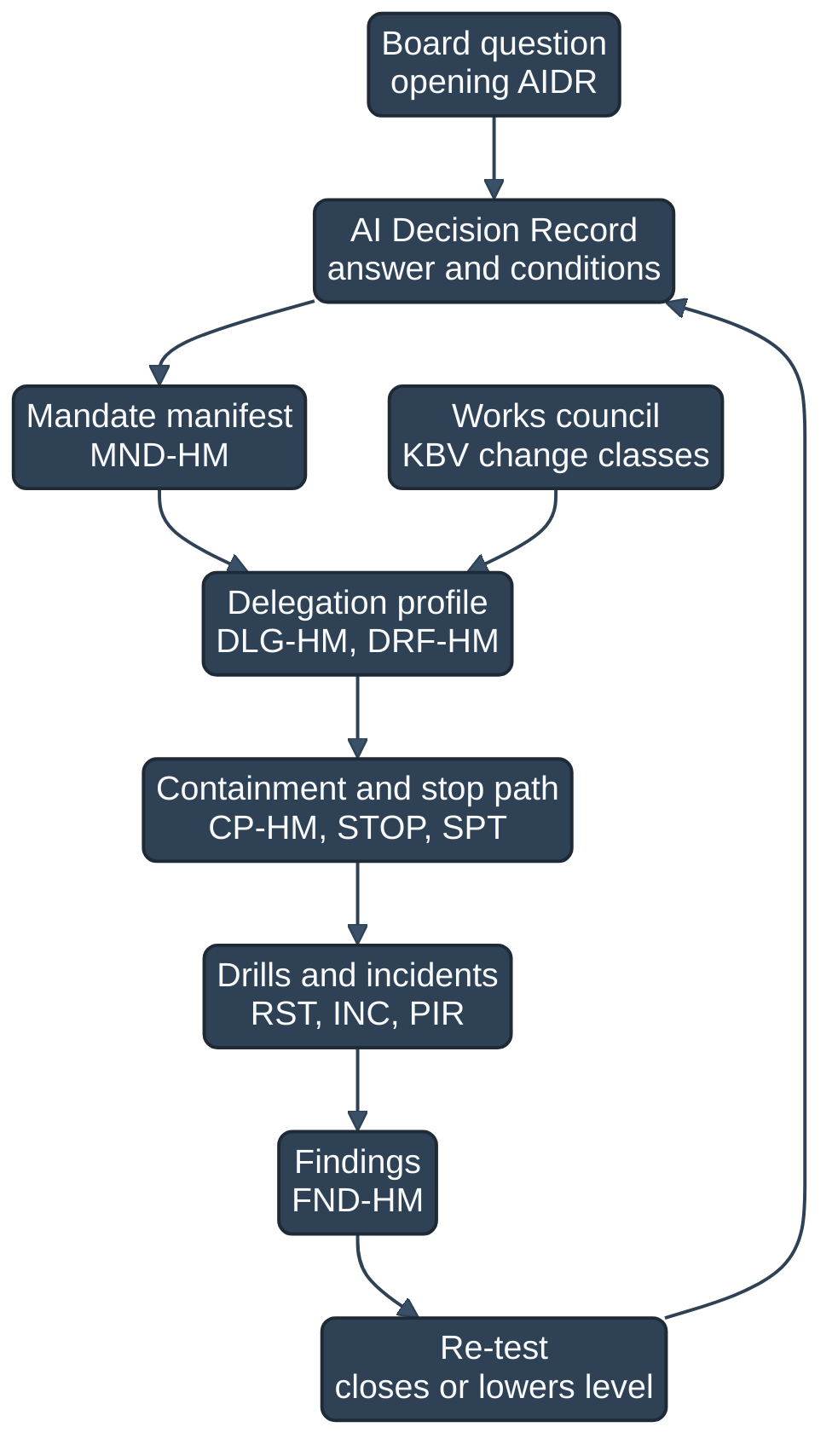
Figure 22.1: How the record families chain. The opening question is answered by an AI Decision Record, which is bounded by a mandate and graded by a delegation profile; drills and incidents produce findings, and a re-test either closes the finding or lowers the level.
Who decides
Decision rights are the second thing the volumes establish. They sit at four tiers in the security architecture charter (pipeline gate, design authority, group AI governance board, executive board) and are completed by the decision rights register of AI Leader, by the change classes of the works agreement and by the seats of the landscape model (6, Nordqvist, 2026) (11, Nordqvist, 2026) (7, Nordqvist, 2026) (15, Nordqvist, 2026).
| Decision | Decided by | Time limit or condition | Source |
|---|---|---|---|
Approve an AI system for a consequential use (DEC-HM-001) |
Business executive of the function the system serves | 10 working days | (11, Nordqvist, 2026) |
AI budget envelope (DEC-HM-002) |
CFO | In the budget round | (11, Nordqvist, 2026) |
Accept residual risk above tolerance (DEC-HM-003) |
CRO | 5 working days | (11, Nordqvist, 2026) |
Stop an AI system or revoke an agent identity (DEC-HM-004) |
Holder set: group CISO, system owner, agent operator | Immediate, no prior approval | (11, Nordqvist, 2026) |
Change a system's own mandate, oversight or stop path (DEC-HM-005) |
CRO | 10 working days; Level 4 never | (11, Nordqvist, 2026) |
| Autonomy level above Level 2 | Group AI governance board (chaired by the CRO); design authority approves levels inside MND-HM-01 (AIDR-0567) |
Veto of the AI domain architect on a Mode 5 go-live without a tested stop path | (8, Nordqvist, 2026) (6, Nordqvist, 2026) |
| Risk acceptance of a finding | Group CISO | 90 days; the finding's author, the closure owner and the red team lead may not accept | (9, Nordqvist, 2026) |
Patch classes exploited-exposed and exploited-internal |
Platform engineer on call and SOC duty analyst, by delegation (AIDR-0554) |
Mitigate 24 hours, fix 72 hours; the pipeline applies the fix | (6, Nordqvist, 2026) |
| Change to individual metrics, behavioural input or use in a consequential decision | Class 1: Konzernbetriebsrat consents. Class 2: joint IT committee, 10 working days. Class 3: information | The owner cannot lower a class; the council can raise it | (7, Nordqvist, 2026) |
Scope of a builder's data use (AIDR-1251) |
Data protection officer with the head of claims operations | Injury claims out of scope | (13, Nordqvist, 2026) |
Environmental budget above 2,500 kWh a month, every Mode 5 budget, every facility budget and every claim before publication (AIDR-1374) |
Group AI governance board; the group CIO below the 2,500 kWh line | Evidence ages: footprint 90 days, benefit 180, drill 90, supplier disclosure 12 months, claim at most the reporting year, hardware record 90; review 14 days before expiry, one extension of at most 30 days | (14, Nordqvist, 2026) |
| Decision right over agents with production write access | Executive board (tier T4) from 2027-03-31; allocation of claims to people at CHRO and CRO (tier T3) from 2027-04-30; ambient AI at the head of group AI platform (tier T2) from 2027-09-30 | Seats of the landscape model | (15, Nordqvist, 2026) |
The stop right is deliberately asymmetric. The right to start something is slow and held by named offices, the right to stop is immediate and held by a set of roles, and in AI Operations it is held by the incident commander, the agent operator and the platform engineer on call without any approval (11, Nordqvist, 2026) (10, Nordqvist, 2026). The executive board is the management body for DORA and holds the ultimate responsibility for ICT risk, so every chain ends there (11, Nordqvist, 2026).
Decisions that shaped the organisation
Bounding what already acted. Hansa Mutual did not wait for a complete inventory before it bounded its agents. AIDR-0021 chose retrieval over fine-tuning for the claims assistant after a comparison in which keyword search found 61 per cent and retrieval 88 per cent, with gate criteria of faithfulness at least 0.95, citation accuracy at least 0.98 and cost at most EUR 0.04 per answer (3, Nordqvist, 2026). EXC-0004 accepted a hosted model's limits on reproducibility through a time-limited exception with compensating controls and not by ignoring the principle (2, Nordqvist, 2026). AIDR-0027 gave the IT-operations agent write access to three namespaces for reversible actions and rejected a fully autonomous action because its blast radius could not be bounded (3, Nordqvist, 2026). The market dimension was in the first manifest and made the rest possible: tool calls, tokens, events and logs carry the market of the claim (3, Nordqvist, 2026).
Autonomy per action. The SOC agent HM-SEC-001 was given its own identity, a permission manifest and a stop path outside the runtime before it was given more autonomy. AIDR-0311 allows Level 3 for two reversible actions, isolating a workstation and revoking sessions, keeps every other action at Level 2 and puts data deletion at Level 0 (4, Nordqvist, 2026). AI Threat records, among the things the group declined, Level 3 for the agent "for now" (5, Nordqvist, 2026); and in January 2028 a seeded test found a restraint failure; the level was cut to 2 on the same day and restored on 2028-03-13 by AIDR-0863 after 49 days (5, Nordqvist, 2026) (9, Nordqvist, 2026).
Decisions about people. The group reclassified its own agent. AIDR-0651 asked what the triage allocation does to individuals, found that it fell under Annex III point 4(b) and removed a capacity factor built on throughput in release 7.0 (7, Nordqvist, 2026). The contestation CNT-HM-0001 showed that an advisory score had become decisive for pay in one unit. AIDR-0677 then negotiated how change is governed, in three classes, instead of each version. DRF-HM-01 records a list of consequential decisions that throughput may feed, and that list is empty (7, Nordqvist, 2026). In the blue team, AIDR-0775 changed the career pyramid with no dismissals (8, Nordqvist, 2026); in leadership, AIDR-1051 decided against a chief AI officer and AIDR-1070 reformulated the adoption target as feature events and set no new percentage (11, Nordqvist, 2026).
What a claim may say. AI Environment turns the rule of evidence age on the group's own public statements. The board's sentence about efficiency was held (AIDR-1361); a draft that said "100 per cent renewable and carbon neutral" was arithmetically defensible and misleading, and both electricity bases are carried side by side; the narrow claim that replaced it withdrew itself when it expired on 2033-01-26 (CLM-HM-0001), and a narrow claim that has lapsed is not a licence to resume the broad one (14, Nordqvist, 2026).
Evidence and its age. From 2028 the decisions turn on what evidence stands behind a level. AIDR-0891 kept the quarterly purple session after a pipeline of continuous emulation proved to generalise less well, and AIDR-0892 ordered the planner and curator onto a second model family by 2028-07-31 (9, Nordqvist, 2026). In operations the answer to AIDR-0950 was that no level rises without a verified claim, a seeded-fault result and a stop drill inside its target; none rose in the year (10, Nordqvist, 2026). In development, AIDR-1161 made the single Level 3 class of AIDR-1153 live only while its revert rehearsal is at most 90 days old, and AIDR-1186 bars tool-assisted COBOL translation until the replay oracle covers the quarter-end settlement run (12, Nordqvist, 2026).
What was declined, held or conditioned
A record is as informative for what it refuses as for what it grants. The following were declined or granted on conditions.
| Record | What was not done | What was done instead | Source |
|---|---|---|---|
AIDR-0021 |
Fine-tuning | Retrieval over the terms | (3, Nordqvist, 2026) |
AIDR-0027 |
A fully autonomous action | An agent with reversible actions only; asymmetric retirement criteria | (3, Nordqvist, 2026) |
AIDR-0034 |
A full go-live (2026-11-01) | Property claims only, 30 per cent of handlers, six weeks from 2026-11-04, a spend ceiling of EUR 4,000 per month | (3, Nordqvist, 2026) |
AIDR-0412 and the conclusions of AI Threat |
A probability for THR-HM-09 and -13; withdrawal of the agents; Level 3 for HM-SEC-001 for now |
Reverse stress tests without probability; the challenger's label "expected" noted, not adopted | (5, Nordqvist, 2026) |
AIDR-1051 |
A chief AI officer | Duties to the AI governance board and the head of group AI platform; review March 2031 | (11, Nordqvist, 2026) |
Answer to AIDR-0950 |
Any rise in level | Conditions for rollback and failover | (10, Nordqvist, 2026) |
AIDR-1071, AIDR-0670 |
Wellbeing and collaboration analytics | Switched off until a works agreement covers them | (11, Nordqvist, 2026) (7, Nordqvist, 2026) |
AIDR-0787 |
A second agent reading case notes | The second agent does not read them | (8, Nordqvist, 2026) |
AIDR-1361 |
The board's sentence "AI work at the group became more efficient in the year to August 2032" | Held until a claim record exists; a narrow claim followed (CLM-HM-0001, revision 2, one use, one pool, one boundary, in energy) |
(14, Nordqvist, 2026) |
AIDR-1375 |
Doubling the engineers' tool licences (2033-02-15) | 700 licences kept until energy per session and a controlled trial exist | (14, Nordqvist, 2026) |
AIDR-1377 |
Renewal of claim revision 2 (2033-05-10) | The sentinel pool no longer represents the use; a renewed claim needs a production-boundary reading from tagged rack meters | (14, Nordqvist, 2026) |
Summary
Three conclusions follow from the records. First, the decision file is the organisation's memory, and it is built in layers that point at one another: a question, an answer, a mandate, a profile, a drill, a finding. A reader who wants to know why a level is where it is can follow the chain without leaving the file. Second, the volumes agree on who decides far better than on how identifiers are written: the four tiers, the asymmetric stop right and the three change classes are stable from The Transformed Security Architect to Vibe to Dev, while numbers are re-dated and reused (Chapter 27). Third, the most informative records are refusals and conditions. The group repeatedly chose to grant less than was asked and to attach to each grant a clock and a test, which is the reason Chapter 23 is about evidence age.
Sources
- Nordqvist, G. AI Governance: Governing Artificial Intelligence in European Enterprises and Public Authorities. (2, Nordqvist, 2026)
- Nordqvist, G. AI Platform and Security: Building and Securing AI Platforms in European Enterprises and Public Authorities. (3, Nordqvist, 2026)
- Nordqvist, G. AI Red Team: AI as an Active Part of Cyber Defence in European Enterprises and Public Authorities. (4, Nordqvist, 2026)
- Nordqvist, G. AI Threat: Are the Dystopias Coming True? Evidence, Risk and Response for European Enterprises and Public Authorities. (5, Nordqvist, 2026)
- Nordqvist, G. The Transformed Security Architect: Role, Craft and Career in the Age of AI in European Enterprises and Public Authorities. (6, Nordqvist, 2026)
- Nordqvist, G. AI Boss: When Artificial Intelligence Manages People in European Enterprises and Public Authorities. (7, Nordqvist, 2026)
- Nordqvist, G. AI Blue: How Artificial Intelligence Transforms the Blue Team in European Enterprises and Public Authorities. (8, Nordqvist, 2026)
- Nordqvist, G. AI Purple: How Red and Blue Learn Together When AI Joins the Loop in European Enterprises and Public Authorities. (9, Nordqvist, 2026)
- Nordqvist, G. AI Operations: How Artificial Intelligence Transforms IT Operations in European Enterprises and Public Authorities. (10, Nordqvist, 2026)
- Nordqvist, G. AI Leader: How Leadership Roles Change When AI Is Used Broadly in European Enterprises and Public Authorities. (11, Nordqvist, 2026)
- Nordqvist, G. AI Developer: How the Developer Role Changes When AI Is Used Broadly in European Enterprises and Public Authorities. (12, Nordqvist, 2026)
- Nordqvist, G. Vibe to Dev: From Vibe Coding to Professional Software, Step by Step, for Builders Who Are Not Developers, in European Enterprises and Public Authorities. (13, Nordqvist, 2026)
- Nordqvist, G. AI Environment: Designing AI for the Greatest Benefit and the Least Environmental Harm in European Enterprises and Public Authorities. (14, Nordqvist, 2026)
- Nordqvist, G. Landscape: A Fact-Based Picture of Architecture and AI at Work, for Leaders, Architects and Citizens. (15, Nordqvist, 2026)