Book 12, AI Developer: Owning the Software
This chapter gathers what AI Developer (Book 12) establishes about Hansa Mutual: the development organisation and its platform, the legacy estate and the people who keep it running, the coding assistants and the single agent mandate, the delegation profile with its one Level 3 class, the ownership, verification and review records, the two incidents that frame the volume's argument, and the decisions with which the volume ends. It draws on AI Developer, Chapters 1 to 33, and on the development profile that the volume adds to the example-organisation file (12, Nordqvist, 2026). Chapter 16 of this dossier covers operations and Chapter 17 the leaders who own the delegation profile.
Two kinds of fact appear. The development profile (headcounts, platform, estate, contracts, roles) is established. The volume's year, September 2030 to August 2031, written in November 2026, is illustrative fiction, and every figure of the year, including the dashboard and sample percentages, is illustrative; the volume says so in its open points (12, Nordqvist, 2026).
The volume in brief
AI Developer asks what happens to the developer, and to the development organisation, when AI writes, reviews, tests and deploys code across the organisation: in the editor, the pull request, the pipeline, the ticket, the legacy migration and the citizen's low-code application. Its thesis has five parts. The developer is transformed, not abolished, from author of code to framer, verifier and steward of software. Delegation of development work is graded and has a ceiling, and Level 4 is never used for a change to production without a gate the change cannot alter, for code in a security-critical or safety-critical path without review by a named developer, for a change to the agent's own mandate, permissions, credentials, test oracles, review rules or pipeline gates, for an irreversible action on production data, or for a decision about a named person's employment, pay, performance rating or access to work. Verification, not generation, becomes the scarce skill, and the junior pipeline must be rebuilt. AI may draft, generate, refactor and, within a mandate, execute, but may not own: the stewardship principle asks of a named developer or team three tests, Name, Understand and Revert, with the corollary that the test oracle must be independent of the generator. Productivity, quality and competence are claims that need evidence. The five developer functions are D1 Frame, D2 Design, D3 Build, D4 Prove and D5 Steward, not to be confused with the operations functions O1 to O5 or the leadership functions L1 to L5 (12, Nordqvist, 2026).
The role of Hansa Mutual in the volume
Hansa Mutual is the volume's large, financially supervised organisation: about 480 people in Group Application Development, about 290 developers, 62 delivery teams, 190 external developers and an internal developer platform, Hansa Forge, of 24 people. It shows what follows when an organisation can build its own controls (gateway, package proxy, sandbox, identity) but is short of review hours, holds a board claim without an evidence age ("42 per cent AI-assisted"), and depends on a legacy system of 6.5 million lines of COBOL and PL/I maintained by twelve people. The volume uses it to show four things: that the stewardship tests Name and Understand could fail without AI (INC-HM-2029-0207) and be passed with AI (INC-HM-2030-0364); a single delegation above Level 2 that falls to Level 2 by its own rule when its evidence ages past 90 days; that an independent oracle and a review that records "not covered" can work, while a gap without an owner and a date still lets a fault through; and that legal fragmentation across seven jurisdictions requires the strictest reading everywhere until a mapping is done (12, Nordqvist, 2026).
What the volume establishes
Organisation and platform
Group Application Development has about 480 employees under Dr. Philipp Reinhardt, who reports to the group CIO, Rainer Lehmann. Hamburg has about 260, Poland about 120, Frankfurt about 60 and market liaisons in the Netherlands, Sweden, Norway, the United Kingdom and Switzerland about 40.
| Group | Size |
|---|---|
| Developers | about 290, of whom about 45 tech leads |
| Testers and quality engineers | about 85 |
| Product owners and analysts | about 60 |
| Architects and designers | about 25 |
| Engineering managers | 20, with spans of 20 to 25 |
| Delivery teams | about 62, of seven to nine people |
| External developers | about 190: about 110 from the nearshore partner Wiślana Software (framework HM-PROC-DEV-2026-02) and about 80 from two consultancies |
| Hansa Forge | 24 people in Group Infrastructure and Cloud, head Lukas Frey: golden paths, CI/CD, package proxy, scanning, the gateway from code tools to models |
The group AI platform team (Anja Weiß) runs the AI gateway and the evaluation service, and site reliability is about 95 people (Tobias Richter). The low-code tool Flowdesk has about 400 builders and 150 applications, 23 of which hold personal data; a sweep classed 96 as tier A, 31 as B and 23 as C, after the first quarter 9 met the criteria, 11 were being remedied and 3 were retired, and one prototype outside Flowdesk was found by counting traffic (12, Nordqvist, 2026).
The estate
Claims core SVC-HM-001 is written in Java (2016, about 2.4 million lines) with a COBOL settlement module from 2004 behind SVC-HM-004. The customer portal and broker interface SVC-HM-005 is TypeScript and Java on Cloud A. Policy administration and premium collection SVC-HM-003 is a mainframe in hansa-dc-frankfurt of about 6.5 million lines of COBOL and PL/I written 1989 to 2008, with JCL batch, run at night by Alster Managed Services. A mobile claims app and a broker plug-in are published. There are 410 services, with infrastructure and policy as code under GitOps. Twelve people maintain the COBOL and PL/I estate, with a mean age of 54 (illustrative), and five are within eight years of retirement (12, Nordqvist, 2026).
People
| Person | Role in the volume |
|---|---|
| Dr. Philipp Reinhardt | head of Group Application Development; accountable for use of DLG-HM-DEV-01 and the mandates; manufacturer duties under the Cyber Resilience Act sit with him (AIDR-1174) |
| Rainer Lehmann; Dr. Annette Krämer | group CIO and owner of the delegation profile; CRO, its reviewer and "partner" |
| Ralf Hauser | senior COBOL and PL/I engineer, 31 years; ROLE-HM-DEV-01; one of the five near retirement; owner of OWN-HM-2030-07 (the settlement module) since 2030-10-21; user in the explainer pilot; has the right to decline sole approval |
| Aylin Demir | junior in the claims portal team, hired September 2030 from the apprenticeship scheme; ROLE-HM-DEV-02; APR-HM-2030-01; CMP-HM-2030-DEV-02 (Foundation) |
| Stefan Brückner | tech lead of the claims core delivery team in Hamburg (nine people); ROLE-HM-TCL-01; owner of the 42 % figure in his team and of MND-HM-DEV-02; steward in INC-HM-2030-0364 |
| Ewelina Maj | test engineer in the Polish service centre; ROLE-HM-QA-01; owns the oracle for the settlement module and the replay; asks "who writes the oracle?" |
| Lukas Frey; Daniel Fischer | head of Hansa Forge (ROLE-HM-PLT-01); platform engineer who read the dependency proposal in March 2031 |
| Jörg Albers; Jens Albers | senior developer and mentor to Demir (practice plan CMP-HM-2030-DEV-P01); engineering manager with a span of 24 |
| Dr. Marit Sommer; Tomasz Kowal | reviewers of RVW-HM-2030-0412 |
| Marlene Voss; Thomas Brandt; Ulf Zimmermann | chief HR officer; chair of the Konzernbetriebsrat; general counsel |
The head of the broker interface team is unnamed. Hansa has no chief AI officer (AIDR-1051); the CRO chairs the AI governance board (12, Nordqvist, 2026).
Tools, modes and contracts
| Identifier | What | Mode and level | Record |
|---|---|---|---|
HM-DEV-001 |
IDE assistant (CodeMeridian, contract HM-PROC-AIDEV-2029-01, exit EXIT-005, licences LIC-HM-DEV-01) |
Mode 2; 340 licences since January 2030 | AIDR-1151 (January 2030, retroactive); AIDR-1176 |
HM-DEV-002 |
test-draft assistant | Mode 4, Level 1 | AIDR-1152 (dated only "2030") |
HM-DEV-003 |
legacy explainer | Level 0; pilot with four of twelve mainframe developers | AIDR-1162 |
| Agent tools through the Hansa Forge gateway | about 120 engineers, in a sandbox, through pull requests, never merging to a protected branch | Mode 3 | |
| Operations agent | Mode 5 under AI Operations | AIDR-0027 |
The contract clauses are no training on the group's code, processing in the EU and 30 days' notice of a model change. Mode 0 ambient AI sits in IDEs, the repository platform and Alster's own code assistance for mainframe batch, a blind spot recorded as "not asserted" in provenance. No coding agent merges or deploys by itself (12, Nordqvist, 2026).
Representation and law
The Konzernbetriebsrat co-determines under BetrVG section 87(1) no. 6. KBV-IT-2024 has annexes -OPS-01 to -03 and -SOC-04 and -05. The IDE assistant was introduced in January 2030 under an interim agreement with the local works council in Hamburg; the Polish representatives and the Dutch ondernemingsraad (consent under WOR Article 27) were informed later and want the same terms. The draft annex KBV-IT-2024-DEV-01 (autumn 2030) has telemetry per team with a minimum group of five, no acceptance rates in assessment or pay, and a rule on prompts and logs. On law, DORA applies to the EU entities (the register of information holds HM-PROC-AIDEV-2029-01 and the third-party policy requires an exit plan, while EXIT-004 concerned something else); the Cyber Resilience Act question concerns the mobile app and plug-in; NIS 2 Article 21(2)(e) bears on the nearshore partner; the UK and Switzerland are outside the AI Act and the CRA; Hansa is provider of the underwriting-support model (Annex III point 5(c)) (12, Nordqvist, 2026).
Decisions and records
The delegation profile and mandates
DLG-HM-DEV-01 version 1.0 (AIDR-1153, 2030-09-30; owner Lehmann, reviewer Krämer, review 2031-03-30) grades each class of development work.
| Class | Level | Condition |
|---|---|---|
| Specify | Level 1 | |
| Design | Level 0 | |
| Generate | Level 2 | outside security-critical and payment paths; Level 1 inside them |
| Refactor | Level 2 | |
| Test | Level 1 | oracle written by someone other than the author of the change |
| Review | Level 1 | an AI comment never counts as one of the two human approvals |
| Deploy, operate, migrate | Level 0 | |
| Document | Level 2 | |
| Patch-level dependency updates | Level 3 Bounded | outside security-critical and payment paths, all pipeline checks pass, update on the approved list, merged by the pipeline after human approval of the class (MND-HM-DEV-01) |
| People class | not delegated |
MND-HM-DEV-01 (the dependency class) was in force from 2030-10-14, owner Lukas Frey, accountable Reinhardt. MND-HM-DEV-02 version 2 (the claims core pilot, AIDR-1158, in force 2030-10-07) has budgets of 45 minutes, 200 tool calls, 25 files and EUR 6 a run; it may not write to verification/oracle/** or to security-critical or payment paths, and it notifies the owner when a package name is denied; review 2031-01-07. The gate-and-revert rule (AIDR-1161, dated 2030-11-04, in force 2030-11-11) keeps the Level 3 class alive only while a revert rehearsal is at most 90 days old and at least two developers hold current verification evidence (12, Nordqvist, 2026).
Records
The volume's range is AIDR-1100 to AIDR-1199, with Nordvik Region at 1100 to 1149 and Hansa Mutual at 1150 to 1199. Hansa's records are 1150 (2030-09-23, the request), 1153 (the profile), 1156 (2030-11-18, ADR template with an AI field), 1158, 1161, 1162 (2030-10-21, COBOL list), 1164 (ROLE-HM-DEV-01, undated), 1166 (2031-01-20, error-budget pilot for SVC-HM-005), 1171 (2030-12-09), 1172 (2031-01-27), 1173 (2030-12-18), 1174 (2031-02-03), 1175 (2031-02-24), 1176 (2031-01-27), 1177 (2031-02-04), 1178 (2031-02-11), 1179 (2031-04-22), 1180 (2031-02-17), 1182 (2031-09-08), 1183 (2031-08-29), 1185 (2031-03-28), 1186 (2031-05-12) and 1187 (2030-11-11, practice plan). Further artefacts are OWN-HM-2030-00 (the COBOL estate, owned by the department Policy Systems), AVR-HM-2030-01, APR-HM-2030-01, HZN-HM-2031-01, DRR-HM-001-LEG (extended with developer_duties), RST-HM-2031-0001 (2031-01-08), RST-HM-2031-0002 (2031-01-19, exit test 0.91 against 0.90 on 150 tasks) and RST-HM-2031-0004 (2031-06-26), ROL-HM-001 and FRZ-HM-2028 from AI Operations, the team agreement teams/claims-core-hamburg/working-agreement.yaml (version 1.0, 2030-10-14, review 2031-01-13) and KBV-IT-2024-DEV-01 (12, Nordqvist, 2026).
Changes and verification records: CHG-HM-2030-0412 (deductibles and caps in property claims, SVC-HM-001, agent draft, with RUN-HM-2030-0188, VER-HM-2030-0007, RVW-HM-2030-0412, SPC-HM-2030-0031 and FND-HM-2030-0021); PRV-HM-2030-0014 for the portal change CHG-HM-2030-0388 (RUN-HM-2030-0231, VER-HM-2030-0044, RVW-HM-2030-0388, OWN-HM-2030-0031); CHG-HM-2030-0415 (logging library in SVC-HM-005, class-approved); CHG-HM-2030-0418 with VER-HM-2030-0004 and SPC-HM-2030-0011; SPC-HM-2030-0001 (shorter claim notification in SVC-HM-005). Findings: FND-HM-2030-0012 (a hallucinated package name, March 2030, with two more rejected the month before) and FND-HM-2031-0004 (a supply-chain incident, advisory 2031-03-04); the rules of engagement for the toolchain test are RoE-HM-2030-DEV-01 (12, Nordqvist, 2026).
Decisions of the year
AIDR-1162 lists the COBOL estate by named owner and deputy by the end of January 2031, the settlement module first, keeps HM-DEV-003 at Level 0 with four users and three recorded conversations with senior engineers (two done, the third in February). AIDR-1186 allows no tool-supported COBOL or PL/I translation before Maj's oracle covers the quarter-end settlement run. AIDR-1173 requires a finding with an owner and a date before merge for any "not covered" entry in a review. AIDR-1172 sets interim terms across the group's companies: no report per named developer, no acceptance rates in assessment or pay, licences at most 340, agent pilot not widened; the annex was unsigned at year end. AIDR-1174 treats the mobile app and the broker plug-in as in scope of the Cyber Resilience Act until the lawyer decides, with Reinhardt holding the manufacturer duties (Lukas Frey deputy), a CRA clock in the case record, ten years of evidence retention and a field for AI-generated parts in provenance; the partner's DORA classification stays open and the strictest reading applies. AIDR-1176 and EXIT-005: the exit test passed at 0.91 and lapsed after 180 days, on 2031-07-18 (12, Nordqvist, 2026).
Events and figures
Before and during the year
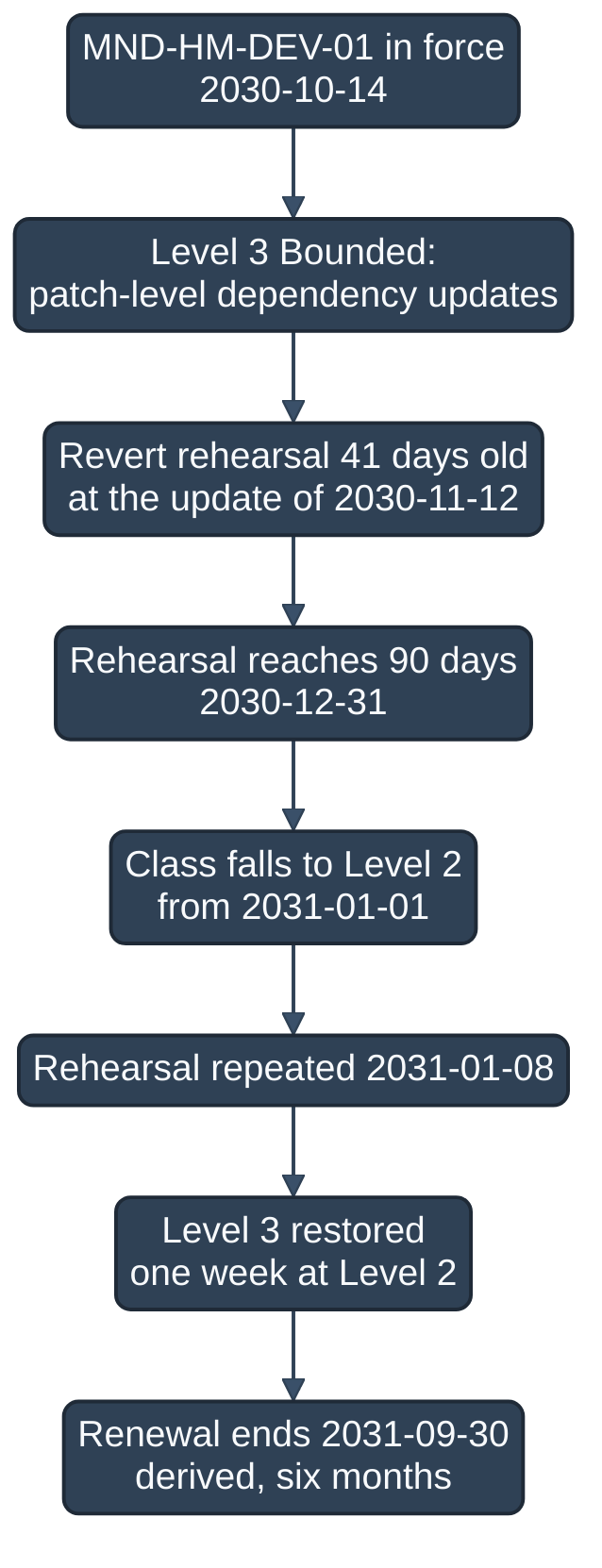
Figure 18.1: The Level 3 dependency class under DLG-HM-DEV-01. Dates are illustrative; the renewal end is derived by the volume from a six-month term.
| Date | Event |
|---|---|
| 1989 to 2008; 2004; 2016 | the COBOL platform is written; the settlement module; claims core |
| June 2029 | INC-HM-2029-0207: 312 claims paid twice by the settlement module, approved by the only other person who knew it; no AI took part |
| January 2030 | HM-DEV-001 introduced with 340 licences under the interim agreement in Hamburg |
| February 2030 | the dashboard's 42 % goes to the board |
| March 2030 | FND-HM-2030-0012, stopped by the package proxy |
| August 2030 | the audit finds 14 of 410 services without an active owner; a sample of 40 pull requests gives 27 % |
| 2030-09-23, 09-30 | AIDR-1150; DLG-HM-DEV-01 |
| 2030-10-07 to 10-14 | MND-HM-DEV-02 version 2 in force; the team agreement adopted, the 42 % withdrawn from the team's reporting, negotiation on KBV-IT-2024-DEV-01 opened, MND-HM-DEV-01 in force |
| 2030-10-21 | AIDR-1162; CHG-HM-2030-0412 merged |
| 2030-11-12 | a dependency update, with the revert rehearsal 41 days old |
| 2030-12-04 | INC-HM-2030-0364 raised |
| 2030-12-31 | the rehearsal for MND-HM-DEV-01 reaches 90 days; the class is at Level 2 from 2031-01-01 |
| 2031-01-07 to 01-12 | MND-HM-DEV-02 review (no outcome recorded); 01-08 rehearsal repeated and Level 3 restored after one week; 01-12 stop path exercise (no outcome recorded) |
| 2031-03-04 | advisory on json-schema-check 5.1.6 (FND-HM-2031-0004) |
| 2031-03-28 | profile review (AIDR-1185), moved from Sunday 2031-03-30; the broker team's apprentice decision reversed (two apprentices in 2031) |
| 2031-04-22, 04-28 | HZN-HM-2031-01; first report, two days early |
| 2031-06-26 | settlement exercise with assistants switched off |
| 2031-07-18 | exit evidence reaches 180 days (derived) |
| 2031-08-26 | second sample of 40 pull requests |
The planned dates are 2031-09-30 (end of the Level 3 renewal, derived, and the review of KBV-IT-2024-DEV-01), 2031-10-15 (restatement to the board), 2031-10-31 (CRA conclusion and COBOL list), 2032-03-30 (delegation review), 2032-05-31 (mainframe decision) and 2032-08-31 (measures read). The Cyber Resilience Act dates the volume gives are 2026-09-11 for reporting and 2027-12-11 for manufacturer duties (12, Nordqvist, 2026).
The two incidents
INC-HM-2029-0207 failed Name and Understand: the settlement module that paid 312 claims twice in June 2029 was approved by the only other person who knew it. INC-HM-2030-0364 is the case in which CHG-HM-2030-0412 paid 31 claims with the wrong deductible, 19 too high and 12 too low, between its merge on 2030-10-21 and 2030-12-04, precisely in the partial-loss case with two deductibles that RVW-HM-2030-0412 had listed as not covered under FND-HM-2030-0021. A claims handler noticed a payout that did not agree with the wording. The change was reverted by feature flag and pipeline rollback in 38 minutes, and Brückner as steward passed Name, Understand and Revert; the incident was classed as not major under DORA. The change had passed a replay of 12,400 recorded claims with 17 differences, all explained, 36 expert cases and a mutation score of 0.83, with review times of 55 and 20 minutes by Sommer and Kowal. The review was honest and the finding had no owner; AIDR-1173 followed on 2030-12-18 and the volume's other rule, AIDR-1123, belongs to Nordvik Region (12, Nordqvist, 2026).
Figures
| Figure | Value | Note |
|---|---|---|
| Dashboard against sample | 42 % (February 2030) against 27 % of 40 pull requests (August 2030) | persistence not measured; second sample 2031-08-26 within five percentage points (illustrative) |
VER-HM-2030-0004 |
9 of 10 seeded errors caught; seven draft tests rejected; expires 2031-02-16 | |
AI comments in RVW-HM-2030-0412 |
4 useful, 2 wrong, 3 noise | |
| Review arithmetic (illustrative) | 32 review hours a week is about 42 diffs of 45 minutes or 60 of 32 minutes | trigger in HZN-HM-2031-01: median review time under 20 minutes for two quarters |
| Exit test | 0.91 against 0.90 on 150 tasks | 180-day limit |
| COBOL estate | 12 maintainers, 5 near retirement, mean age 54, 6.5 million lines |
All figures are illustrative (12, Nordqvist, 2026).
Across the degrees of delegation
The table of classes above is the delegation profile. Across the usage modes the picture is: Mode 0 ambient AI that no register sees (including Alster's), Mode 2 for 340 IDE licences, Mode 3 for about 120 engineers through the gateway under MND-HM-DEV-02 in a pilot at Brückner's team, Mode 4 for the test-draft assistant and the explainer, and Mode 5 only for the operations agent. The one Level 3 class is the dependency update, and its life is conditional on evidence of rehearsal that expires.
What the volume concludes for Hansa Mutual
The volume's lesson, set out in its Chapters 31 and 32, is that scale lets Hansa build controls, while the exposure is volume; that 42 % is a claim of known age; that the legacy risk is a risk about people (owner, oracle, knowledge, translation last); and that legal fragmentation is a cost, since the register maps Germany and the EU and not the Netherlands, Sweden, Poland, Norway, the UK or Switzerland. It closes with a table of eight decisions (12, Nordqvist, 2026).
| Decider | Decision | By |
|---|---|---|
| Board | restate 42 %; no target or headcount on AI share | 2031-10-15 |
| CIO | renew MND-HM-DEV-01 on measured reverts or lower it |
2031-09-30 |
| Voss and Brandt | sign the annex | 2031-09-30 |
| Zimmermann | CRA conclusion | 2031-10-31 |
| Krämer | DORA classification of the partner; exit-test cadence | Q2 |
| CIO | fund knowledge capture and succession | 2032-05-31 |
| Reinhardt | apprentice intake in the broker interface team for 2032 | 2031-12-15 |
| Board | the people class stays undelegated in all seven units |
Chapter 19 follows Hansa Mutual into Vibe to Dev, where a builder who is not a developer works on the platform this volume describes.
Open threads
These are collected in Chapter 27.
- Level 3 class. The renewal term is six months to 2031-09-30 (derived); the volume gives no count of merged or reverted updates, and the class fell to Level 2 for a week and was restored on 2031-01-08.
- Unrecorded outcomes. The
MND-HM-DEV-02review (2031-01-07) and the stop path exercise (2031-01-12) have no outcome; nor have the error-budget pilot (AIDR-1166, review 2031-04-20) or the result ofHM-DEV-003. - Two agreements. The claims core team has a working agreement (2030-10-14) and a practice agreement (AIDR-1171, 2030-12-09); the volume's Chapter 21 says the second extends the first.
- Dates.
ROLE-HM-DEV-01(AIDR-1164) and AIDR-1152 are undated or dated only by year; AIDR-1151 is January 2030 and retroactive; the review of 2031-03-30 is a Sunday and was held on Friday 2031-03-28. - Identifier collision.
RST-HM-2031-0001is the rehearsal of 2031-01-08 here (derived) and, in Vibe to Dev, the restore test of 2031-11-14. - Board figure. The 42 % has not been confirmed as corrected in the board minutes; the nearshore partner's DORA classification is open; Alster's assistance is a blind spot; the register reread of 2031-07-28 has no outcome.
- Works agreement and the builder lane.
KBV-IT-2024andKBV-IT-2024-DE (Hamburg)are the same agreement named two ways; the annex draft bars reports per named developer, while Vibe to Dev has lane logs that identify named builders (Chapter 19). The volume also says Lehmann's AIDR-1172 presupposes that Voss holds the dialogue with Brandt, and that Polish and Dutch bodies receive the same terms through their own procedures.
Summary
Our conclusions are three. First, the development volume gives Hansa Mutual a delegation profile that is mostly Level 0 to Level 2, with one Level 3 class whose life depends on a dated rehearsal; that is the cleanest example in the dossier of a level that lapses by its own rule, and it did lapse for a week. Second, the two incidents show what the stewardship tests catch and miss: the first failed because the module was approved by the only other person who knew it, the second passed Name, Understand and Revert and still paid 31 claims wrongly because a "not covered" entry had no owner. Third, the largest exposures are not the assistants but the people and the claims: twelve COBOL maintainers, five near retirement, and a 42 % figure with no evidence age. The functions D4 Prove and D5 Steward carry the record. Everything dated after November 2026 is illustrative.
Sources
- Nordqvist, G. AI Developer: How the Developer Role Changes When AI Is Used Broadly in European Enterprises and Public Authorities. (12, Nordqvist, 2026)