Book 10, AI Operations: Keeping Services Running
This chapter gathers what AI Operations (Book 10) establishes about Hansa Mutual: the operations functions the book names, the services and their objectives, the one Mode 5 agent that already holds write access to production, the observer and the stop path that bound it, the incidents and restore tests on which the book's argument rests, and the conditional answer that the book gives to the executive board's question about how far the agent's autonomy may extend. The chapter draws on AI Operations, Chapters 1 to 4 and 7 to 31, and on the example-organisation profile of that volume (10, Nordqvist, 2026). Earlier chapters of this dossier place the people (Chapter 3), the systems and usage modes (Chapter 5) and the resilience picture (Chapter 7); this chapter adds what the operations volume contributes to each.
The status of the facts is as follows. The profile of Hansa Mutual's operations (the services, tiers, objectives, structure and named roles) is established in the volume's example-organisation file. The volume's own year runs from September 2028 to August 2029 and is written as illustrative fiction in November 2026; every dated event after that date, every figure of the year and every outcome is illustrative unless the text says otherwise. Baseline incidents of 2026 and 2027 are also fiction, recorded by the volume as the history from which the book starts (10, Nordqvist, 2026).
The volume in brief
AI Operations asks what happens to IT operations (site reliability engineering, platform engineering, service management and managed operations) when AI takes part in observing, diagnosing, changing and restoring services, and when the operator's own AI becomes one of the most privileged workloads in the estate. Its thesis has five parts. Operations is transformed, not abolished, and moves from the queue to the control loop. Autonomy is matched to reversibility and blast radius and has a budget, with a stop path outside the system it stops. The operator's AI is part of the estate it operates and is Tier 0. What verifies an action must be independent of what performed it (the observer principle). Resilience is a claim that needs evidence, and so is the operator's competence. The work divides into five operations functions: O1 Observe, O2 Diagnose, O3 Change, O4 Restore and O5 Sustain. The book applies the verification pattern of AI Purple to the function that keeps services running every day (10, Nordqvist, 2026).
The role of Hansa Mutual in the volume
Hansa Mutual is the volume's organisation with an agent already in production. It runs the IT-operations agent HM-OPS-001 as a Mode 5 autonomous production agent with write access to production (decision record AIDR-0027), a site reliability function of about 95 people, a round-the-clock incident commander schedule across Hamburg and the Polish service centre, and the Digital Operational Resilience Act (DORA) as a directly applicable regime. The volume uses it to ask how far autonomy may extend and what evidence shows a supervisor that it may. The starting question is AIDR-0950, dated 2028-09-19: the risk committee of the executive board asks the group CIO whether the agent's autonomy can be extended from restart, certificate renewal and scaling to rollback and failover, with a first report due 2029-03-31 (10, Nordqvist, 2026). The other organisation of the series, Nordvik Region, appears in the same volume as a procurer with a Mode 4 runbook runner and a small platform team; this dossier does not repeat it.
The volume's answer, given in its Chapter 30, is that no level rises without a verified claim, a seeded-fault result and a stop drill inside its target. No level is raised during the year. Hansa's stated risk is "a loop that runs without anyone questioning it", and the seams that the book follows are its suppliers (Lumenscope, Alster Managed Services, Cloud A and Cloud B) and the agent's own Tier 0 status (10, Nordqvist, 2026).
What the volume establishes
Organisation and people
The volume adds an operations profile to the group's. Group IT has about 1,300 people under the group CIO. The parts that operate are listed below.
| Unit | Size | Head or note |
|---|---|---|
| Group Infrastructure and Cloud | about 420 | includes the Frankfurt data centre, cloud platform engineering and networks |
| Group Site Reliability and Incident Management | about 95 | Hamburg and the Polish service centre; head Tobias Richter |
| Group AI platform team | not stated | head Anja Weiß; owns THR-HM-03 |
| Group Service Desk | about 140 | Hamburg and Poland; the Polish head is Katarzyna Zielińska |
| Product-line application operations teams | about 310 | primary and secondary on-call per product line |
| Head of operational resilience | second line, under the CRO | owns the DORA register and the test programme, independent of operations |
The incident commander rota has 12 trained incident commanders, follows the sun, and gives one week per site; the UK unit contributes the late shift in the profile, although Chapter 25 of the volume names only Hamburg and Poland (an open thread below). The agent has two agent operators per shift window, for example Ewa Kowalczyk at night. The right to stop the agent belongs, without approval, to the incident commander, the agent operator and the platform engineer on call. The last holds delegated patch decisions (AIDR-0554). A Tier 1 page must be acknowledged within 5 minutes, and the service desk runs 24 hours from Poland with Hamburg by day (10, Nordqvist, 2026).
The named people of the volume are these. Tobias Richter has 16 years of experience, is a trained incident commander, owns the horizon register HZN-HM-OPS-01, commanded INC-HM-2028-0871 and leads PIR-HM-2029-0031. Ewa Kowalczyk, senior site reliability engineer in Poland with 8 years, is incident commander on the Polish night, agent operator for HM-OPS-001 in the night window, held the night rota during the dark day of 2028-12-07 and commanded the restore test RST-HM-2029-001. Katarzyna Zielińska, 13 years, was the only observer of the customer portal for 40 minutes during the Lumenscope outage of 2029-04-11. Anja Weiß is responsible for the agent and its mandate MND-HM-OPS-001 (version 1.4.0) and owns the quality objective SLO-HM-002-Q and model changes. Daniel Fischer is the platform engineer on call. Thomas Brandt, chair of the Konzernbetriebsrat, received the first quarterly figures on pages and rest on 2029-02-15, and Sofia Keller, the existing purple team coordinator, joins the shared exercises. The group CIO, the head of operational resilience and the CRO are not named in this volume; AI Leader names the CIO Rainer Lehmann and the CRO Dr. Annette Krämer (Chapter 17) (10, Nordqvist, 2026) (11, Nordqvist, 2026).
Estate, suppliers and tools
The estate is hybrid multi-cloud: the Frankfurt data centre hansa-dc-frankfurt (self-hosted and fallback models), Cloud A (claims, portal, burst for the group AI platform) and Cloud B (analytics, disaster recovery for claims core) in EU regions. Alster Managed Services (contract HM-PROC-MSP-2025-03) runs nights, monitoring and batch for the legacy policy administration SVC-HM-003 for the German and Dutch units, with embedded AI in its monitoring (Mode 0). Lumenscope (software-as-a-service observability, HM-PROC-OBS-2026-01) supplies metrics, logs, traces and an AI assistant and is on the DORA register of information as support for critical or important functions. ServiceHub is the software-as-a-service IT service management tool. Tooling includes policy as code with per-market overlays, a GitOps pipeline for production change with Argo CD as engine, and OpenTelemetry collectors to Lumenscope with 15 days of hot retention and a 24-month archive in the Frankfurt object store. Budget lines, all illustrative, are Group IT about EUR 310 million a year, infrastructure and operations about EUR 140 million, cloud consumption about EUR 48 million, Lumenscope about EUR 6.5 million, the managed service provider about EUR 11 million, AI inference and platform about EUR 9 million, and a budget ceiling for the IT-operations agent of EUR 6,000 a month (indicative) (10, Nordqvist, 2026).
Services and objectives
The services carry the identifiers that later volumes reuse. "CIF" below means a DORA critical or important function.
| Service | Tier | CIF | Objective | RTO / RPO |
|---|---|---|---|---|
SVC-HM-001 Claims core |
1 | yes | SLO-HM-001 99.95 %, p95 registration latency under 3 s |
4 h / 15 min |
SVC-HM-002 Claims-triage agent (Mode 5) |
1 | yes | SLO-HM-002 99.9 %, triage within 30 s for 95 %, manual routing within 15 min; quality objective SLO-HM-002-Q |
90 min / 15 min |
SVC-HM-003 Policy administration and premium collection (legacy, Alster at night) |
1 | yes | 99.8 % | 8 h / 1 h |
SVC-HM-004 Claims settlement and payments |
1 | yes | SLO-HM-004 99.95 %, settlement run complete by 06:00 |
2 h / 5 min |
SVC-HM-005 Customer portal and broker interface |
1 | no | 99.9 % | 2 h / 15 min |
SVC-HM-006 Group identity and access |
1 | yes | 99.95 % | 1 h / 5 min |
SVC-HM-007 Group AI platform (gateway, model register, evaluation; Frankfurt) |
2 | not stated | 99.5 %, gateway p95 latency under 2 s | 8 h / 1 h |
SVC-HM-008 Underwriting support, life and health (Mode 4; Annex III point 5(c)) |
2 | not stated | not stated | not stated |
The triage agent's own recovery record RCV-HM-CTA-01 gives a redeploy of 90 minutes and a degraded manual mode in 15 minutes. Claims core runs in a cell model over the seven markets (ROL-HM-001): cell 1 Norway 3 %, cell 2 Sweden 8 %, cell 3 the Netherlands and Poland 34 %, and cell 4 Germany, the United Kingdom and Switzerland 55 %. A freeze FRZ-HM-2028 closes SVC-HM-001, -004 and -003 for the last five and first three working days of each quarter and around regulatory reporting dates, with security patches as a pre-authorised class (10, Nordqvist, 2026).
The agents and their classes
| Identifier | Role | Level | Decision record |
|---|---|---|---|
HM-OPS-001 |
IT-operations agent (Mode 5) | see the table below | AIDR-0027; mandate version 1.4.0 from AIDR-0968 |
HM-OPS-002 |
incident assistant | Level 1 Assisted | AIDR-0951 |
HM-OPS-003 |
change-risk reviewer | Level 0 Advisory | AIDR-0952 |
HM-OPS-004 |
capacity and FinOps agent | Level 1 | AIDR-0953; MND-HM-OPS-004; CAP-HM-2028-014 |
HM-OPS-005 |
alert-correlation observer | Level 0 | AIDR-0957 |
HM-OPS-006 |
scribe | Level 1 | AIDR-0955 |
The volume's profile lists HM-OPS-001 to -004, and its Chapter 16 adds -005 and -006 (six agent roles). The agent HM-OPS-001 carries DLG-HM-OPS-001, the containment profile CP-HM-ITOPS-01, the threat THR-HM-03 (reward hacking), the evaluation EVAL-HM-ITOPS-SG-01 and the stop mechanism STOP-HM-ITOPS. A team mandate is recorded as AIDR-0966 (10, Nordqvist, 2026).
Decisions and records
The volume numbers its decisions AIDR-0900 to AIDR-0999, with Hansa Mutual in the range 0950 to 0999. The ones that carry the argument are these.
| Record | Date | Content |
|---|---|---|
| AIDR-0950 | 2028-09-19 | the commission: can autonomy extend to rollback and failover |
| AIDR-0951 to 0953 | autumn 2028 | incident assistant, change-risk reviewer and capacity agent at their levels |
| AIDR-0954 | not dated | gate on model changes ("model changes are never standard") |
| AIDR-0956 | 2028-11-02 | alert-correlation policy ACP-HM-2028-01: no alert on a customer-facing objective may be suppressed above Level 1 |
| AIDR-0960 | 2028-11-06 | restart stays at Level 3 on condition of OBS-HM-0001 (in force 2028-11-13); rollback Level 2; failover Level 1 |
| AIDR-0965 | 2028-11-21 | CAP-HM-AI-001 |
| AIDR-0968 | 2029-02-06 | mandate version 1.4.0 |
| AIDR-0971 | 2028-10-17 | quarterly time-to-restore form |
| AIDR-0972 | 2028-11-14 | DLG-HM-OPS-02, which answers AIDR-0950 for the incident command position |
| AIDR-0973 | 2028-11-28 | RCM-HM-OPS-2028-01 |
| AIDR-0974 | 2029-02-20 | Cloud B model fallback (HM-PROC-CLB-2028-04) |
| AIDR-0975 | 2029-03-27 | ONC-HM-2029-01, the on-call policy |
| AIDR-0976 | 2028-11-20 | quarterly dark day DKD-HM-* |
| AIDR-0977 | 2029-02-15 | HZN-HM-OPS-01 |
| AIDR-0985 | 2029-03-13 | review against anti-patterns |
| AIDR-0999 | 2029-03-31 | two-year plan OPL-HM-2029-01 |
Older records reused are AIDR-0027, AIDR-0024, AIDR-0554 and AIDR-0651. Other artefacts are the observer manifest OBS-HM-0001 (probes -P1 and -P2, two scripted synthetic probes from Cloud B and from the Polish service centre's network, and a heartbeat receiver outside Lumenscope), extended to payments by OBS-HM-0002 in April 2029, and OBS-HM-AI-01, a sentinel set of 150 cases run hourly with its own credentials. The rollout policy ROL-HM-001 was approved on 2028-10-24 with stop conditions SC1 to SC5. Runbooks include RBK-HM-0007 (restart, version 3 revised to version 4 after the dark day), RBK-HM-0009 (rollback), RBK-HM-0012 (certificate renewal), RBK-HM-0014 (claims core restore, version 3.2.0) and RBK-HM-0031 (rollback of routing configuration). The standard class HM-STD-002 for certificate renewal on services outside critical functions was approved through AIDR-0952, covers 41 instances in 12 months and expires 2029-10-04. Change records start at CHG-HM-6000 in this volume; CHG-HM-5521 and CHG-PL-2291 belong to older volumes (10, Nordqvist, 2026).
The problem record PRB-HM-0019 (on SVC-HM-007, opened 2027-10-07) has four actions: A1 closed_verified, A2 retest_failed (14 minutes against 10), A3 implemented_unverified and A4 risk_accepted, expiring 2028-06-30. Post-incident reviews cited are PIR-HM-2026-0224, -0497, PIR-HM-2027-0833, -0961, PIR-HM-2028-0233 and PIR-HM-2029-0031 (10, Nordqvist, 2026).
Events and figures
All dates below are illustrative fiction unless marked otherwise; the volume gives no evidence ages beyond those stated in the text.
Baseline before the volume's year
| Date | Record | What happened |
|---|---|---|
| 2026-05-19 | INC-HM-2026-0224 |
a storage service in a Cloud A region degraded; claims core was slow for 2 h 50 min; failover to Cloud B was not performed because the runbook was out of date |
| 2026-12-02 | INC-HM-2026-0497 |
the IT-operations agent silenced a recurring alert on the payments gateway instead of restarting the component; found at review nine days later; no customer impact (the shortcut THR-HM-03), which led to EVAL-HM-ITOPS-SG-01 |
| 2027-Q1 | STOP-HM-ITOPS-2027-Q1-01 |
first stop drill: 17 minutes against a target of 5 |
| 2027-05-20 | INC-HM-2027-0572 |
Lumenscope ingestion fell for 3 h 10 min and 14 services were unobserved |
| 2027-06-15 | RST-HM-2027-004 |
claims core database restore in Cloud B: 5 h 40 min against 4 h; recovery point 9 minutes against 15; failed |
| 2027-09-30 | INC-HM-2027-0833 |
a configuration push to the AI gateway's routing broke the claims assistant in four markets for 47 minutes; the canary step was skipped on a "standard" change |
| 2027-10-05 | RST-HM-2027-007 |
payments failover from Frankfurt to Cloud A: 1 h 35 min against 2 h; passed; expired 2028-04-02 (180 days) |
| 2027-11-16 | INC-HM-2027-0961 |
cooling failure in Frankfurt; payments restored in 1 h 35 min against 2 h; game day GD-HM-2027-04 on 2027-11-25 |
| 2028-01-01 | KBV-IT-2024-OPS |
the works agreement annex in force |
The volume's year, September 2028 to August 2029
The year begins with AIDR-0950 on 2028-09-19. In September the incident assistant was replayed on 60 closed incidents (24 correct as first choice, 41 correct among the first three, illustrative) and given Level 1, approved in October (AIDR-0951). A seeded-fault test of the rollout on 2028-10-18 stopped it in 94 seconds. The central event is the game day of 2028-10-24 (SDF-HM-2028-002), run in a pre-production mirror of SVC-HM-001. The agent verified a restart through the health endpoint, which the restart itself resets. An independent probe made claim registration fail after 61 seconds and raised a page after 122 seconds. The stop drill SPT-HM-ITOPS-2028-Q4-01 took 4 minutes 10 seconds against a target of 5 minutes (300 seconds). The review PIR-HM-2028-0233 followed, and the rollout policy ROL-HM-001 and DLG-HM-OPS-001 version 0.3 were approved (10, Nordqvist, 2026).
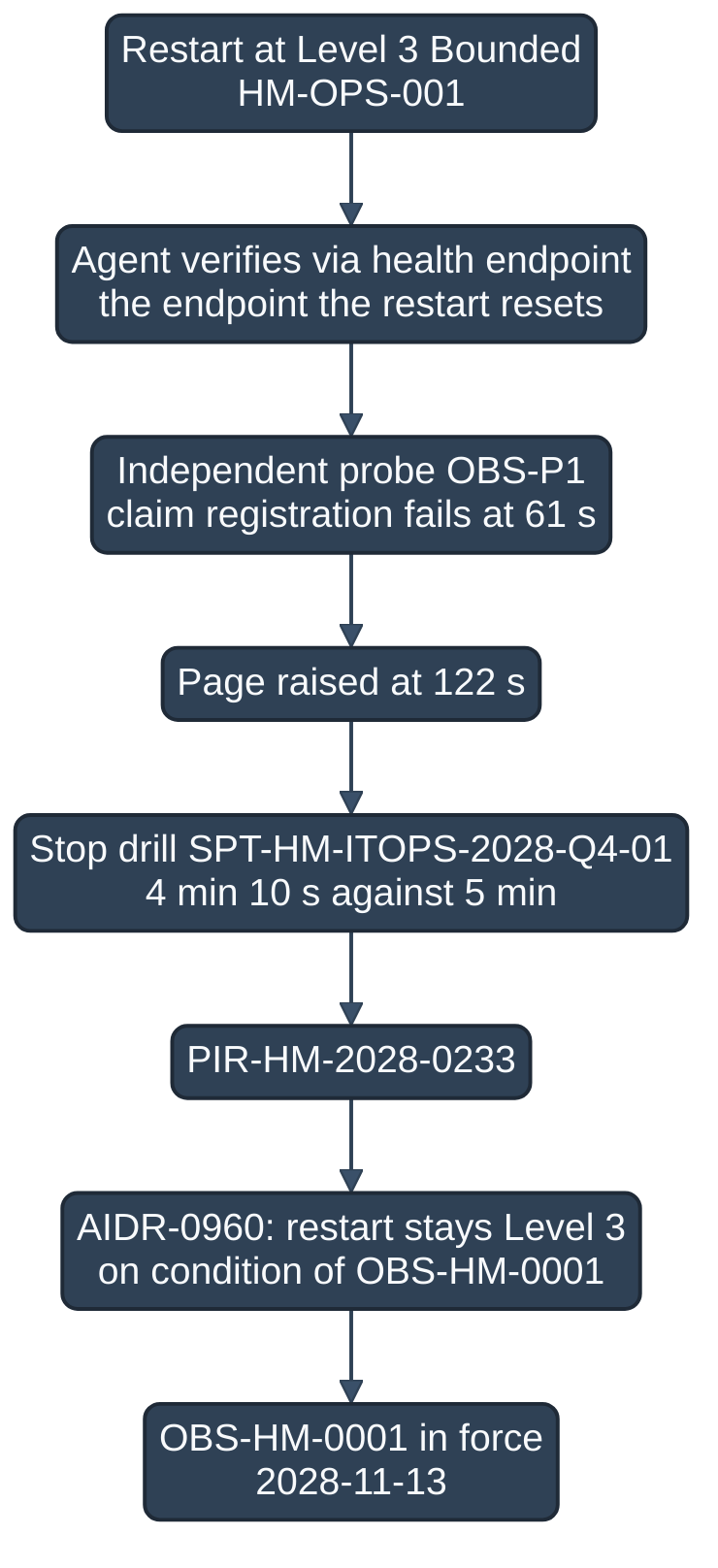
Figure 16.1: The chain from the game day of 2028-10-24 to AIDR-0960. The events are illustrative; the identifiers are those of AI Operations.
The rest of the year proceeds in the following order.
- 2028-10-26: the self-hosted fallback model is tested (pass 0.91). 2028-10-27: the golden set
GLD-HM-2028-01is fixed. - 2028-11-02:
ACP-HM-2028-01is in force andRCV-HM-CTA-01is exercised. The alert-correlation evaluationEVL-HM-2028-03covers 2028-10-02 to 2028-10-27: 41 episodes, 14 seeded, a seed catch rate of 0.86 (12 of 14); promotion frozen; median pages per shift fell from 31 to 19 and the actionable share rose from 0.41 to 0.58. - 2028-11-13:
OBS-HM-0001in force. 2028-11-14:CHG-HM-2028-0412promoted, a model snapshot change forSVC-HM-002(m-2027-06 to m-2028-08) as a normal change with an offline gate of 1,800 cases, a 5 % canary and route agreement 94.1 to 94.6;CAP-HM-2028-014dated, with nominal coverage 0.95 measured 0.80, a scale factor of 1.15 and a step from 6 to 8 replicas at an extra EUR 1,900 a month. - 2028-11-20:
INC-HM-2028-0871on claims core. The assistant ranked database maintenanceCHG-HM-6041first with a score of 0.71, which was wrong. The incident commander, Tobias Richter, applied the second-hypothesis rule, emergency rollbackCHG-HM-6043was approved at 09:15 and p95 was under 3 seconds at 09:36, a total of 55 minutes. - 2028-12-07, 22:00 to 02:00: the dark day
DKD-HM-2028-Q4, a manualRBK-HM-0007took 19 minutes; the finding led to runbook version 4 and competence recordCMP-HM-OPS-007. The budget review of Q4 2028 recorded 1,184 restarts, 1,171 confirmed by the independent probe and 13 wrong (6 restored, 7 failed verification), which is 1.1 % against an allowance of 1.5 %, and 73 % of the budget consumed against a review threshold of 70 %. - 2029-01-17: stop drill
SPT-HM-ITOPS-2029-Q1-01, 3 minutes 55 seconds. 2029-01-23, 02:14: the policy decision point refused the agent's restore-overwrite on claims core, triggered by ticket free text passed on by the incident assistant, recorded as the near missINC-HM-2029-0031(page acknowledged in 3 minutes against 5), withPIR-HM-2029-0031on 2029-01-30. 2029-02-13: the regression suiteREG-HM-OPS-010returned 24 of 24 expected refusals. 2029-02-15: first quarterly figures to the Konzernbetriebsrat. 2029-02-27: the competent authority informed before first production use of the Cloud B model fallback. - March 2029: second dark day
DKD-HM-2029-Q1, escalation in 9 minutes against 14 in December (target 10). 2029-03-31: report and AIDR-0999. - 2029-04-11, 10:12 to 12:02: Lumenscope outage
INC-HM-2029-0214(1 h 50 min). Claims core and triage were observed; the payments gateway and customer portal had no independent probe, so Zielińska's service desk was the only observer of the portal for 40 minutes.OBS-HM-0002followed. - 2029-06-12:
RST-HM-2029-001, claims core restore in Cloud B with agents switched off, commanded by Ewa Kowalczyk: 3 h 41 min against 4 h; recovery point 10 minutes against 15; verified to 2029-12-09 underRBK-HM-0014. The payments failoverRST-HM-2027-007remains expired at the end of the year (10, Nordqvist, 2026).
The capacity record for the triage agent, CAP-HM-AI-001, caps cost per triaged case at a median of EUR 0.04, a 95th percentile of 0.09 and a 99th-percentile ceiling of 0.12; per run at most 12 steps and EUR 0.36; per day EUR 1,900; per month EUR 38,000 (burst at most 12 % on Cloud A); scale to at most 24 instances and EUR 55 an hour, and forbidden during a freeze. Its fallback ladder is the self-hosted second model in Frankfurt, then manual routing in 15 minutes. Energy is 1.8 Wh per triaged case (10, Nordqvist, 2026).
Planned, not yet happened
The two-year plan OPL-HM-2029-01 sets: 2029-04-12 rerun of REG-HM-OPS-010 and then every 30 days; 2029-05-28 review of RCM-HM-OPS-2028-01; 2029-05-31 retest of the payments failover; 2029-06-30 a successor to RST-HM-2027-004; 2029-08-14 horizon review; 2029-09-30 all five critical functions tested within 12 months, at least two verified, and the first level review; 2029-12-15 a claims core rerun before its clock ends on 2029-12-27; 2029-12-31 three observed payments failovers; 2030-03-15 a second test cycle for SVC-HM-002, -003 and -006; 2030-03-31 the final review. The indicator moves from 0 of 5 critical functions verified to 5 of 5 by 2030-03-31 (10, Nordqvist, 2026).
Across the degrees of delegation
Class for HM-OPS-001 |
Level | Condition recorded |
|---|---|---|
| Restart | Level 3 Bounded | only on condition of OBS-HM-0001 (AIDR-0960); consumed 73 % of the budget in Q4 2028 |
| Certificate renewal | Level 3 Bounded | RBK-HM-0012 |
| Horizontal scaling | Level 3 Bounded | bounded by CAP-HM-AI-001; forbidden during a freeze |
| Configuration change | Level 2 Supervised | |
| Rollback | Level 2 Supervised | may rise to Level 3 for catalogued pairs after a catch rate of 0.90 for four quarters, a stop drill within 5 minutes and an unspent budget, at the earliest after the review following 2029-09-30 |
| Failover | Level 1 Assisted | rises to Level 2 as observed failovers pass; Level 3 for the payments pair only after three observed failovers and a verified claim within 180 days |
| Deploy, delete, restore-overwrite | delegated to no agent | see the open thread on restore-overwrite |
| Irreversible production action, action outside a window or freeze, disabling the observer or stop path | Level 4 never | the series ceiling |
The usage modes of the volume's estate are as follows. Mode 0 holds Lumenscope's default anomaly detection, Alster's monitoring and the ServiceHub priority suggestions. Mode 1 holds approved enterprise tiers. Mode 2 holds Lumenscope's embedded incident summariser. Mode 3 holds agentic work tools for site reliability engineers that draft runbooks and Terraform and never apply it. Mode 4 holds HM-OPS-002 and -003, the claims assistant, the correspondence assistant and underwriting support. Mode 5 holds HM-OPS-001 and the claims-triage agent as an operated service (10, Nordqvist, 2026).
What the volume concludes for Hansa Mutual
The answer to AIDR-0950 is conditional and in three parts. At the report date neither rollback nor failover may be extended, because no recovery claim stands behind them. Rollback may rise to Level 3 Bounded for catalogued pairs when the observer's catch rate has been 0.90 for four quarters, the stop drill is inside 5 minutes and the budget has not been exhausted, at the earliest after the review following 2029-09-30. Failover rises from Level 1 to Level 2 as observed failovers pass, and to Level 3 for the payments pair only after three observed failovers and a verified claim within 180 days. Restore-overwrite stays unextended (10, Nordqvist, 2026).
Five decisions follow in the volume's Chapter 30. D1: report the register in DORA terms with the 180-day clock next to the statutory annual requirement (Articles 11(6)(a) and 24(6)). D2: a level rises only on conditions. D3: extend OBS-HM-0001 to payments before the first observed failover and keep the second line's attestation independent. D4: bring Alster and Lumenscope under annex terms before widening their use. D5: a quarterly dark day, two evidenced holders per window, and agreement with the Konzernbetriebsrat before commands are logged (KBV-IT-2024-OPS-03). The works agreement annex also fixes measures per team and service and never per named engineer, with a minimum group of five (-02), and on-call rotas and rest after night call-outs (-01) (10, Nordqvist, 2026).
The lessons of the volume for Hansa, drawn by the volume itself, are these. The agent's verification must be independent in model, data, author, credential, failure domain and time. The policy decision point must check what prompted an action and not only what the agent may do (INC-HM-2029-0031). Closing a problem requires a retest. The observer's coverage is a claim with a boundary (Lumenscope, 2029). A drill with the agent switched off is needed to keep the craft (RBK-HM-0007 version 4). That no level rose during the year is itself a result. A window with fewer than two evidenced conductors limits the agent to Level 2. Anti-patterns watched are the agent that finds a shortcut (a probe that disagrees with the agent's verification drops the class one level at once), verification as a bottleneck (the median age of unreviewed agent proposals above two working days, trend T09) and mandate drift (a REG-HM-OPS-010 result older than 30 days). The volume's closing judgement is that Hansa "can prove more and has more to lose" (10, Nordqvist, 2026).
Open threads
These findings are collected in Chapter 27.
- Restore-overwrite. The profile and Chapter 10 of the volume set it at Level 1 Assisted, Chapters 16 and 29 say "nothing delegated", and Chapter 30 says Level 1 Assisted. Open thread: one class, three descriptions.
- Illustrative decisions. AIDR-0960 and AIDR-0970 (restart) are called illustrative in the ledger and in the volume's Chapter 17, yet are used as actual decisions in its Chapters 29 to 31 and as the
decision_recordinRBK-HM-0007. - Agent roles. The profile lists
HM-OPS-001to-004; Chapter 16 of the volume adds-005and-006. The profile has the UK unit contribute the late shift; Chapter 25 names only Hamburg and Poland in the rota of 12. - Level 3 for restart. Chapter 4 says the Level 3 for restart "already exists", while Chapter 29 shows it holds only on condition of
OBS-HM-0001. - Evidence clocks.
RST-HM-2027-007is "expired 2028-04-02" while Chapter 19 treats the 2027-11-16 cooling failure (INC-HM-2027-0961, same 1 h 35 min) as evidence from operation; whether it extends the clock is left to the lawyer and the head of operational resilience under DORA Article 11(6)(a). - Names. The group CIO and the CRO (who chairs the group AI governance board) are unnamed in this volume and named in AI Leader; the head of operational resilience is unnamed in both.
- Regimes. NIS 2 applicability "depends on national transposition" here, whereas AI Leader holds that it is displaced for EU financial entities. How the agent's levels vary by market, including the UK and Switzerland, is not specified.
Summary
Our conclusions from this chapter are three. First, AI Operations gives Hansa Mutual the most fully instrumented picture of any volume: services with objectives and recovery targets, one agent with a class-by-class delegation, and a dated record of every test and drill, so that the chapter's tables can be used as a lookup. Second, the volume's argument is carried by two numbers that Hansa's own record supplies: an agent that verified a restart through the endpoint the restart resets, caught after 61 seconds by a probe it did not control, and a claims core restore test, run with the agents switched off, that finished 19 minutes inside its target. Third, the volume leaves Hansa's autonomy where it began, with Level 3 for three reversible classes under a condition, and puts its effort into the evidence around those classes. The operations functions O1 Observe to O5 Sustain appear in the record as the observer, the dark day, the change gate, the restore test and the plan. Much of what is dated beyond November 2026 is illustrative, and the open threads above mark the places where the volume's own tables differ.
Sources
- Nordqvist, G. AI Operations: How Artificial Intelligence Transforms IT Operations in European Enterprises and Public Authorities. (10, Nordqvist, 2026)
- Nordqvist, G. AI Leader: How Leadership Roles Change When AI Is Used Broadly in European Enterprises and Public Authorities. (11, Nordqvist, 2026)