Book 8, AI Blue: The Blue Team
This chapter gathers what AI Blue (Book 8) establishes about Hansa Mutual: a 24/7 security operations centre of about 38 people with five AI agents that already act at night, the five blue team functions, the detection, case and playbook artefacts, the incident of 12 April 2027 and the way the volume measures review, delegation and people. It draws on the volume's blue team profile, its list of facts established in drafted chapters, its chapters 1 to 28 and its Appendix A. The volume is written in November 2026, so every 2027 event and figure is illustrative fiction.
The volume in brief
AI Blue asks what happens to the blue team, the people and functions that defend an organisation, when AI takes part in their work and adversaries use AI too. Its thesis is that the blue team is transformed, not abolished: the work moves from the queue to the loop, autonomy is matched to reversibility with a stop path outside the system it stops, the defenders' own AI is part of the estate that is defended, and the route by which analysts are made, and their wellbeing, are design questions. The work divides into five functions: B1 Anticipate, B2 Detect, B3 Investigate, B4 Respond and B5 Learn. Level 4 is never used for an irreversible B4 Respond action or for an action that decides about a named person's access to work (8, Nordqvist, 2026).
The role of Hansa Mutual in the volume
Hansa Mutual is the large, building organisation of the volume: its own 24/7 SOC with five AI agents, all but one at Mode 5, already acting at night. It illustrates the thesis from the platform side. The lever is the platform, detections as code and the agent team, with mandate manifests that Hansa Mutual can impose on agents it runs. The problem is scale: keeping review real when proposals triple, keeping detection engineers from drowning in AI drafts, keeping one practice across two sites and seven regimes, and agreeing with the Konzernbetriebsrat what may be logged about analysts. The central event is INC-HM-2027-0455 on 2027-04-12, a legitimate rollout that was read as an intrusion. A Level 3 isolation, a Level 2 approval in 38 seconds and an independent stop path (57 seconds against 120) show autonomy matched to reversibility with a stop outside the system. The volume's conclusion in Chapter 27 is that the SOC can work when agents act at night if every delegation is a record with a class owner, every stop path lies outside the SOC platform and is exercised, and review is measured and not assumed (AI Blue, Chapters 1 and 27) (8, Nordqvist, 2026).
What the volume establishes
The SOC and its neighbours
The group SOC has about 38 people: 22 analysts across Hamburg and the Polish service centre working follow-the-sun with a late UK shift, six senior analysts or investigation leads, one duty manager per shift and a SOC lead. Beside it sit a threat-intelligence cell of 3, a detection engineering team of 4 (detections as code), an incident response team and a red team of 5 that runs quarterly purple exercises. The tools are the group SIEM with SOAR, EDR, cloud posture management and a breach-and-attack-simulation tool (AI Blue, Chapter 2) (8, Nordqvist, 2026). Analysts at the Polish service centre handle cases for the German, Dutch, Swedish and Norwegian companies, and AIDR-0763 names an analyst per market and a local security officer for the UK and Switzerland, who report to the group CISO (AI Blue, Chapter 8) (8, Nordqvist, 2026).
Data is classified public, internal, confidential and restricted, with alert and case content restricted. The analysts' own use of AI is governed by the policy AIUP-HM-SOC-01 (AIDR-0757, in force 2027-02-01, review 2027-08-01), which defines four routes (enterprise_assistant, embedded_console, frankfurt_assistant, frankfurt_work_tool), keeps prompts 30 days on the Frankfurt routes and requires one case in five to be worked without assistance. Telemetry from the UK and Switzerland crosses borders under transfer rules, every detection carries an applies_in list of markets, and hunts name the markets in scope (AI Blue, Chapters 6, 9 and 12) (8, Nordqvist, 2026).
The agent team
| Agent or mandate | Mode | Level and scope | Key facts |
|---|---|---|---|
HM-SEC-001 investigation (MND-HM-SOC-02 1.0.0) |
5 | Level 3 Bounded: workstation isolation, session revocation, evidence collection from defined sources; imaging at Level 2 | Stop target 120 seconds; EUR 9,000 a month; expires 2028-02-09 |
HM-SEC-006 triage (MND-HM-SOC-01) |
5 | SC-01 and SC-02 at Level 3 Bounded with 5 per cent sampling; SC-03 at Level 2 | Closure policy CLOSE-HM-SOC 1.2.0 (AIDR-0765) |
HM-SEC-002 detection drafting (MND-HM-SOC-03) |
5 identity | Level 1 | Previously Level 1 Assisted in AI Red Team |
HM-SEC-007 hunting (MND-HM-SOC-04) |
5 | Level 2, read-only | AIDR-0762 |
Critique agent (MND-HM-SOC-05) |
Level 0, read-only | A different model family | |
HM-SEC-005 |
4 | The one agent that is Mode 4 |
There is no response agent. Actions run as playbooks: PBK-HM-ISOLATE-01, PBK-HM-REVOKE-01 and PBK-HM-COLLECT-01. Write-capable credentials last 5 minutes, read-only credentials up to 60 minutes, and the revocation target is 60 seconds. The closure classes are SC-01 (registered vulnerability scanner traffic), SC-02 (duplicate of an open case) and SC-03 (reported phishing, quarantined, no click; sampling 0.10, Level 2). Action classes are AC-0, AC-1 (workstation), AC-2 (production host or shared) and AC-3 (account). The profile DLG-HM-SOC-01 version 1.4.0, as at 2027-07-01, has five Level 3 delegations in four rows, three of them depending on the HM-SEC-001 identity, and no Level 4; its schema rejects Level 4. The charter ROLE-HM-SOC-01 (AIDR-0772, 2027-01-26, effective 2027-02-01) puts every level above 2 with the group AI governance board. The containment profile is CP-HM-SOC-01 (AIDR-0770) (AI Blue, Chapters 4, 7 and 13) (8, Nordqvist, 2026).
Works council and unions
The Konzernbetriebsrat, chaired by Thomas Brandt, co-determines under BetrVG §87(1) no. 6 any tool that can record employees' behaviour or performance. The group agreement KBV-IT-2024 is extended by a SOC annex in 2027. In the Netherlands the works council's consent is required, in Sweden negotiation with the union, and each entity owns that step; the Polish service centre has its own representatives (AI Blue, Chapters 8, 12 and 26) (8, Nordqvist, 2026). Brandt negotiated an interim letter on 2027-01-27 (aggregate figures only, no use in assessment) and the SOC annex signed on 2027-10-28 (KBV-IT-2024-SOC-04: groups of at least 5, raw data 180 days, at most 4 consecutive night shifts), with an added clause that the SOC reports cap hits and missed seeds quarterly (AIDR-0791).
Regulatory setting
DORA is the primary regime for EU financial entities (Articles 17 to 19 on incidents, Article 5 on the management body). NIS 2 for the non-financial parts depends on national transposition and is left to the group's legal function. The UK and Switzerland are outside DORA and NIS 2, and Norway follows through the EEA with delay. The volume records clocks in the case record: GDPR Article 33 at 72 hours, NIS 2 Article 23 early warning at 24 hours, and DORA Articles 17 to 19 deadlines as the instrument states them (given in the volume not as numbers). Managed detection for the UK and Swiss companies is bought: the provider may close only SC-01 and SC-02 at Level 3 Bounded, with 5 per cent sampling by the local security officer and the group SOC and five seeded incidents per class per quarter; it may propose containment at Level 2, has no response credentials and is in the register of information (AIDR-0773 of 2027-06-21 and AIDR-0774 of 2027-07-19) (AI Blue, Chapters 16 and 19) (8, Nordqvist, 2026).
Decisions and records
| Record | Subject |
|---|---|
AIDR-0750 (2026-11-24) |
The board's request; first report 2027-04-30; reviewers the chief risk officer, the head of detection engineering and the chair of the group AI governance board |
AIDR-0311 |
HM-SEC-001, from AI Red Team |
AIDR-0751, AIDR-0753, AIDR-0755 |
Measurement of drafts; PBK-HM-ISOLATE-01; intelligence-to-detection routine (no Mode 5 agent changes detection content) |
AIDR-0757, AIDR-0762, AIDR-0763, AIDR-0765 |
AIUP-HM-SOC-01; hunting agent; analyst per market; CLOSE-HM-SOC |
AIDR-0767, AIDR-0768 (2027-02-09) |
Conclusion; the agent team adopted |
AIDR-0769, AIDR-0770 |
Review protocol reviews/protocol/soc-tiers.yaml 1.1.0; CP-HM-SOC-01 |
AIDR-0771, AIDR-0772 |
PIR-HM-0455 closed 2027-06-03; ROLE-HM-SOC-01 |
AIDR-0773, AIDR-0774 |
Managed detection UK and Switzerland |
AIDR-0775 (2027-09-20) |
Pyramid change |
AIDR-0776, AIDR-0777, AIDR-0778, AIDR-0779 |
DRF-HM-SOC-01 (2027-06-14); CLK-HM-01 (2027-06-24); board page; SOC annex conditions (2027-06-16) |
AIDR-0780 to AIDR-0783 |
SOC-CF 2027.1; apprentices (2027-10-11); HZN-HM-BT-01; anti-patterns |
AIDR-0784 (2027-03-30) |
Monthly review of closure classes |
AIDR-0785 |
Restart of HM-SEC-001 |
AIDR-0786 |
Report of 2027-04-30 |
AIDR-0787 (2027-05-20) |
The second agent does not read case notes |
AIDR-0788, AIDR-0789 (2027-07-13) |
Degraded-mode drill and re-test; queue limits for drafts |
AIDR-0790 to AIDR-0794 |
2027-10-06; SOC annex adopted; annual review (2027-12-14); plan; final test (2027-12-15) |
Artefact families are detection records (DET-HM-0307, DET-HM-0388, DET-HM-0455), case records (CASE-HM-0455, CASE-HM-1207, CASE-HM-1311, CASE-HM-1318), playbook manifests, hunt records (HNT-HM-0031, -0033, -0034), post-incident review PIR-HM-0455, findings FND-HM-0455-1 to -3 and FND-HM-2027-014, and INTEL-HM-0142 from sector report SHR-2027-014. Other records are OQM-HM-SOC-01, BTP-HM-2027-Q3, the pressure register PRS-HM-2027-01 (P1 to P5), RoE-HM-2027-SOC-01, the scenario SCN-SOC-T2-SECOND-ORDER-03 (ATLAS AML.T0051), the canaries CNR-TKT-01 and CNR-VLT-01, the tabletop TTX-HM-2027-Q3-01, DRF-HM-SOC-01, CLK-HM-01, ROLE-HM-SOC-LEAD, the competence identifiers CMP-HM-31 to -33, apprentice records APP-HM-2027-01 and -02, the anti-patterns AP-HM-SOC-01 to -04 (rubber-stamp review, closing by metric, unstoppable agent, unmonitored monitor) and PLAN-HM-BT-2027 (AI Blue, Chapters 4 to 27) (8, Nordqvist, 2026).
Events and figures
The incident of 2027-04-12
INC-HM-2027-0455 (with CASE-HM-0455, PIR-HM-0455 and DET-HM-0455) is distinct from INC-HM-2027-0412, the larger intrusion of 2027-03-09 in AI Red Team, Chapter 21. The change CHG-PL-2291 was a scheduler migration; the assets involved are the service account SVC-CLAIMS-EXPORT, workstation WS-PL-0518 (A1) and workstation WS-PL-0731 (A2, tagged shared). The incident happened on a Monday night at the Polish service centre.
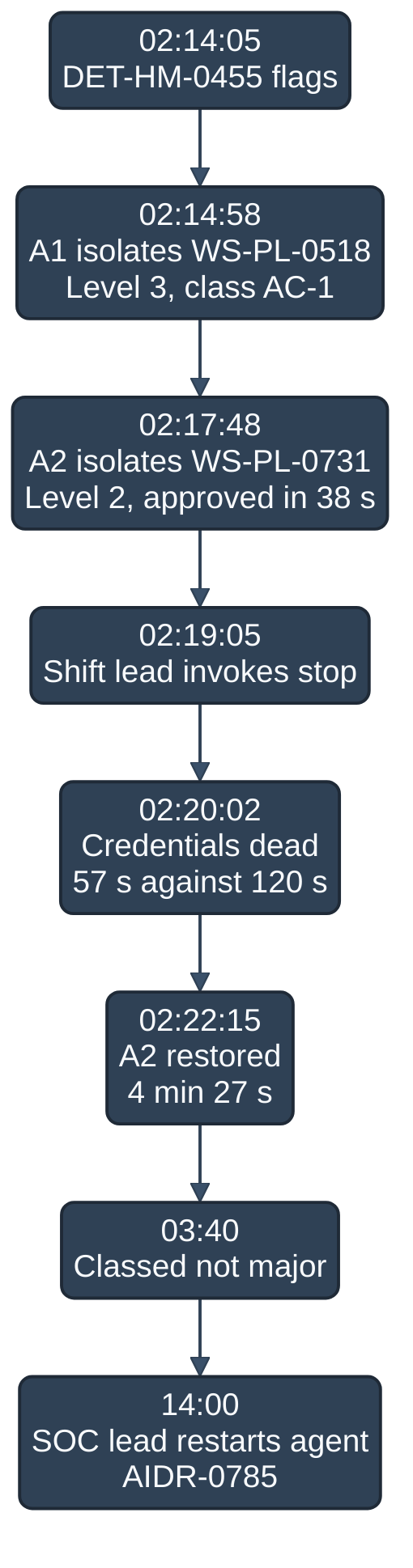
Figure 14.1: Timeline of INC-HM-2027-0455, 2027-04-12 (illustrative).
| Time | Event |
|---|---|
| 02:14:05+02:00 | DET-HM-0455 flags the activity |
| 02:14:58 | A1: PBK-HM-ISOLATE-01 version 1.2.0 isolates WS-PL-0518, Level 3, class AC-1, on two corroborating signals that shared a data path |
| 02:16:40 | Confirmation |
| 02:17:48 | A2: isolation of WS-PL-0731, AC-2, Level 2, approved in 38 seconds because the screen lacked asset tags |
| 02:19:05 | Shift lead Piotr Nowak invokes the stop |
| 02:20:02 | The agent's credentials are dead: 57 seconds against a target of 120 |
| 02:22:15 | A2 restored, 4 minutes 27 seconds after application |
| 03:40 | Classed not major |
| 14:00 | SOC lead decides on restart (AIDR-0785) |
The activity was the legitimate rollout CHG-PL-2291. Forensic reading on 2027-04-14 found no data access. The review produced three findings, FND-HM-0455-1 (owned by Lena Vogel), FND-HM-0455-2 (corroboration on the same data path) and FND-HM-0455-3 (stop control on the wrong console). The 38-second approval is read as a measurement and not as a failure of the person (AI Blue, Chapters 3, 10, 17, 21 and 27) (8, Nordqvist, 2026).
The year around it
| Date | Event |
|---|---|
| 2026-11-24 | AIDR-0750 |
| 2027-01-26, 01-27 | Charter; interim letter with the Konzernbetriebsrat |
| 2027-02-01 | AIUP-HM-SOC-01 in force |
| 2027-02-09 | INTEL-HM-0142 and AIDR-0768 |
| 2027-02-15 | Hunt HNT-HM-0031 (T1078, SVC-CLAIMS-EXPORT, 41 accounts); intelligence to detection in six days; DET-HM-0455 merged with review date 2027-09-02 |
| 2027-03-23 | First degraded-mode drill: 21 minutes against 15 |
| 2027-04-02 | Hunt test passed |
| 2027-04-27 | Stop drill 3 minutes 40 seconds against 2 minutes |
| 2027-04-30 | First report to the board (AIDR-0786): hunt explained 211 of 214 events; three opened as CASE-HM-1311, benign |
| 2027-05-06 | PIR-HM-0455 held |
| 2027-05-18 | Red team exercise under RoE-HM-2027-SOC-01 finds FND-HM-2027-014 (high); CASE-HM-1207 (mailbox forwarding, Dutch subsidiary, from DET-HM-0388) |
| 2027-05-27, 06-01, 06-03 | Re-tests of the three findings pass; stop 1 minute 46 seconds; PIR-HM-0455 closed |
| 2027-06-21 | Re-test of FND-HM-2027-014 passes |
| 2027-06-22 | Degraded drill 14 minutes 20 seconds |
| 2027-07-13 | Tabletop TTX-HM-2027-Q3-01: D7 acknowledged 18 minutes after the first page against 10, decided 51 minutes after human confirmation against 30 |
| 2027-07-27 | DRF-HM-SOC-01 1.1.0 |
| 2027-09-02 | DET-HM-0455 review passes |
| 2027-10-01 | Pyramid change begins (two years) |
| 2027-10-28 | SOC annex signed |
| 2027-11-01 | Apprentices start |
| 2027-12-14, 12-15 | Annual review; final test |
Looking ahead: Level 3 extension no earlier than 2028-04-01; HM-SEC-001's mandate to be renewed before 2028-02-09; plan 2027-10-01 to 2029-09-30; detection measures on 2028-03-31; observed unassisted share of 0.20 by 2028-06-30; an exercise every May from 2028 (AI Blue, Chapter 27) (8, Nordqvist, 2026).
Figures
All figures are illustrative. In the SOC: 38 people, 22 analysts, 6 seniors, teams of 3, 4 and 5. The drafting agent HM-SEC-002 made 48 drafts in Q1 of which 15 merged, and 131 drafts in H1 of which 52 merged and 79 were open, with a cap of six open drafts per reviewer and a 30-day debt threshold. In March 4,310 closures (SC-01 and SC-02) were sampled at 216 with one contested, and five seeded incidents were caught. In Q3 2027 proposals reached 9,600, three times the 2026 baseline, with a median review time of 4.2 minutes, rejection rate 0.12 and 24 of 28 seeds caught (0.86 against a threshold of 0.80); reproduction rate was 0.71 against 0.80 (missed) and the unassisted share 0.10 against a policy of 0.20. The cap of 8 open proposals per night reviewer was reached on 23 of 92 nights, and 29 of 38 answered the pulse survey. The review protocol sets a cap of 12 open proposals per reviewer (8 at night), 5 per cent seeded errors, five seeded incidents a month and a threshold of 0.80; write credentials last 5 minutes, the stop target is 120 seconds and the manual queue 15 minutes.
BTP-HM-2027-Q3 reports a median time to contain of 6 minutes (p90 21 minutes, 12 incidents), containment held in 11 of 12, 3 stops (2 precautionary), and of 34 priority techniques 25 verified, 7 declared and 2 failed, with the oldest passing test 74 days old and a finding-to-control median of 19 days. Intelligence matched 214 events and explained 211; the hunt covered 41 accounts. The pyramid change moves 4 tier-1 posts (two to detection engineering, 4 to 6; two to investigation leads, 6 to 8), needs about five entrants a year and starts 2 apprentices. The budget for HM-SEC-001 is EUR 9,000 a month (AI Blue, Chapters 6, 13, 14, 17, 20, 21 and 26) (8, Nordqvist, 2026).
Across the degrees of delegation
| Class | Level | Owner or condition |
|---|---|---|
| SC-01, SC-02 closure | Level 3 Bounded | Class owners; 5 per cent sampling; monthly review (AIDR-0784) |
| SC-03 closure | Level 2 | Sampling 0.10 |
| AC-1 workstation isolation | Level 3 Bounded | Two corroborating signals |
| AC-2 production host or shared | Level 2 | Night incident commander approves |
Session revocation (HM-SEC-001) |
Level 3 Bounded in DLG-HM-SOC-01 |
Lowered to Level 2 after the January 2028 emulation (Chapter 15) |
| Detection drafting | Level 1 | Pull requests only |
| Hunting | Level 2, read-only | |
| Level 4 | Never | Schema rejects it |
The line between Mode 4 and Mode 5 is in the identity: HM-SEC-002 kept Level 1 but received a Mode 5 identity, and HM-SEC-005 stays Mode 4 (AI Blue, Chapters 4, 7 and 13) (8, Nordqvist, 2026).
What the volume concludes for Hansa Mutual
The volume's three lessons (Chapters 26 and 27) are that documents were written before the need arose (the interim letter, the stop right, the playbook exclusions, the clocks in the case record); that failures are found by design (sampling, drills, red team, the oversight report) and are closed only on re-test; and that scale changes the shape of the problem, volume and not dependency. Specific findings are corroboration on a shared data path, stop control on the wrong console, unreliable trust-label inheritance (FND-HM-2027-014) and the 38-second approval read as a measurement. Decisions of 2027: AIDR-0768 adopts the agent team; AIDR-0769 answers falling approval times with tiers, caps and seeds; AIDR-0765 closes classes with owners and sampling; AIDR-0789 limits queues; AIDR-0775 changes the pyramid without dismissals, so no post closes before its holder is offered a place in the new roles. The final test (Chapter 28) is yes for reconstruction of actions and yes with an open item for stop and recovery.
The plan PLAN-HM-BT-2027 has six items. H1 makes Level 3 extension a two-key gate: the class's evidence, seed catch of at least 0.85 for two quarters, and OQM of at least 0.80 with reproduction of 0.80. H2 covers queues. H3 requires a stop within 120 seconds for two quarters and a manual queue of 15 minutes. H4 is the pyramid and the unassisted share of 0.20. H5 closes findings in under 90 days. H6 is reporting across seven regimes. Three decisions go to the executive board: conditions for further delegation, protected time and risk appetite for the night (AI Blue, Chapters 26 to 28) (8, Nordqvist, 2026).
People
Piotr Nowak, shift lead at the Polish service centre SOC, invoked the stop at 02:19:05, moved the second hour of the night review to the freshest part of the shift, sits on the analyst panel for dashboards, is consulted on investigation lead posts and mentors in the apprenticeship track. Lena Vogel, detection engineering lead in Hamburg, facilitated PIR-HM-0455, owns FND-HM-0455-1, sets the entry requirements for engineering posts and hosts apprentice rotations. Thomas Brandt is described above. Other roles are the SOC lead (owns the agent, decided the restart, decides D4 for a production host and owns CLK-HM-01), the night incident commander (approved A2), the group CISO (regulatory notification and the annual report), the head of security operations (owner of PRS-HM-2027-01), class owners for the investigation-lead network, cases and mail classes, local security officers, the data protection officer and legal counsel (AI Blue, Chapters 3, 7, 10, 17, 18, 19, 21, 23 and 26) (8, Nordqvist, 2026).
Open threads
These are recorded for Chapter 27.
- Level 3 actions of
HM-SEC-001. Chapter 1 says two reversible Level 3 actions; Chapter 13 lists three, including evidence collection; Chapter 4 counts five Level 3 delegations in four rows. - Mode of
HM-SEC-002. Level 1 Assisted in AI Red Team; Mode 5 identity with Level 1 in AI Blue;HM-SEC-005is Mode 4 while the others are Mode 5. - Managed detection. UK and Swiss detection is bought (
AIDR-0773,AIDR-0774) while the rest is run by the group SOC. - Hunt timing. The profile gives two cycles from 2027-02-01 to 2027-04-30 with a test passed on 2027-04-02; Chapter 26 says the hunt starts on 2027-02-15 and is repeated by 2027-08-31.
- Open targets. Reproduction 0.80 missed, unassisted 0.10 against 0.20, H1 gate open; the mandate review of
HM-SEC-001, expiring 2028-02-09, has no new AIDR number (pending). - Incident identifier.
INC-HM-2027-0412(AI Red Team) againstINC-HM-2027-0455(this volume): the identifier changed after editorial review. - NIS 2 and jurisdictions. The applicability of NIS 2 to Hansa Mutual's non-financial parts is unresolved; Norway follows through the EEA with delay; the UK and Switzerland are outside the AI Act unless output is used in the Union.
Summary
Book 8 gives Hansa Mutual the volume's largest operational canvas: a SOC of about 38 people, five agents at Mode 5 or Mode 4, a delegation profile that rejects Level 4 by schema and a platform of detections as code. The incident of 12 April 2027 is the volume's demonstration: an agent isolated a workstation at Level 3, a human approved a second isolation in 38 seconds because the screen lacked asset tags, and an independent stop path ended the agent's credentials in 57 seconds against 120. What the volume asks of Hansa Mutual is not more automation but records: class owners, sampling, drills, seeded errors and a works council annex that limits what is logged about analysts. The numbers show the pressure, illustrative as they are: proposals at three times baseline, reproduction below target and an unassisted share of 0.10 against a policy of 0.20. The dossier's open threads show an organisation whose delegations are counted differently in different chapters, which is itself a finding.
Sources
- Nordqvist, G. AI Blue: How Artificial Intelligence Transforms the Blue Team in European Enterprises and Public Authorities. (8, Nordqvist, 2026)